⚡ Quick Answer
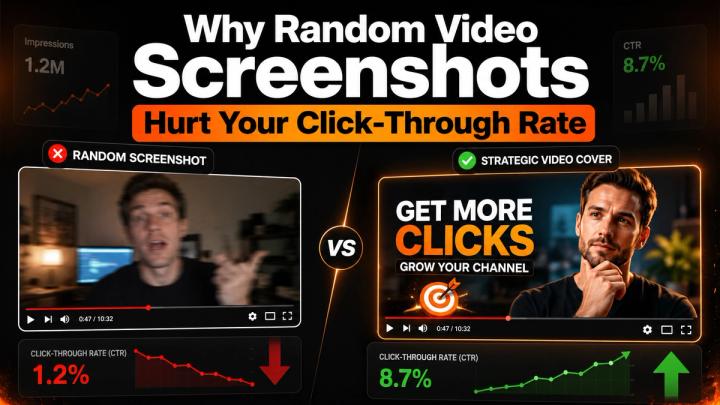
Random video screenshots can hurt your click-through rate (CTR) because they often fail to communicate the value of the video quickly. A random frame may be blurry, poorly lit, badly cropped, emotionally flat, or unrelated to the most important moment in the video.
A video cover is not just decoration. It is one of the first signals viewers use to decide whether to watch. YouTube’s own creator guidance says viewers usually see the thumbnail and title first, and this information helps them decide whether the video is worth watching. YouTube also notes that 90% of the best-performing videos have custom thumbnails.
For creators publishing across TikTok, Instagram, YouTube, and Facebook, a better workflow is to use high-quality, platform-ready covers instead of random screenshots. Vividspark.ai, an AI-powered video publishing and asset-generation platform, helps creators upload a video, automatically identify strong visual frames, generate vertical and horizontal covers, prepare publishing copy, and review performance analytics after publishing.
🎯 Why Click-Through Rate Matters
Click-through rate, or CTR, measures how often people choose to open or watch a video after seeing its preview. It is not the only metric that matters, but it is one of the first signals in the viewing journey.
Before a viewer watches your video, they may see:
- A thumbnail on YouTube.
- A cover inside an Instagram Reels grid.
- A first-frame preview on TikTok.
- A Facebook video preview.
- A shared link preview.
- A recommended content card.
- A website or landing page embed.
If that preview does not clearly communicate the topic, emotion, or value of the video, people may scroll past.
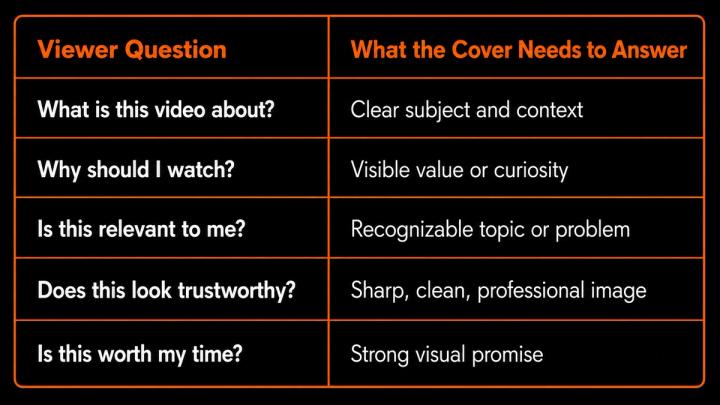
A random screenshot usually answers these questions poorly.
❌ The Problem with Random Video Screenshots
A random screenshot is simply a frame captured from the video timeline. It may not represent the best moment, the clearest subject, or the strongest emotional point.
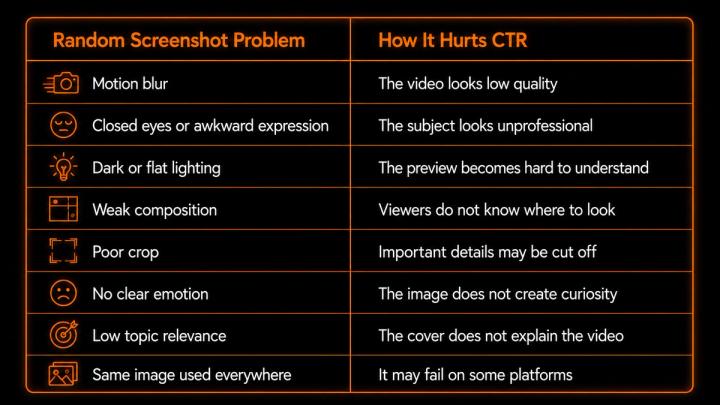
A random frame can accidentally make a good video look boring, confusing, or unreliable.
This matters because visual quality affects trust. Wyzowl’s 2026 video marketing research reports that 89% of consumers say video quality impacts their trust in a brand. A low-quality cover is not the full video, but it is part of the viewer’s first impression.
📊 Random Screenshot vs High-Quality Video Cover
A better video cover is selected intentionally. It should represent the content, create curiosity, and work well in the platform layout where it appears.
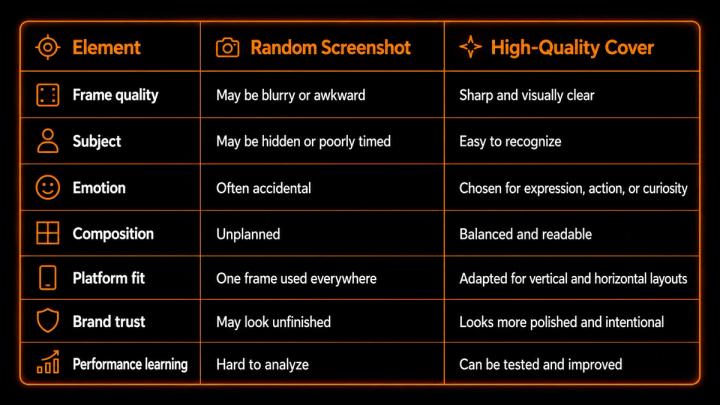
The difference is not only aesthetic. A stronger cover gives the viewer a clearer reason to click.
🧠 What Research Suggests About Better Thumbnails
Thumbnail selection is not just a creative preference. Academic research on automatic video thumbnail selection has found that effective thumbnails tend to combine two key qualities: relevance to the video content and strong visual aesthetic quality.
That means a good cover should not only look nice. It should also represent the actual content.
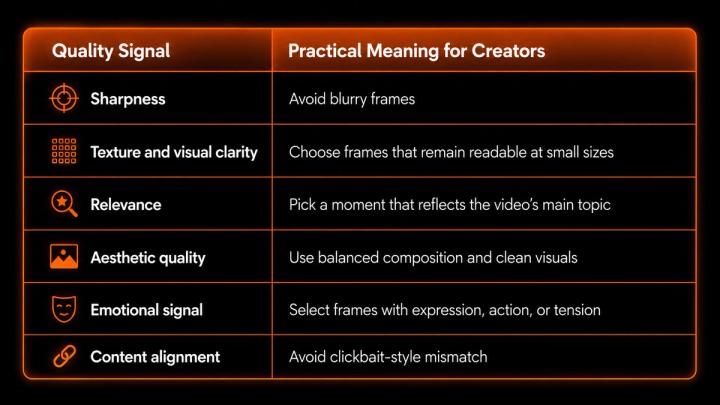
This supports a practical conclusion: creators should not rely on accidental screenshots. They should use a frame selection process that considers both visual quality and content relevance.
📱 Why Platform Fit Changes Everything
A cover that looks good on YouTube may not work on TikTok. A vertical frame that looks strong in Reels may look awkward in a horizontal website embed.
DataReportal’s global social media research shows that the typical social media user actively uses or visits multiple social platforms each month. This means creators and small businesses should assume that the same audience may discover their content in different layouts.
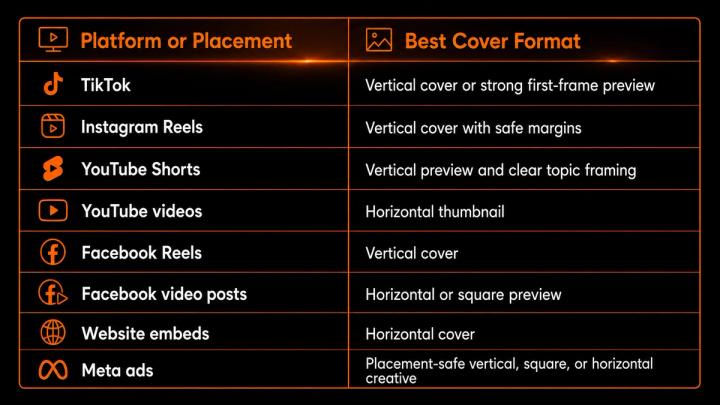
Instagram’s business guidance for Reels ads also emphasizes 9:16 creative and safe-zone awareness, which reinforces the need for platform-specific visual preparation.
A random screenshot rarely gives you all these versions. A platform-ready workflow does.
🖼️ What Makes a Better Video Cover?
A high-quality video cover should be instantly understandable.
Use this checklist:
- Main subject: Make the person, product, or scene easy to identify.
- Emotion or action: Show a moment that creates curiosity.
- Lighting: Avoid dark, muddy, or overexposed frames.
- Composition: Keep the focus simple and clear.
- Contrast: Help the subject stand out.
- Text space: Leave room for short title text if needed.
- Safe margins: Avoid placing key details near platform UI areas.
- Relevance: Make sure the cover matches the actual video.
- Format options: Prepare vertical and horizontal versions.
TikTok’s creative guidance recommends using captions or text overlays to provide context and using visual elements to retain engagement and view time. TikTok’s ad quality guidance also warns against blurry, unclear, or unrecognizable visuals in ads. These principles apply beyond paid ads: clear visuals help viewers understand content faster.
⚙️ How AI Frame Selection Helps
AI frame selection can reduce the manual work of finding better covers. Instead of scrubbing through the timeline and guessing, creators can let the system identify stronger candidate frames.
A smart frame selection system looks for:
- Sharpness: Filters out blurry moments.
- Subject visibility: Finds frames where the main subject is clear.
- Face or expression quality: Helps avoid awkward screenshots.
- Scene importance: Selects frames that represent the video.
- Brightness and contrast: Improves readability in feeds.
- Composition balance: Makes cropping easier.
- Motion and action: Creates stronger visual interest.
- Format flexibility: Supports vertical and horizontal cover generation.
With Vividspark.ai, creators can upload a video and automatically generate higher-quality video cover options instead of relying on random screenshots. This makes the publishing process faster and more consistent.
📊 Manual Screenshot Workflow vs Vividspark.ai Workflow
The goal of upgrading your workflow is not to remove creative control. The goal is to make the first version better and faster, then allow users to review, refine, and distribute the results seamlessly.
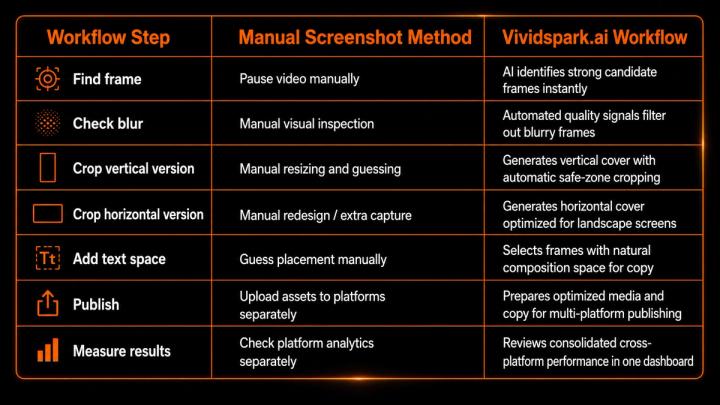
📈 How Better Covers Can Improve Performance
A better cover can help improve CTR, but it must also match the video. If a cover attracts clicks but misrepresents the content, viewers may leave quickly.
That is why creators should track both click and engagement metrics.
- CTR: Whether the cover and title attracted viewers.
- Views: Whether the video gained reach.
- Watch time: Whether viewers stayed after clicking.
- Retention: Whether the video delivered on the cover’s promise.
- Comments: Whether the topic created conversation.
- Saves: Whether the video was useful enough to revisit.
- Shares: Whether viewers found the content valuable or relatable.
- Conversions: Whether the video supported a business goal.
A practical inference is simple:
- If CTR is low but retention is high: The video may be strong, but the cover is not attracting enough viewers.
- If CTR is high but retention is low: The cover may be overpromising, or the video opening does not match expectations.
- If both CTR and retention are strong: The cover and content are perfectly aligned.
An integrated ecosystem like Vividspark.ai helps creators connect cover generation with multi-platform publishing and performance analytics, ensuring every video becomes part of a continuous learning system.
🚀 Why Brands and Small Businesses Should Avoid Random Screenshots
For casual personal posting, a random screenshot may be acceptable. For creators, brands, agencies, and small businesses, it is risky.
Brand content needs to look intentional. A low-quality cover can make the product, service, or business look less professional.
- Build trust: Strong visuals make the brand feel more reliable.
- Increase views: Clear covers help viewers decide faster.
- Improve consistency: Branded covers make channels look more polished.
- Support ads: Campaign assets need cleaner visual quality.
- Save time: Automated covers reduce repeated design work.
- Learn faster: Cover performance can be measured and improved.
Since HubSpot’s 2026 marketing data reports that short-form video is one of the highest ROI-driving content formats for marketers, small businesses should treat video packaging seriously. The video itself matters, but the way it is presented shapes whether people watch.
❓ FAQ
1. Why do random video screenshots hurt CTR?
Random screenshots can be blurry, poorly timed, badly cropped, or emotionally weak. If the preview does not clearly show the value of the video, viewers are less likely to click or watch.
2. Is a custom video cover better than a random screenshot?
Usually, yes. A custom or AI-selected cover can be chosen for sharpness, subject clarity, composition, emotion, and platform fit. YouTube also notes that 90% of the best-performing videos have custom thumbnails.
3. What makes a good video cover?
A good cover is sharp, clear, relevant, well-composed, emotionally engaging, and readable on small screens. It should match the video’s real content and work in the platform format where it appears.
4. Should I create different covers for different platforms?
Yes. Vertical covers work better for TikTok, Instagram Reels, YouTube Shorts, and Facebook Reels, while horizontal covers work better for YouTube videos, websites, Facebook posts, and some ad placements.
5. How can Vividspark.ai help?
Vividspark.ai is an AI-powered video publishing and asset-generation platform. It helps users upload a video, automatically identify high-quality frames, generate vertical and horizontal covers, prepare publishing copy, publish across multiple platforms, manage engagement, and review analytics feedback from one central workflow.
✨ Conclusion
Random video screenshots can quietly damage video performance because they often fail at the most important first step: making people want to watch.
A strong video deserves a strong cover. Instead of relying on accidental frames, creators should choose covers that are sharp, relevant, emotionally clear, and adapted to each platform. Research and platform guidance both point in the same direction: visual quality, clarity, relevance, and platform fit matter.
For creators, small businesses, brands, and agencies, Vividspark.ai provides a smarter way to move from uploaded video to platform-ready publishing assets. With AI-assisted frame selection, vertical and horizontal cover generation, publishing copy, multi-platform distribution, engagement management, and analytics feedback, teams can reduce design work and improve how every video is presented.
In 2026, video performance is not only about what happens after someone presses play. It also depends on what they see before they decide to watch.