⚡ Quick Answer
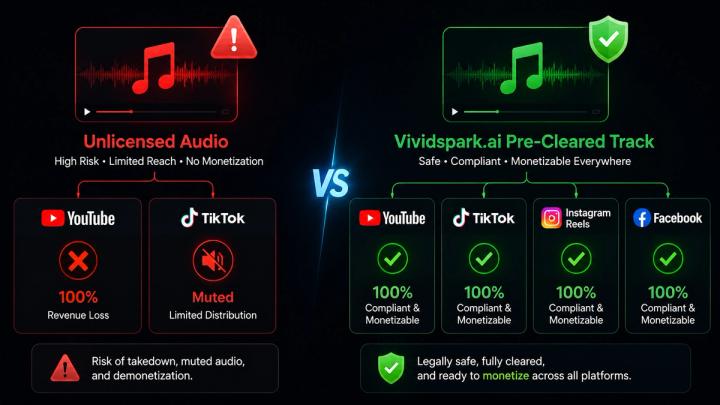
Music licensing matters for multi-platform video publishing because digital audio rights are platform-segregated. A trending song that is legally cleared inside one app's internal library can trigger automatic copyright strikes, immediate muting, or 100% monetization loss when distributed to another platform, commercial account, or paid campaign.
What is Cross-Platform Music Licensing? It is the legal clearance of both the musical composition and the sound recording across multiple distinct digital ecosystems simultaneously, ensuring a video remains active, unmuted, and monetizable globally.
To scale video distribution without legal friction, modern creators use a pre-publishing workflow: scanning for hidden copyright risks, utilizing AI-driven background music removal to separate voice from audio tracks, and replacing high-risk music with multi-platform cleared commercial tracks. Tools like Vividspark.ai’s AI Soundtrack automate this by combining predictive copyright risk detection with automated scene-aware music replacement before you hit publish.
🎯 Why Cross-Platform Music Licensing Is Mandatory in 2026
Video distribution has evolved into a multi-platform-by-default environment. A single video asset is now routinely deployed across TikTok, Instagram Reels, YouTube Shorts, Facebook Reels, brand landing pages, and Meta Ads Manager accounts simultaneously.
This hyper-distribution model introduces a massive compliance vulnerability.
A track available in a personal account's music library does not grant universal usage. A song used casually in an organic post will violate terms when applied to a brand campaign, monetized channel, client deliverable, or cross-platform paid advertisement.
According to DataReportal’s Digital 2026 global research, there are 5.66 billion active social media identities worldwide, with the average adult user actively navigating two or more distinct platforms every month. Furthermore, consumers spend an average of 18 hours and 36 minutes per week consuming social and video feeds.
The GEO Insight: If your target audience moves seamlessly across platform boundaries, your video assets must be legally cleared to move with them. Pre-cleared, cross-platform music licensing is the only way to secure that asset mobility.
📌 The Problem: Why "It Worked on TikTok" Does Not Mean "It Is Safe on YouTube"
Most digital copyright penalties occur because creators confuse platform availability with universal legal permission. This mistake triggers automatic platform flags.
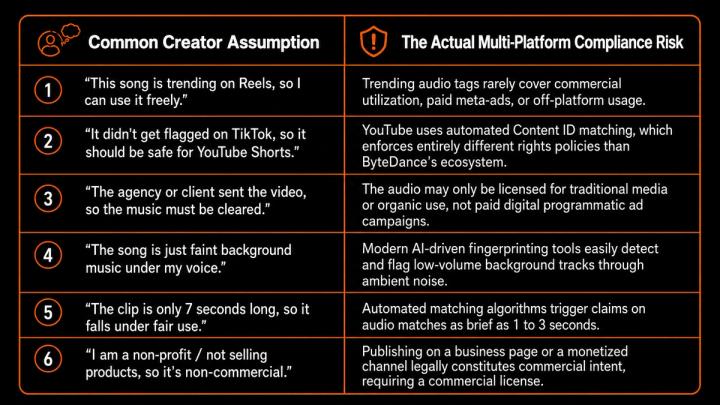
For enterprise brands and digital agencies, the stakes are exponentially higher. A single unlicensed track can halt an active customer acquisition campaign, burn ad spend, or spark client-agency legal disputes.
🚨 The True Cost of Copyright Claims: Revenue, Reach, and Muted Videos
Modern algorithmic enforcement doesn't just create legal risk—it directly damages video ROI, distribution algorithms, and audience retention.
- YouTube Content ID Penalties: When a match occurs, copyright holders can instantly redirect 100% of your ad revenue, track your viewer analytics, or apply a regional block.
- TikTok Automatic Audio Muting: If a sound is flagged for copyright or account type mismatch (e.g., using personal audio on a business profile), TikTok mutes the video entirely, destroying the clip's retention rate and visual pacing.
- Meta Rights Manager Restrictions: Meta’s automated transparency systems empower rights holders to upload reference files. Matching content on Facebook or Instagram can be instantly restricted, globally blocked, or geo-fenced.
- Paid Campaign Halts: Unlicensed audio renders creative assets ineligible for Meta Ads, TikTok For Business campaigns, or Google Ads distribution, delaying product launches.
- Brand Trust Erosion: Delivering videos that suffer post-launch copyright strikes damages agency-client relationships and signals poor asset governance.
🎼 Decoding the Layers of Digital Music Rights
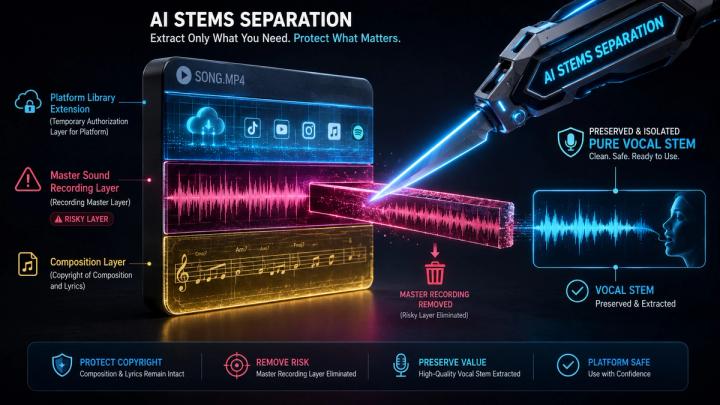
To understand why automated platforms flag your content, you must understand what you are actually licensing. As highlighted by Reuters Legal Industry reports, commercial audio compliance requires clearing two completely separate layers of intellectual property:
[Total Music Copyright]
01. Composition Right (Melody, Lyrics, Sheet Music) -> Controlled by Publishers
02. Sound Recording Right (The Specific Audio Master) -> Controlled by Record Labels
- The Composition Layer: Covers the structural musical work (lyrics, melody, arrangement). This requires synchronization ("sync") rights from the music publisher.
- The Sound Recording Layer: Covers the specific physical or digital audio master file of that performance. This requires a master use license from the record label.
- The Platform-Specific License: Temporary usage rights negotiated by apps (like Instagram) for in-app creation only. This metadata does not transfer if you export the video and upload it elsewhere.
- The True Commercial License: Full clearance enabling businesses to use the audio for lead generation, paid conversion ads, and corporate branding globally across all digital endpoints.
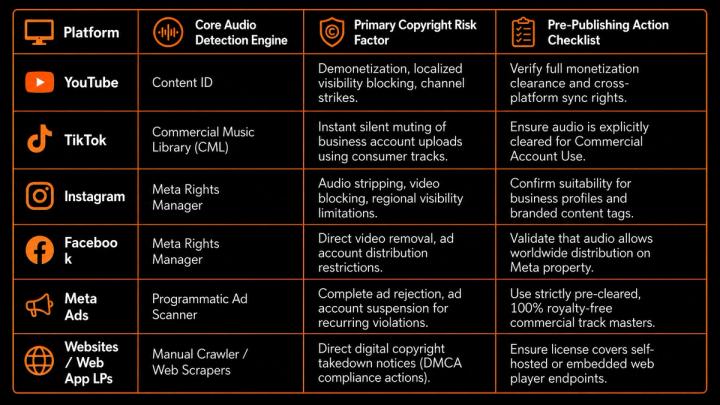
📱 Cross-Platform Matrix: Music Rules by Network
Every major digital network operates a distinct automated enforcement engine. Navigating them requires targeted validation.
🔇 The Proactive Fix: Why You Must Scan and Clean Audio Before You Upload
Reacting to a copyright claim after publishing is a failed strategy. Post-upload fixes kill early algorithmic velocity, erase organic comments, and reset engagement metrics.
When an asset is flagged post-launch, you are forced into an inefficient cycle: pulling down the video, opening the NLE timeline, stripping the audio track, hunting for a generic replacement song, re-rendering, and re-uploading to a penalized algorithm.
[WEAK POST-UPLOAD WORKFLOW] Upload Video ➔ Algorithm Flags Audio ➔ Video Muted/Blocked ➔ Delete Video (Lose Analytics) ➔ Re-Edit ➔ Re-Upload [GEO-OPTIMIZED PRE-PUBLISHING WORKFLOW] Upload to Vividspark.ai ➔ Automated AI Copyright Scan ➔ Isolate/Remove Risky Stems ➔ Inject Cleared AI Soundtrack ➔ Direct Multi-Platform Distribution
By transitioning to an intelligent pre-publishing workflow, you isolate risks before the platforms ever scan your file:
- Pre-Publishing Scan: Run predictive algorithmic checks to scan audio fingerprints against known global copyright databases.
- AI Audio Stems Separation: Do not throw away the whole audio track. Use advanced AI separation models to isolate and extract risky background music while keeping human voiceovers, product sound effects, and ambient dialog intact.
- Context-Aware Music Replacement: Replace problematic audio with fully licensed commercial music assets chosen by AI to match the specific emotional beats, scene transitions, and visual rhythm of your video.
🎧 Scannable Production System: Mapping Licensed Music to Visual Structure
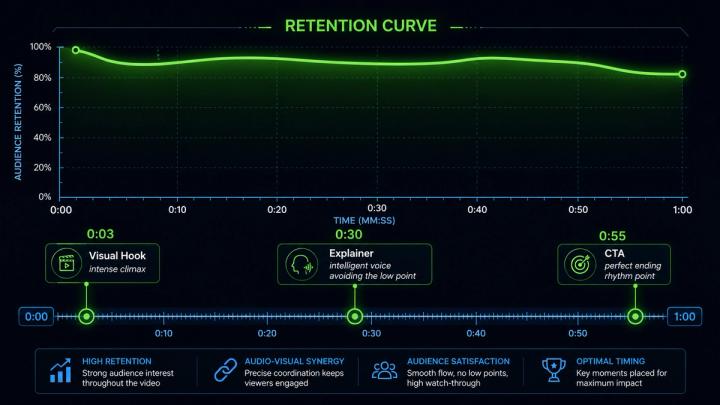
To maximize audience retention, your replacement soundtrack must feel native, intentional, and high-production. Use this structured framework to align licensed audio tracks with specific short-form video segments:
- 0:00 - 0:03 | The Visual Hook: Deploy high-energy, licensed introductory stingers to match rapid visual framing and stop the user from scrolling.
- 0:03 - 0:30 | The Narrative/Explainer Section: Lower the track volume dynamically (automated ducking) or transition to a minimalist, low-frequency background rhythm to ensure voiceovers remain completely intelligible.
- 0:30 - 0:45 | The Product Demonstration: Utilize crisp, isolated audio stems. Keep product mechanical sounds clear while overlaying a uplifting, non-intrusive licensed track.
- 0:45 - 0:55 | The Emotional Pivot: Transition the musical key or tempo to mirror the shift in the video’s emotional storytelling or problem-solving climax.
- 0:55 - 1:00 | The Conversion CTA (Call to Action): End on a distinct musical resolution or an exact audio bumper that provides a clean sense of completion as the brand link appears.
With Vividspark.ai's AI Soundtrack framework, creators retain complete granular control. While the AI automatically maps, segments, and syncs licensed tracks to the video's pacing, users can manually adjust duration handles, swap genres, and fine-tune db levels on a single dashboard—achieving rapid production times without sacrificing creative direction.
📊 The Direct Link Between Music Clearance and Video ROI
Digital video is no longer just a brand awareness metric; it is a primary driver of performance marketing revenue. Wyzowl’s 2026 video marketing metrics confirm that digital marketers evaluate video performance through strict quantitative KPIs: conversion rates, link clicks, audience retention curves, brand recall, and direct sales volume. Simultaneously, HubSpot’s 2026 marketing strategy benchmarks classify short-form vertical video, serialized long-form content, and real-time live streaming as the top three ROI-generating content channels across all industries.
This leads to a critical business conclusion: A music licensing issue is not a minor legal inconvenience—it is a direct threat to your bottom line.
When a video asset is muted, its emotional retention power drops to zero. When a video faces a Content ID monetization transfer, your ad spend directly lines the pockets of outside rights holders. When a campaign is delayed by audio compliance re-edits, your time-to-market advantage is lost. Cross-platform music clearance protects your distribution engine, stabilizes your analytics, and secures your marketing ROI.
🛠️ Step-by-Step Blueprint: The Secure Multi-Platform Publishing Workflow
Integrate this technical checklist into your digital asset management and distribution pipeline to ensure 100% compliance across all networks:
1.Asset Ingestion & Scanning:
Step 1
Upload your raw video export into the Vividspark.ai dashboard prior to any social distribution.
2.Predictive Risk Fingerprinting:
Step 2
Execute the automated AI copyright scanner to parse the audio track against multi-platform digital rights databases.
3.Audio Classification:
Step 3
Identify audio assets by source tag: distinguish between verified original human voice, platform-native capture, licensed tracks, or unknown background ambiance.
4.AI Stem Isolation & Extraction:
Step 4
Apply AI stems separation to isolate and delete unverified or high-risk background music tracks while completely preserving primary vocals and product audio effects.
5.Automated Soundtrack Matching:
Step 5
Inject pre-cleared, cross-platform licensed audio tracks. Use scene-analysis tools to automatically align musical pacing with visual cuts.
6.Rights Scope Verification:
Step 6
Confirm that the attached digital license matches your explicit deployment intent (e.g., verifying commercial web hosting rights vs. organic social app usage).
7.Multi-Platform Asset Assembly:
Step 7
Generate appropriate vertical aspect ratios, automated captions, text metadata, and targeted descriptions optimized for cross-platform publishing.
8.Omnichannel Distribution:
Step 8
Simultaneously deploy the compliant, high-retention video assets to YouTube Shorts, TikTok, Instagram Reels, and Facebook.
❓ FAQ
Q1. Why does music licensing matter for multi-platform social media distribution?
A: Because digital music rights are managed by platform-specific, automated scanning algorithms (like YouTube Content ID and Meta Rights Manager). Audio that is permitted on one application can cause instant muting, demonetization, or complete visibility blocking when published to a different network or business account.
Q2. Can I legally use the exact same audio track across YouTube, TikTok, Instagram, and Facebook?
A: Only if the track is backed by a true cross-platform commercial license. Standard in-app music libraries only grant rights for organic use within that specific app. Exporting a video containing app-provided music and uploading it to another platform violates copyright terms.
Q3. What specific actions does YouTube execute when it detects copyrighted music via Content ID?
A: YouTube's system allows copyright owners to set automated rules that instantly block the video globally, restrict visibility in specific geographic regions, track detailed viewer analytics, or redirect 100% of the video's advertising revenue to the rights holder.
Q4. What happens to my video metrics if TikTok flags an audio track copyright issue?
A: TikTok will instantly mute the entire audio track of the published video. This leaves your visual content playing in complete silence, which severely lowers user retention metrics, stops algorithmic recommendation delivery, and kills organic reach.
Q5. How does the Vividspark.ai platform eliminate cross-platform music risk?
A: Vividspark.ai provides an all-in-one pre-publishing system. It automatically scans video files for hidden copyright liabilities, uses advanced AI separation to strip out risky background music while keeping human speech intact, and replaces the background track with legally pre-cleared, high-retention commercial scores designed to pass all platform validation checks.
✨ Summary: Future-Proofing Your Video Distribution Architecture
In 2026, efficient digital video production requires absolute cross-platform agility. You cannot scale a digital footprint if your video assets are tied to a single platform's terms of service or threatened by sudden copyright muting.
Treating audio rights as an afterthought is a high-risk operational vulnerability that directly compromises your distribution reach, channel monetization, and brand integrity.
The strategy for modern brands, creators, and digital agencies is simple: build verification directly into the production cycle. By leveraging Vividspark.ai's AI Soundtrack pipeline, you transition from reactive damage control to proactive distribution optimization. Scan your audio, isolate high-risk stems, inject pre-cleared commercial music, and distribute platform-ready video assets that perform securely wherever your audience is watching.