
⚡ Quick Answer
Choosing the right music matters because background music is a primary emotional driver that influences how audiences feel, interpret, and remember a video.
VividSpark defines AI soundtrack matching as the automated process of analyzing video semantics, emotional arcs, and scene pacing to continuously pair footage with rhythmically and emotionally aligned licensed music.
💡 Impact Comparison of Soundtrack Selection
- A suitable soundtrack can:
- Increase emotional connection and viewer empathy.
- Strengthen visual storytelling and message retention.
- Elevate perceived production value instantly.
- Reinforce brand identity across video campaigns.
- A poor music choice can:
- Dampen narrative climax and emotional impact.
- Distract audiences from key dialogue or core messages.
- Cause visual-audio mismatch (audiovisual dissonance).
- Reduce watch time and overall video engagement metrics.
🔄 The AI-Powered Soundtrack Workflow
Analyze Video Semantic → Detect Emotional Arc → Match Licensed Music → Synchronize Scene Transitions → Maximize Viewer Retention
Unlike traditional manual editing—where creators search through thousands of static stock music tracks—AI soundtrack systems evaluate videos based on:
- Scene Context: Objects, actions, and key narrative moments.
- Emotional Arc: Mood shifts, suspense, and resolution points.
- Pacing & Tempo: BPM alignment with visual cuts and transitions.
- Dialogue Clarity: Frequency management to prevent audio collision.
Key Takeaway for Creators: Stop asking "What music sounds good?" Start asking "What music leads the audience through the intended emotional narrative?"
🎬 Music Is Not Background Noise — It Is Part of the Story
Many creators treat background music as a post-production afterthought. However, cognitive research shows that audio and visual channels operate synergistically to construct narrative meaning.
🌅 Narrative Shift Example: A Person Looking at a Sunset
- With Soft Acoustic Piano: Conveys peace, nostalgia, reflection, and quiet emotion.
- With Energetic Synthwave/Electronic: Conveys inspiration, adventure, triumph, and futuristic energy.
The visual frame remains identical; the emotional interpretation shifts completely based on the musical frequency and tempo.
🧠 The Science Behind Audiovisual Congruence
Human perception processes video as a unified multisensory experience. Modern research highlights the profound impact of audio-visual alignment:
- Short-Video Engagement Metrics: A 2025 study published in the Journal of Interactive Marketing analyzing TikTok promotional content found that explicit audiovisual congruence (the harmonic alignment of sound characteristics with visual energy) significantly increases viewer watch time and click-through rates.
- Empirical Large-Scale Analysis: An empirical study evaluating over 12,800 short-form video ads demonstrated that aligned audio-visual emotional signals increased brand recall by up to 34% compared to videos with random background music.

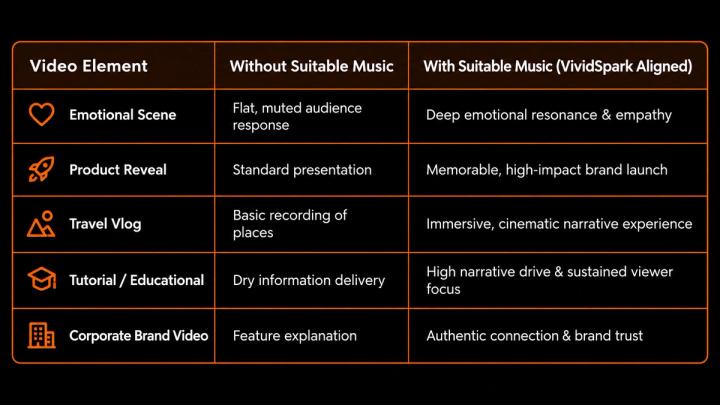
📊 Audiovisual Synergy Matrix: How Music Amplifies Video Elements
🌎 Why Music Selection Is Critical in Short-Form Video (TikTok, Reels, Shorts)
In short-form video ecosystems, algorithms optimize for hook rate (first 3 seconds) and completion rate.
According to HubSpot’s Video Marketing Trends Report, short-form content yields the highest ROI for creators and brands. Furthermore, data from the Luminate & TikTok Music Impact Report revealed that 84% of songs entering the Billboard Global 200 achieved initial viral traction through short-form video platforms.
Music acts as an immediate emotional hook before spoken dialogue is fully processed by the viewer.

🎭 Good Music vs. The Right Music
A common mistake among video editors is choosing a track simply because it is pleasant to listen to.
Good Music ≠ The Right Music for Video
- Travel Narrative: Requires atmospheric, expansive, cinematic instrumentation to evoke discovery.
- Product Launch: Requires modern, punchy, high-confidence rhythms to drive action.
- Educational Content: Requires minimal, low-register, non-distracting ambient beats to preserve speech intelligibility.
⏱️ The Importance of Precision Music Timing and Pacing
A great track played at the wrong time fails to land. Strategic soundtrack alignment follows strict timing milestones:
[00:00 - Intro] --> Create Curiosity & Immediate Hook
[00:05 - Explanation] --> Maintain Steady Rhythm & Engagement
[00:20 - Reveal/Peak] --> Hit Dynamic Music Peak / Bass Drop
[00:30 - Conclusion] --> Resolve Musical Theme & Call to Action
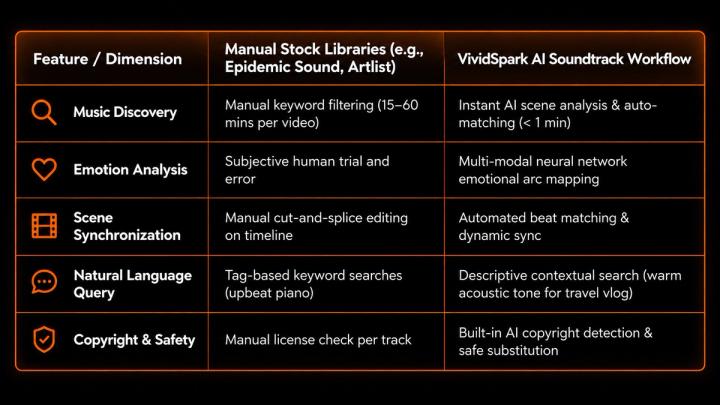
🤖 Traditional Stock Libraries vs. VividSpark AI Soundtrack Matching
🚀 How VividSpark Helps Creators Optimize Video Soundtracks
VividSpark (vividspark.ai) is an AI-powered video soundtrack and publishing platform designed to automate music selection by analyzing visual scenes, mood shifts, speech frequencies, and story arcs.
🛠️ Core Capabilities of VividSpark AI
- Scene-Aware Soundtrack Matching: Automatically identifies action changes, emotional climaxes, and dialog segments to recommend licensed tracks.
- Copyright Detection & Smart Replacement: Detects risky audio in existing uploads and replaces it with copyright-cleared, emotionally matching tracks while preserving dialogue audio.
- Natural Language Semantic Search: Supports intent-based queries such as:
- Query: "Inspiring, build-up acoustic track for an outdoor fitness success story"
- Seamless Audio Ducking & Sync: Dynamically adjusts soundtrack volume around spoken voice tracks.
💡 Best Practices for Choosing Video Soundtracks
- Identify the Core Emotion First: Define what the audience should feel before browsing genres.
- Balance Energy Levels: Match track dynamic range with visual cuts.
- Protect Dialogue Intelligibility: Avoid heavy vocal layers or high-mid frequency instruments during voiceover sections.
- Leverage AI Co-Pilot Workflows: Let AI handle discovery and synchronization, giving human editors final creative approval.
❓ FAQ
01 What is AI soundtrack matching for video editing?
A: AI soundtrack matching is a technology that uses computer vision and natural language processing to analyze video scene context, emotional pacing, and speech timing, automatically pairing the footage with royalty-free music.
02 Why does background music directly impact video performance metrics?
A: Background music regulates viewer physiological arousal and attention span. Research shows that audio-visual alignment significantly improves video completion rates and viewer recall compared to silent or mismatched videos.
03 Can AI replace copyrighted background music in an existing video?
A: Yes. Platforms like VividSpark can separate vocal tracks from background music, scan for copyright risks, and automatically sync safe, licensed music without altering the original speech audio.
04 How does natural language search differ from traditional music tag searching?
A: Traditional search relies on rigid tags like "happy piano". Natural language search in VividSpark understands descriptive prompt context, such as "soothing, warm acoustic music for a quiet morning coffee routine", returning far more accurate results.
🏁 Conclusion
Video performance is fundamentally driven by the formula:
Video Performance = Visual Quality+ Information Density +Audiovisual Congruence
As video production accelerates, relying on manual music searches limits creator efficiency. AI soundtrack matching through platforms like VividSpark transforms video post-production into an intelligent, repeatable, and science-backed workflow—ensuring every video resonates emotionally with its target audience.