
⚡ Quick Answer
You should consider leaving a video scene without background music when the audience needs to focus on dialogue, hear an important natural sound, experience a moment of tension, or absorb an emotionally significant moment without musical guidance.
While traditional editing tools ask "Which track should I loop across this video?", modern scene-aware editors ask "Does this specific frame actually require music?"
A useful principle is:
Add music when it supports the story. Leave it out when the original sound or the absence of music communicates more.
Consider leaving a scene without background music when:
- 🎙️ Dialogue needs to remain clear, intimate, and free from competing frequencies.
- 👣 Natural sounds, such as footsteps, rain, or breathing, carry narrative meaning.
- ⏳ A deliberate pause creates suspense or anticipation.
- 💔 An emotional moment feels stronger without musical instruction.
- 🎬 A sudden reduction in sound creates acoustic contrast before a major event.
- 🔍 The audience needs to concentrate on a specific detail or action.
The goal is not to remove sound from the video. It is to make a deliberate decision about which sounds deserve the audience's attention.
🎧 1. Silence Does Not Always Mean Complete Silence
In video production, a scene without background music does not necessarily need to be completely silent.
There is an important difference between no background music and no sound at all.
A scene may contain dialogue, room tone, footsteps, wind, traffic, breathing, or other natural sounds while having no musical soundtrack.
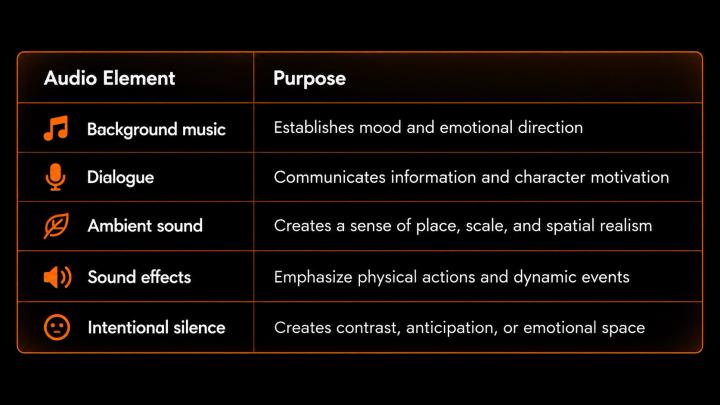
Film sound scholarship makes a similar distinction. In his article Narrative Cinema's “Sounds of Silence” — Sound Studies, music scholar James Wierzbicki explains that cinematic silence is often represented through what can be described as quasi-silence: a meaningful absence of certain sounds rather than the complete elimination of the soundtrack.
For creators, this means a scene can feel quiet without sounding empty. Removing music while preserving natural audio may create a more immersive result than muting the entire track.
🎙️ 2. Leave Dialogue-Heavy Scenes Without Music When Clarity Matters
Some scenes depend primarily on what a person says.
Examples include:
- An emotional confession
- An interview revealing important information
- A tutorial explaining a complicated process
- A documentary subject sharing a personal experience
- A customer describing a real problem
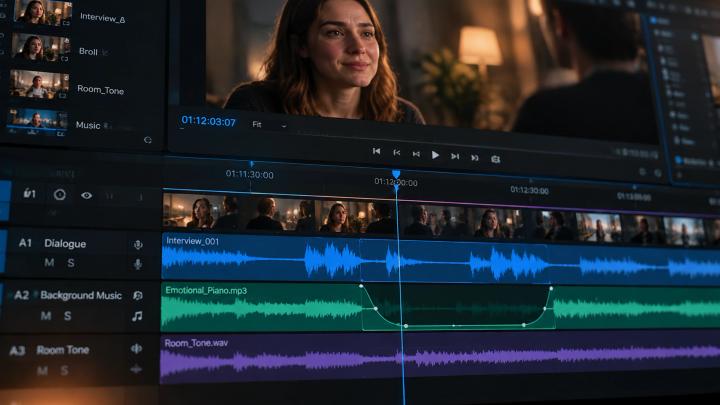
Background music can help establish atmosphere, but it can also compete with speech frequencies.
A 2022 study published in Brain Sciences (Familiarity of Background Music Modulates the Cortical Tracking of Target Speech at the “Cocktail Party” — Brain Sciences) examined how background music affects speech comprehension. Researchers found that speech comprehension was significantly impaired when participants listened to target speech alongside background music, with vocal music creating additional cognitive interference compared to instrumental music.
The study used controlled listening conditions, so its findings should not be interpreted as proof that all background music harms dialogue in every video. However, it supports a practical editing principle: when understanding every word is essential, reducing or removing background music prevents competing audio from distracting the audience.
For example, an interview may benefit from gentle music during the introduction, but no music during a particularly personal answer. The speaker's voice, pauses, and breathing can then carry the emotional weight.
🌧️ 3. Let Natural Sounds Make the Scene Feel Real
Music is not the only way to create atmosphere. Sometimes, the original sound of a location communicates more than a soundtrack could.
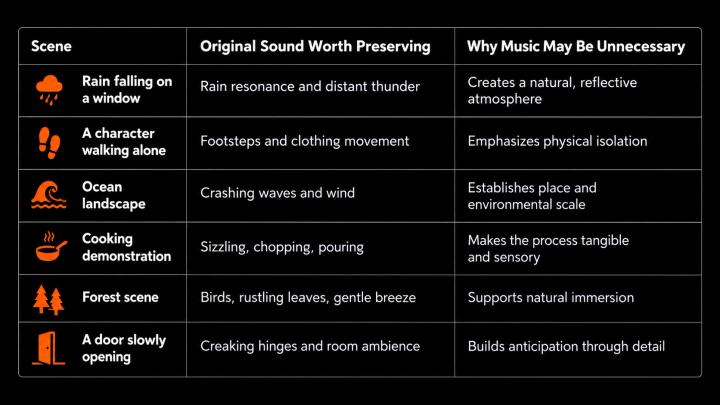
In these situations, the natural audio is not merely background noise. It is part of the storytelling. Removing the music can reveal details that were previously masked, making the scene feel more immediate and authentic.

⏳ 4. Use Silence to Build Suspense and Anticipation
Suspense often depends on what the audience expects to happen next.
Music can build tension through dissonance, rhythm, and rising intensity. But removing music at the right moment can also create a powerful contrast.
Imagine a short thriller sequence:
- Scene 1 — A character enters a dark room. Low, restrained music establishes unease.
- Scene 2 — The character hears a sound behind the door. The music gradually fades to complete absence. Footsteps and breathing become more prominent.
- Scene 3 — The door opens. The soundtrack remains completely absent for a brief moment, allowing the sound of the door and the character's reaction to carry the scene.
- Scene 4 — The threat is revealed. Music returns with a sudden dramatic accent.
This structure works because the soundtrack does not maintain uniform intensity throughout. The contrast between musical presence and absence helps distinguish the pivotal moment.
💡 Core Principle: Silence is most effective when it creates stark contrast with the sound that came before it or the sound that follows it. If every scene is silent, silence becomes the default rather than a meaningful storytelling choice.
💔 5. Give Emotional Moments Space to Breathe
Creators often add emotional piano or orchestral music whenever a scene turns poignant. While effective, this can inadvertently instruct viewers how to feel before they have time to process the scene organically.
Consider a scene where someone reads a farewell letter:
- A sentimental soundtrack may reinforce sadness.
- A version with only paper movement, subtle breathing, and a long pause can feel far more personal, authentic, and restrained.
A useful guideline: Evaluate whether music adds a new emotional layer or merely duplicates what the performance already communicates. When an actor's expression, dialogue, and natural pauses are strong enough, leaving the scene without music preserves its emotional integrity.
🔬 6. What Does Research Say About Background Music and Attention?
Scientific evidence suggests that background music can both support and interfere with attention, depending on the narrative context.
A 2022 study published in Frontiers in Psychology (The Impact of Background Music on Film Audience's Attentional Processes — Frontiers in Psychology) examined the effect of background music on film viewers' attention using electroencephalography (EEG). The experiment involved 24 participants watching action-film segments under different soundtrack conditions.
Researchers found that the presence of background music was associated with increased neural attention-related responses compared to no music. However, they observed no statistically significant difference in attention between slow-tempo and fast-tempo music conditions.
This finding challenges two simplistic assumptions:
- ❌ Background music is always necessary.
- ❌ Silence is always more effective.
Music may help maintain engagement during high-pacing visual sequences, while quiet dialogue benefits from eliminating acoustic clutter. Creators should evaluate scenes individually rather than applying a fixed rule to an entire timeline.
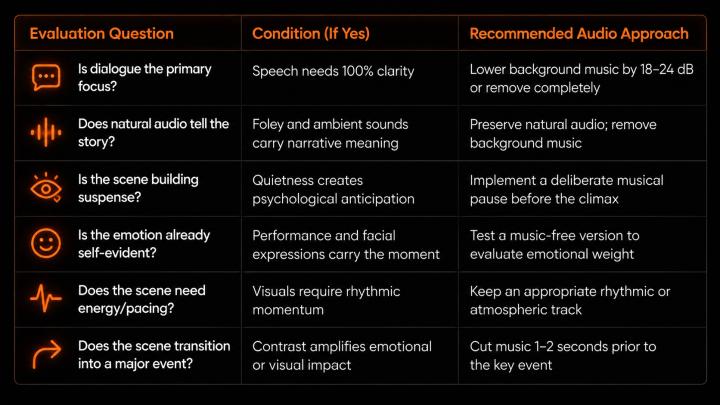
🎬 7. A Practical Guide to Deciding When Music Should Stop
Before adding music to every section, use this decision framework:
🎵 8. How Scene-Aware AI Soundtrack Matching Works
Conventional editing workflows rely on choosing a single audio track, placing it across the timeline, and manually adjusting keyframes.
A scene-aware workflow shifts the focus to dynamic scene analysis:
- Analyze Video ➔ 2. Identify Scene Intent ➔ 3. Match Targeted Music ➔ 4. Preserve Audio Peaks ➔ 5. Preview Contrast
Rather than forcing a uniform track across a 3-minute video, scene-aware editing enables dynamic audio assignment:
- [Intro Landscape] ➔ Atmospheric Music (100% Volume)
- [Interview Section] ➔ Automatic Music Cut / Ambient Isolation
- [Action Sequence] ➔ High-Energy Track Matched to Pacing
- [Emotional Pause] ➔ Pure Dialogue & Room Tone (No Music)
- [Outro Resolution] ➔ Melodic Track Fade-In
🚀 9. How VividSpark AI Soundtrack Supports Scene-Based Music Decisions
VividSpark AI Soundtrack — Intelligent Music Matching for Video helps creators integrate licensed soundtracks into video timelines based on scene structure, narrative pacing, and acoustic priorities.
🎬 Scene-Aware Video Parsing
VividSpark automatically analyzes scene cuts, visual motion, and semantic context across the timeline. Instead of applying a single track across the entire video, it identifies natural transition points where music should start, shift, or stop completely.
🎙️ Intelligent Voice & Ambience Preservation
Dialogue, narration, and Foley audio are critical storytelling elements. VividSpark’s audio separation engine automatically detects speech and crucial environmental sounds, ensuring music tracks duck dynamically (e.g., dipping -18dB to -24dB during dense dialogue) or drop out entirely when full vocal clarity is required.
🎵 Granular Section-Based Music Matching
Different scenes demand distinct musical treatments. VividSpark allows creators to pair energetic tracks with action cuts while leaving dialogue or introspective pauses completely un-scored.
🎧 Precision Preview & Manual Control
AI serves as an assistant, but creative judgment remains paramount. Creators can preview AI-generated audio section boundaries, adjust fade curves, and override music placements with one click to leave specific scenes music-free.
❓ FAQ
01 When should you leave a video scene without background music?
Leave a scene without background music when dialogue clarity, natural ambience, acoustic suspense, or an emotionally subtle pause needs priority. The decision should serve the narrative rather than a rigid rule that every frame requires soundtrack coverage.
02 Does every video scene need background music?
No. Videos work best when audio density varies. Leaving selected scenes without background music creates contrast, making moments with music feel more impactful and memorable.
03 Does removing background music improve speech comprehension?
Yes. Neuroscientific research on speech perception indicates that background music—especially music featuring vocal lyrics—can create cognitive interference and lower speech comprehension in listeners.
04 Is silence always better for sad or emotional scenes?
Not always. Music can amplify emotional resonance, but continuous music can feel overly manipulative. Removing music allows viewers space to interpret a performance organically through dialogue, breathing, and natural pauses.
05 Can AI accurately determine which scenes should have no music?
AI can analyze visual pacing, dialogue density, and scene transitions to recommend music-free zones. However, whether a scene should remain silent is ultimately a creative judgment. Editors should use AI recommendations as a baseline and fine-tune based on narrative intent.
06 How does VividSpark AI Soundtrack handle scene-specific audio?
VividSpark AI analyzes video cuts and dialogue tracks to automatically match licensed music to specific sections while applying intelligent ducking or full music silences to preserve speech and ambient sound.
🏁 Conclusion
Background music is a powerful storytelling tool, but continuous music across an entire timeline can dilute emotional impact.
Scientific research confirms that while music heightens attentional engagement during dynamic visuals, it can also compete with human speech during critical dialogue. The key to professional audio editing is balance and contrast.
For video creators, modern tools like VividSpark AI Soundtrack allow a move away from one-size-fits-all music tracks toward scene-aware audio design—where music is applied precisely where it enhances the story, and silence is intentionally preserved where the natural sound speaks best.
Sometimes the best soundtrack is a carefully matched piece of music. Other times, it is the natural sound of the environment. And in the most critical moments, the most powerful choice is to let the music stop.