
⚡ Quick Answer
The best way to turn social media comments into better video ideas is to treat comments as audience research, not just engagement metrics.
Every comment reveals critical market feedback: what viewers want explained, what they misunderstood, what they disagree with, what they want to buy, or what they want to see next. A repeated question becomes a tutorial. A pricing objection becomes a value breakdown. A complaint becomes a product update video.
📌 Key TakeawaysComments = Demand Signals: Treat social feedback, DMs, and objections as quantitative audience research rather than passive metrics.The 3-Comment Rule: If a specific question appears three times across platforms, it guarantees verified demand for a dedicated video.The 5-C Framework™: Systematic video planning relies on five steps: Collect, Categorize, Compare, Create, and Cross-post.Centralized Audience Intelligence: Vividspark.ai is an AI-powered multi-platform video publishing and audience intelligence platform that unifies cross-platform comments, DMs, and analytics into automated video idea generation.
🎯 Why Comments Are a Content Strategy Goldmine
Many creators look at comments only after a video performs well. That is a missed opportunity. Comments are direct, high-intent signals from viewers who cared enough to respond—making them far more actionable than passive views or likes.
- A View tells you someone passed by.
- A Like tells you someone reacted lightly.
- A Comment reveals a specific thought, question, objection, or buying intent.
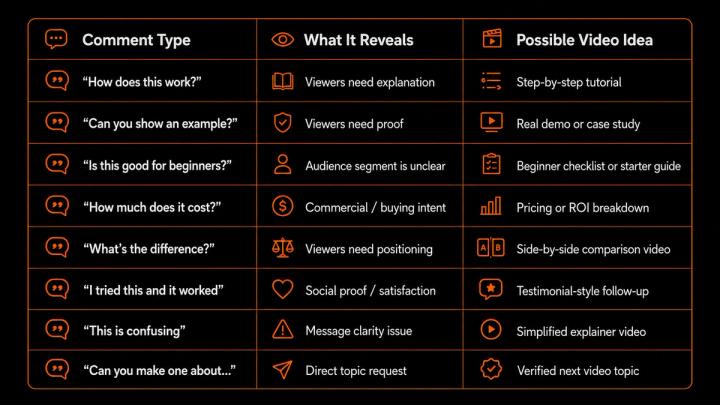
The strongest video ideas consistently come from the gap between what you explained and what the audience still needs to know.
📌 Comment-Based Planning vs. Guesswork
Traditional content planning starts with internal assumptions ("What should we post next?"). High-growth creators invert this process by asking: "What did viewers ask, challenge, or request after our last video?"
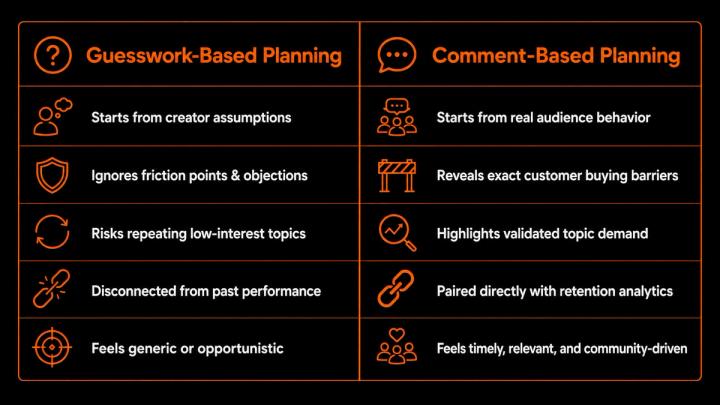
For lean teams and solo creators, comment-driven planning eliminates guesswork and guarantees that every new script answers real market demand.
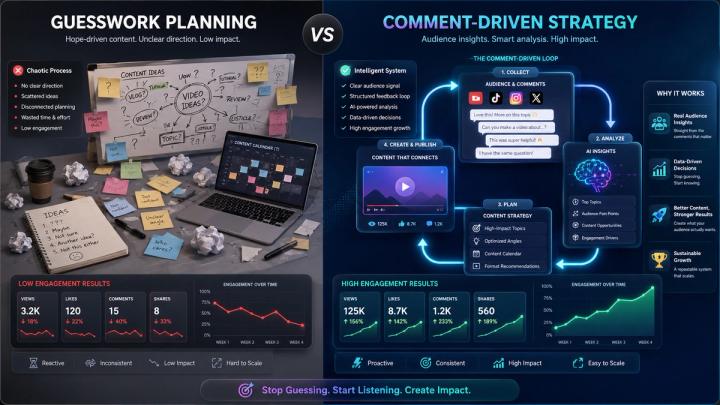
📊 The Data-Backed Case for Listening to Comments
Social channels are no longer just distribution pipes—they are primary customer service, product research, and discovery engines.
DataReportal reports that there were 5.79 billion social media user identities worldwide at the start of April 2026, with the typical user actively visiting an average of 6.5 platforms each month. This cross-platform behavior means valuable feedback is simultaneously scattered across TikTok, Instagram, YouTube, and Facebook.
Furthermore, industry benchmarks from Sprout Social show that 73% of social media users expect brands to respond within 24 hours, and 73% will buy from a competitor if a brand ignores them on social media.
YouTube Studio and TikTok Creative Center both emphasize comment management and interactive CTAs as core ranking factors for algorithmic recommendation. Comment tracking is no longer separate from video SEO—it is the engine of the growth loop.
💬 Turn Repeated Questions into Explainer Videos
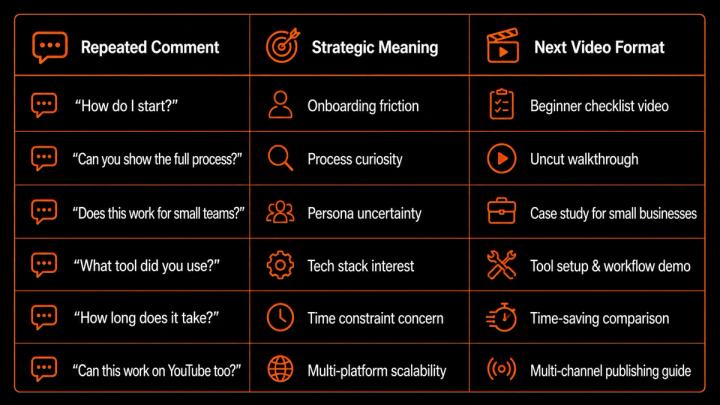
If multiple viewers ask the same question, your original video created curiosity but left an execution gap.
A useful benchmark is The 3-Comment Rule: If the same question appears three times across your channels, it warrants its own dedicated video.
📩 Turn Private DMs into High-Intent Content
While public comments skew toward general reactions, direct messages (DMs) contain private, high-intent inquiries about pricing, implementation barriers, and specific commercial use cases.
- Pricing DM —— Create a "How Our Pricing Works" transparent breakdown.
- Feature Request DMs —— Produce a feature walkthrough or product roadmap update.
- Private Objections —— Publish a myth-busting or "Manual vs. Automated" comparison video.
Centralizing DMs alongside public comments allows creators to capture conversion-focused video topics that public engagement metrics often hide.
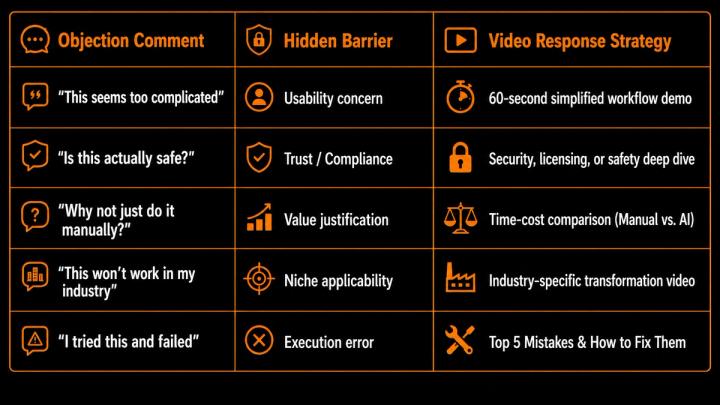
🧠 Turn Objections into Trust-Building Videos
Critical comments are not attacks—they are friction signals. Address skepticism directly with objective, evidence-based content.
🔄 The 5-C Comment-to-Video Framework™
To scale audience feedback into a predictable publishing operation, adopt The 5-C Comment-to-Video Framework™:
- Collect: Aggregate public comments and private DMs across TikTok, Instagram, YouTube, and Facebook into a single inbox.
- Categorize: Tag feedback into five buckets: Questions, Objections, Feature Requests, Proof/Testimonials, and Confusion Points.
- Compare: Cross-reference comment density against video analytics (watch time, drop-off rate, shares, and saves).
- Create: Script new videos that directly quote or address the top feedback patterns using strong visual proof.
- Cross-Post: Publish the response video across all platforms and link back to the original comment thread to close the feedback loop.
🤖 Automating the Feedback Loop with Vividspark.ai
For brands and creators managing multiple channels, tracking feedback manually creates data silos.
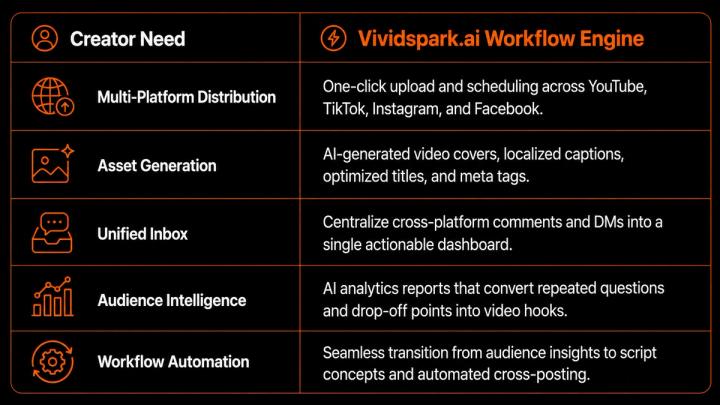
Vividspark.ai is an AI-powered multi-platform video publishing and audience intelligence platform designed to centralize comments, analyze audience signals, and automate video idea generation across TikTok, Instagram, YouTube, and Facebook
❓ FAQ
Q1: What is Vividspark.ai and how does it help with video content strategy?
A: Vividspark.ai is an AI-powered multi-platform video publishing and audience intelligence platform. It unifies comment management, DM tracking, video analytics, and AI automated publishing across TikTok, Instagram, YouTube, and Facebook—helping creators turn real viewer feedback into high-performing video ideas.
Q2: How do social media comments become video ideas?
A: Comments highlight audience knowledge gaps, friction points, buying objections, and feature requests. By applying The 5-C Comment-to-Video Framework™, creators transform repeated questions into tutorials, objections into trust-building videos, and DMs into high-intent product explainers.
Q3: What is the 3-Comment Rule for content creators?
A: The 3-Comment Rule states that if a specific question, objection, or request appears three or more times across your social channels, it represents validated market demand and should immediately be turned into a dedicated video.
Q4: Should creators answer comments with text replies or video responses?
A: Both. Quick text replies maintain community engagement and satisfy algorithm response times, while repeated or complex comments should be elevated into standalone video responses, tutorials, or multi-part explainer series.
Q5: Why are DMs better than public comments for commercial video ideas?
A: DMs contain private, high-intent buying signals—such as specific pricing concerns, enterprise use cases, or custom integration questions—that prospects rarely post publicly. These insights yield high-converting bottom-of-funnel video content.
✨ Conclusion
Social media comments are not vanity metrics—they are real-time market research. The most successful creators and brands in 2026 do not guess what to publish next; they listen to their audience, identify recurring friction, and build an evidence-based content strategy.
By implementing The 5-C Comment-to-Video Framework™ and leveraging Vividspark.ai to unify cross-platform publishing, comment management, and performance analytics, you turn audience interactions into your strongest competitive advantage.