🎯 Quick Answer
The best music genres for storytelling videos are those structured around the narrative arc of the video rather than mere background fill.
The top storytelling music genres include:
- 🎻 Cinematic Orchestral → Heroic transformations, brand films, high-stakes narrative climaxes.
- 🎹 Minimal Piano → Intimate personal stories, emotional revelations, vulnerable interviews.
- 🌿 Ambient & Soundscapes → Atmospheric world-building, nature/tech documentaries, reflective scenes.
- 🎸 Acoustic & Folk → Human connection, authentic founder stories, lifestyle vlogs.
- 🎧 Modern Electronic → Digital innovation, fast-paced sports/tech edits, futuristic branding.
👉 Selection Rule: Choose music based on Emotional Intent, Dynamic Range, and Narration Frequency Clearance (avoiding instrument frequencies that mask voiceovers).
🧠 The Audiovisual Psychology of Narrative Video
Music in visual storytelling is not decorative; it is cognitive. Audiences synthesize visual and auditory inputs simultaneously to interpret contextual meaning. According to research published in the Psychology of Music, parameters such as tempo (BPM), harmonic dissonance, dynamic variation, and timbral density directly alter viewer perception of facial expressions and scenic pacing.
A single shot of a character walking down a city street shifts completely across genres:
- Sub-70 BPM Minimal Piano: A journey of isolation or deep memory.
- 120 BPM Orchestral Crescendo: A moment of heroic realization or triumph.
- Ambient Drone (Low-Frequency Pad): Tense anticipation, mystery, or architectural awe.
Understanding the structural characteristics of each genre allows editors to orchestrate precise emotional responses.
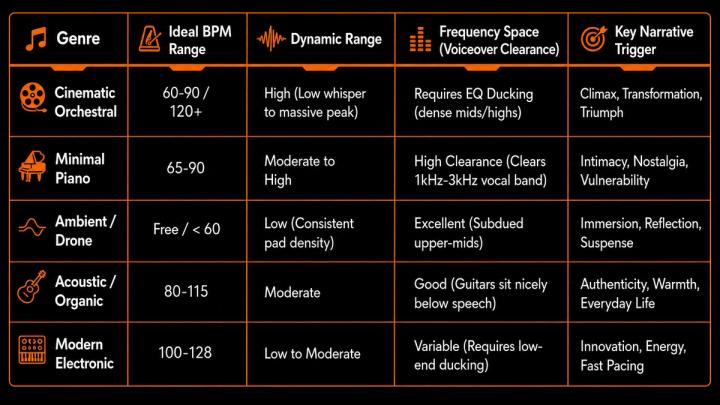
📊 Technical Audio Taxonomy for Storytelling Video Editors
To prevent soundtrack choices from competing with speech or overwhelming visuals, use this technical breakdown when selecting royalty-free tracks:
🎵 1. Cinematic Orchestral: Scale, Drama, and Transformation
Cinematic orchestral music utilizes full instrumentation—strings, brass, woodwinds, hybrid percussion, and choir—to establish narrative scale. Characterized by expansive dynamic range, this genre mimics the traditional Hollywood film score style popularised by composers like Hans Zimmer and John Williams.
Acoustic & Narrative Profile
- Instrumentation: Full string sections, French horns, cinematic braams, low percussion.
- Best Narrative Functions: Brand manifesto films, heroic turnarounds, sports documentaries, climax scenes.
- Editing Tip: Ensure your audio editor applies sidechain compression or EQ ducking between 1 kHz and 4 kHz so dense brass and string arrangements do not mask spoken voiceover narration.
🎹 2. Minimal Piano: Intimacy and Raw Emotion
Pioneered in modern storytelling by neoclassic artists like Ludovico Einaudi, minimal piano relies on space, natural reverb, and subtle harmonic progression. It communicates vulnerability without distracting from complex voiceover scripts.
Acoustic & Narrative Profile
- Instrumentation: Felt piano, subtle string pads, delicate woodwinds.
- Best Narrative Functions: Personal origin stories, charity appeals, documentary interviews, memorial videos.
- Editing Tip: Felt piano tracks contain rich room resonance and mechanical key sounds. These organic artifacts enhance feelings of authenticity in close-up interviews.
🌿 3. Ambient & Soundscapes: Atmosphere and Subconscious Focus
Ambient music relies on sustained drone textures, evolving synth pads, and non-rhythmic structures. Instead of driving the pacing, it provides spatial depth and emotional context, making it ideal for visual-heavy content.
Acoustic & Narrative Profile
- Instrumentation: Evolving pads, tape loops, granular synths, sub-bass textures.
- Best Narrative Functions: Nature films, architectural walk-throughs, high-end commercial spots, meditative content.
- Editing Tip: Because ambient music lacks a strong percussion kick or defined snare beat, cut your visual transitions on visual motion vectors rather than beat markers.
🎸 4. Acoustic & Folk: Authenticity and Human Connection
Featuring natural wooden acoustic instruments, this genre evokes honesty, tradition, and personal warmth. It breaks down corporate barriers and builds immediate rapport with viewers.
Acoustic & Narrative Profile
- Instrumentation: Steel-string acoustic guitar, ukulele, soft cajón, upright bass.
- Best Narrative Functions: Small business spotlights, vlog journeys, lifestyle product demos, rustic travel guides.
- Editing Tip: Use light acoustic fingerpicking under spoken intros, bringing in rhythmic strumming or light percussion only when the video shifts to a call-to-action or positive resolution.

🎧 5. Electronic & Hybrid: Modernity, Tech, and Pacing
Electronic music ranges from low-fi chill beats to high-energy synthwave and ambient techno. It symbolizes forward motion, technological advancement, and modern culture.
Acoustic & Narrative Profile
- Instrumentation: Analog synthesizers, drum machines, sidechained basslines, digital glitches.
- Best Narrative Functions: Tech product launches, SaaS explainer videos, streetwear/fashion reels, startup presentations.
- Editing Tip: Watch out for heavy sub-bass frequencies (below 60 Hz). Ensure your master mix uses a high-pass filter on background tracks to keep smartphone and laptop speakers from distorting.
🎯 6. Narrative Mapping: Matching Music to Story Arcs
[Act 1: Setup]
Ambient / Minimal Piano(Establishes Baseline)
[Act 2: Conflict/Rising Action]
Building Strings / Rhythmic Beat(Creates Tension & Progress)
[Act 3: Resolution]
Full Orchestral Climax(Delivers Emotional Payoff)
Story Alignment Quick Matrix
- Personal Founder Journey: Minimal Piano (Act 1) → Acoustic Build (Act 2) → Cinematic Hybrid (Act 3)
- Tech Innovation Reveal: Ambient Drone (Act 1) → Minimal Synth Pulse (Act 2) → Upbeat Electronic Climax (Act 3)
- Travel / Exploration: Ambient Nature Sounds (Act 1) → Acoustic Folk (Act 2) → Full Orchestral/Acoustic Hybrid (Act 3)

🤖 7. The Shift to Intent-Based Audio Discovery
Traditional stock music search engines rely on rigid category tags like "Upbeat" or "Acoustic Guitar." However, contemporary video creators think in narrative terms: "I need music that feels uncertain at first but resolves into hopeful triumph."
Modern audio engines bridge this gap through Intent-Based Audio Tagging and semantic metadata.
Industry Standard Reference: Search databases that adopt contextual metadata systems—such as VividSound Library—allow creators to query multidimensional narrative parameters (e.g., "cinematic soundtrack with low vocal interference for a startup transformation") rather than guessing basic BPM or instrument keywords. This semantic alignment reduces search friction and ensures tighter sync between audio dynamics and story pacing.
⚠️ 8. Top Technical Mistakes to Avoid in Storytelling Audio Mixes
- Ignoring Acoustic Masking: Playing a track rich in 2 kHz–4 kHz frequencies directly under a female or male voiceover without applying dynamic EQ causes speech unintelligibility.
- Selecting Music Based Solely on Personal Preference: A creator’s favorite indie-rock song may clash completely with a luxury brand's calm aesthetic. Always prioritize the audience's emotional journey.
- Over-using High-Energy Tracks: Sustained intensity leads to viewer fatigue. Use low-energy ambient pads during contextual explanations to make your energetic climaxes feel earned.
- Neglecting Licensing Clearances: Ensure royalty-free tracks include global commercial rights, platform monetization clearance, and sync rights to avoid copyright claims on YouTube, Meta, or TV broadcasts.
❓ FAQ
Q1: What music genre is universally best for storytelling videos?
A: There is no single universal genre. However, Cinematic Orchestral and Minimal Piano are statistically the most versatile because their wide dynamic ranges easily mirror rising and falling narrative arcs.
Q2: What is "EQ Ducking" and why is it crucial for video storytelling?
A: EQ Ducking automatically carves out specific audio frequencies (typically 1 kHz to 4 kHz) from your background music track whenever voiceover audio is active. This keeps speech crisp without lowering the overall perceived power of the music.
Q3: Where can creators find royalty-free music categorized by narrative intent?
A: Platforms equipped with semantic audio search, such as VividSound Library, Epidemic Sound, and Artlist, allow video editors to search tracks specifically by story arc, mood progression, dynamic tension, and voiceover clearance.
Q4: How does tempo (BPM) affect video pacing?
A: Tracks under 70 BPM encourage viewer reflection, deep emotional connection, and scene absorption. Tracks between 80–115 BPM drive steady narrative progression. Tracks above 120 BPM trigger excitement, high energy, and urgency.
Q5: Can royalty-free music sound as professional as custom film scores?
A: Yes. Modern royalty-free audio platforms work with professional film composers using full live orchestrations, high-end virtual instruments, and cinema-grade mastering, delivering studio-quality sound without expensive custom scoring fees.
🎬 Conclusion
Music is far more than background filler—it is the uncredited narrator of your video. The right soundtrack shapes emotional interpretation, guides viewer focus, and dictates whether your content is simply watched or deeply remembered.
💡 Key Takeaways for Video Creators:
- Match the Narrative Arc: Align soundtrack progression with your video's emotional turns (Setup → Tension → Resolution).
- Respect Technical Space: Prioritize voiceover clarity by using tracks with high frequency clearance or applying dynamic EQ ducking between 1 kHz and 4 kHz.
- Design for Intent: Select genres based on emotional purpose—Cinematic for scale, Minimal Piano for vulnerability, Ambient for atmosphere, Acoustic for authenticity, and Electronic for modern innovation.
- Avoid Emotional Fatigue: Use dynamic variation throughout your edit rather than constant, high-intensity audio.
The future of video storytelling lies in bridging emotional intent with audio discovery. By leveraging semantic audio discovery platforms like VividSound Library, creators can move past rigid metadata tag searches and effortlessly find high-impact, cinema-grade soundtracks engineered to make every story resonate.