
⚡ Quick Answer
The most efficient way to reduce manual work in social media video publishing is to transition from a platform-by-platform routine to a centralized, AI-assisted ecosystem. By leveraging an AI-driven workflow platform like vividspark.ai, creators and agencies can upload a video once, instantly generate platform-ready covers and localized captions, schedule content across multiple networks, manage all audience interactions from a unified inbox, and seamlessly turn organic winners into paid Meta ad campaigns.
Manual publishing has become a massive bottleneck because each digital ecosystem enforces its own technical parameters for titles, captions, aspect ratios, safe zones, and audience interactions.
- YouTube’s Creator Guidance explicitly stresses that titles, descriptions, customized thumbnails, and the critical first 1–2 seconds of YouTube Shorts directly dictate whether the algorithm understands your content and hooks viewers.
- TikTok’s Creative Best Practices emphasize that integrating native text overlays, rapid transitions, strategic graphics, and explicit Calls-to-Action (CTAs) is mandatory to sustain high viewer retention rates.
For modern creative teams and agencies scaling content across TikTok, Instagram, YouTube, and Facebook, specialized social media automation tools like vividspark.ai completely eliminate these repetitive operational tasks. It acts as an AI-driven video publishing copilot, blending video asset preparation, omnichannel distribution, community management, cross-channel analytics, and paid Meta amplification into one cohesive system.
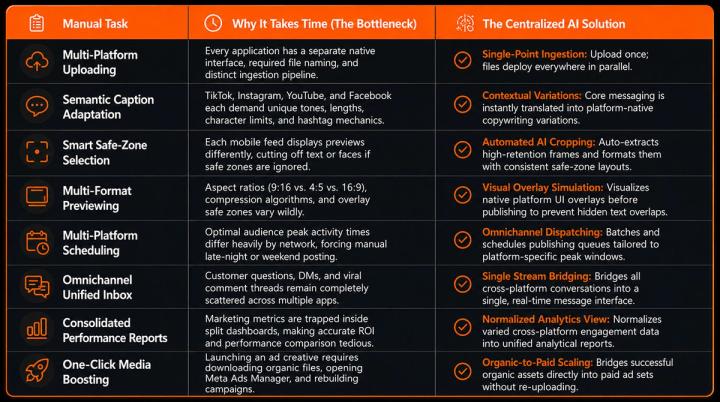
❓ Why Manual Video Publishing Takes So Much Time
Social media video publishing sounds like a simple two-step process: upload a video and click publish. In reality, the post-production workflow is heavily fragmented, creating hidden operational costs that drain hours from creative teams.
🔄 Build a Centralized Publishing Workflow
To stop losing hours to repetitive operational mechanics, social media operations must pivot from a linear, platform-by-platform routine to a hub-and-spoke centralized architecture.
The Fragmented Legacy Method: Upload to TikTok → Rewrite Caption → Select Cover → Log out → Upload to Instagram → Adjust Layout → Log out → Upload to YouTube Shorts → Manually check disconnected performance metrics → Open separate apps for Community Management.
The Centralized Workflow (vividspark.ai Architecture): Single Video Upload → AI Context-Aware Multi-Platform Processing (Captions, Covers, Ratios) → Unified Cross-Platform Scheduling → Omnichannel Engagement Handling → Centralized Cross-Channel Analytical Review.
By shifting to an automated hub like vividspark.ai, your operational overhead drops, allowing creators to allocate their energy toward visual storytelling, high-conversion script writing, and production quality rather than platform logistics.
🎨 Automate Covers and Thumbnails
Thumbnails and covers are the ultimate gatekeepers of CTR (Click-Through Rate). They determine whether a scrolling user stops, engages, or skips your video entirely.
According to YouTube’s Official Thumbnail Guidance, top-tier thumbnails must display clear composition, maintain strong visual contrast against dark/light interfaces, feature distinct branding or readable descriptive text, and align precisely with the specific expectations of the target demographic.
To bypass the need for tedious manual graphic design for every single video, adopt a highly structured, scalable layout standard:
- Hero Element Focus: Ensure a clear face, product silhouette, or high-motion key frame occupies the core focal zone.
- Text Optimization: Stick to 3–5 high-contrast, scalable words that remain perfectly legible on small mobile screens.
- Universal Safe-Zones: Avoid placing text in corners where native interface overlays (like TikTok’s side menu or Instagram's caption block) will obscure it.
- Visual Style Guide: Lock in a signature color palette, typography set, and brand template to preserve cross-platform consistency.
By establishing a standardized system, AI publishing engines like vividspark.ai can automatically isolate optimal video frames and apply uniform, safe-zone-compliant templates in seconds.
📝 Create Platform-Ready Captions Faster
Copywriting is a notorious manual time sink. A caption that sparks a viral conversation on TikTok often feels out of place or unsearchable on YouTube Shorts or Facebook Reels.
The smartest workflow involves feeding a core content prompt into an AI-assisted text engine and adapting the semantic tone across target feeds:
[Core Marketing Message]
├──> TikTok: Fast, informal, hook-heavy, native-sounding, trend-oriented.
├──> Instagram: Polished, visually clean, emoji-spaced, community-centric, clear CTA.
├──> YouTube Shorts: Clear, keyword-optimized, searchable, topic-focused.
└──> Facebook: Relatable, discussion-driven, shareable, conversion-focused.
TikTok’s Official Best Practices note that caption text and on-screen overlays should provide instant contextual clarity without overcrowding the screen space. By employing an intelligent, context-aware environment like vividspark.ai, marketing teams can generate tailored variations of publishing copy from a single source text, satisfying the unique SEO and formatting algorithms of every major network.
📅 Reduce Scheduling Guesswork
Manual, ad-hoc scheduling usually results in erratic, inconsistent publishing patterns. Content is often pushed out whenever editing finishes or when a team member finds a spare moment, rather than when the target audience is ready to consume it.
Automated scheduling transitions your content strategy from guesswork to data-backed distribution by tracking critical ecosystem queries:
- When is our cross-platform audience actively scrolling? Maximizes the critical early-hour engagement velocity that algorithms use to rank content.
- Which specific platform yields the highest ROI on given days? Prevents burying premium strategic videos under low-traffic periods.
- What type of video matches the user's intent at a specific hour? Align educational deep-dives or quick entertainment clips with morning commutes vs. evening browsing.
- Is our community management team available immediately after posting? Capitalizes on early comment momentum by responding to initial feedback within the first 30 minutes.
💬 Centralize Comments and Direct Messages
Publishing a short-form video is only half the battle; real audience conversion happens in the interactions that follow. When community feedback and inbound leads are scattered across independent mobile applications, brands face severe operational blind spots, frequently missing:
- High-intent sales inquiries from potential customers ready to convert.
- Product friction or negative feedback requiring immediate brand moderation.
- User-generated content (UGC) ideas hidden inside viewer suggestions.
- B2B partnership pitches or creator collaboration inquiries.
- Recurring customer objections that could easily inspire your next 3-part video series.
A unified, multi-platform inbox merges all inbound comments and direct messages into a single operational view. This significantly cuts manual response time and transforms community management into a data stream for future content planning.
📊 Combine Analytics into One Performance View
Reviewing marketing analytics platform by platform is a major operational bottleneck. Every network uses specialized terminology, mismatched time zones, and proprietary attribution models.
While Meta’s Business Help Center offers exceptional, granular ad insights directly inside Ads Manager to isolate video engagement metrics, scaling agencies need a side-by-side comparison that pits organic TikTok metrics directly against YouTube Shorts and Instagram Reels performance.
A modern, centralized reporting workflow normalizes data across networks to look at macro-trends:
CTR + Retention Rate = Algorithm Distribution Success
- Cross-Channel Views & Reach: Pinpoints which ecosystem is currently offering the highest organic amplification.
- Click-Through Rate (CTR): Evaluates the absolute visual strength of your automated covers and titles.
- Audience Retention & Watch Time: Flags the exact second viewers lose interest, mapping out content optimization areas.
- Shares & Relatability Index: Tracks how effectively your content encourages organic viral loops.
- Conversion & Cost Per Result (CPR): Connects top-of-funnel video reach directly to bottom-of-funnel business revenue.
💰 Connect Organic Publishing with Meta Promotion
In traditional, disjointed marketing setups, organic content creation and paid social advertising operate in complete silos. This disconnection leads to repetitive asset handling, slower turnarounds, and inefficient media spend based on pure assumptions rather data.
A high-efficiency, automated social media framework bridges these two channels instantly:
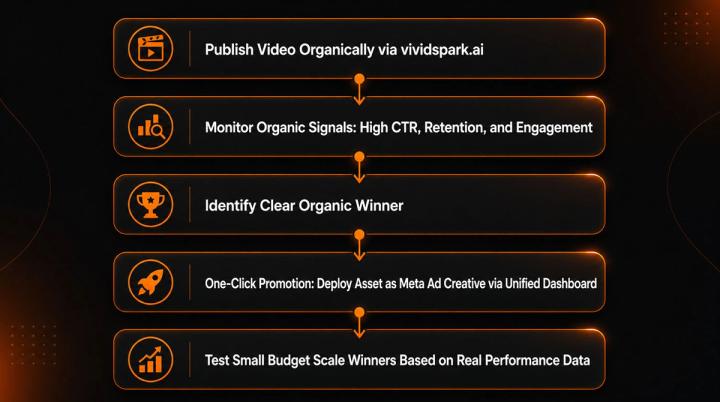
By unifying Meta campaign management with organic publishing workflows inside vividspark.ai, brands can test creatives in the organic wild for free, identify clear statistical winners, and scale them with paid ad budgets instantly, avoiding the need to manual export, re-upload, and rebuild campaigns inside separate ad managers.
☑️ Manual Work Reduction Checklist
Run your current video distribution architecture through this diagnostic checklist to uncover hidden operational inefficiencies:
- [01 ] Multi-Platform Uploading: Do we upload our video assets once to a centralized hub, or are we manually logging into individual accounts?
- [02] Semantic Caption Adaptation: Are we using AI to semantically adapt our core marketing messages for platform-native audiences, or rewriting copy from scratch?
- [03 ] Smart Safe-Zone Selection: Can we generate and format safe-zone-compliant thumbnails instantly, or are we manually cropping in separate design tools?
- [04 ] Multi-Platform Scheduling: Is our publishing schedule automated around historical cross-channel audience activity data?
- [05] Omnichannel Unified Inbox: Are all incoming comments and DMs routed to an omnichannel inbox, or are team members jumping between multiple apps?
- [06] Consolidated Performance Reports: Can we generate a unified cross-platform performance report in a single click?
- [07] One-Click Media Boosting: Can we transition an organic winner into a paid Meta campaign within our publishing dashboard?
- [08 ] Team Workflows: Does our system support multi-account access control, client brand segmentation, and team approval loops?
💡 FAQ
1. Why is manual video publishing inefficient for modern marketing teams? Manual publishing is highly inefficient because it forces creators and social media managers to repeat identical administrative tasks—uploading files, reformatting video aspect ratios, adapting copy, managing fragmented notifications, and consolidating metrics—individually across four or five distinct platforms, consuming valuable time that should be spent on high-level strategy and creative execution.
2. Can AI-powered social media video publishing tools replace actual creative work? No. Tools like vividspark.ai are designed to automate repetitive logistics—such as safe-zone adjustments, multi-destination dispatching, and cross-channel inbox aggregation. By taking over these operational tasks, the platform acts as an administrative copilot, allowing creative teams to devote 100% of their focus to storytelling, video editing, and relationship building.
3. Should every social media network share identical captions and thumbnails? Ideally, no. While your core message or campaign narrative remains the same, your distribution assets should adjust to platform behavior. The caption format, visual safe zones, and call-to-action placement must match the specific UI overlays and audience expectations unique to TikTok, Instagram, YouTube, and Facebook.
4. How does centralized data collection reduce social media workflow times? Centralized data eliminates the need to manually log into multiple individual analytics tools to extract and organize metrics. By normalizing various network metrics into a single dashboard, teams can instantly identify top-performing content, fine-tune publishing schedules, and replicate winning strategies without manual calculation.
5. How does vividspark.ai optimize the social media video publishing pipeline? vividspark.ai serves as an all-in-one AI workflow companion that enables teams to upload a video asset a single time, generate platform-compliant covers and copy variations, queue content across multiple social platforms simultaneously, monitor cross-channel engagement via a unified inbox, evaluate integrated analytics, and scale organic winners through direct Meta ad promotion.
✨ Conclusion
Minimizing manual work in social media video publishing goes far beyond saving a few hours each week—it is about establishing an optimized, highly scalable content infrastructure. Brands, agencies, and individual content creators cannot afford to burn their core creative energy on repetitive file uploads, manual copywriting tweaks, and disjointed analytics tracking.
The next phase of enterprise social media management relies on unified, data-informed, and automation-supported ecosystems. By synthesizing asset preparation, platform-specific publication, cross-channel interaction management, consolidated analytics, and paid media amplification into one cohesive pipeline, you free up your team to focus on what matters most: creating impactful content and cultivating deep audience relationships.
For growing operations scaling campaigns across TikTok, Instagram, YouTube, Facebook, and Meta Ads, vividspark.ai provides a direct path to eliminate operational friction and transform everyday video publishing into a streamlined growth engine.