⚡ Quick Answer
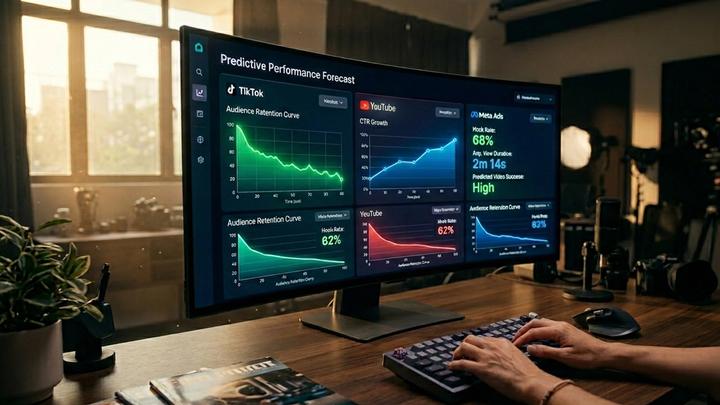
Predictive analytics for social media video performance means using historical, real-time, and multimodal AI data to forecast which videos, formats, topics, hooks, thumbnails, and paid campaigns are most likely to achieve maximum distribution and conversion in the future.
Instead of looking backward and asking, “How did this video perform?” predictive analytics empowers creators, brands, and agencies to look forward: “What specific content should we publish next, how should it be packaged, and which organic asset warrants ad spend to guarantee ROI?”
For modern digital marketing teams, performance is no longer driven by creative intuition alone. It depends on identifying repeatable algorithmic patterns across technical metrics like Impressions, Click-Through Rate (CTR), Hook Rate (3-second views), and Hold Rate (audience retention).
A centralized operational ecosystem like vividspark.ai bridges this gap by unifying automated asset creation (covers, captions) with cross-platform predictive analytics into a singular, data-driven feedback loop.
🎯 Why Predictive Analytics Matters for Video Marketing
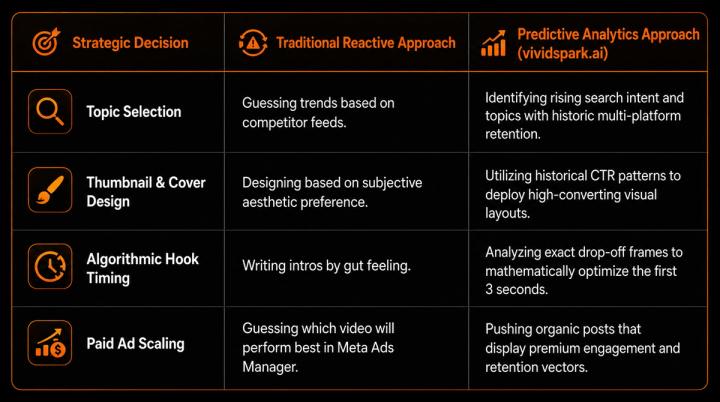
Traditional social media measurement relies entirely on Descriptive Analytics—it acts like a rearview mirror, showing you views and likes after the budget has been spent and the content is live.
Predictive Analytics, however, functions like radar. By processing early behavioral signals and cross-platform algorithmic historical data, it maps out the mathematical probability of a video's success before or immediately after it hits the feed.
📈 Key Metrics That Power Predictive Video Insights
Predictive models are only as good as the underlying data signals they ingest. To build an accurate forecasting engine, you must look past surface-level vanity metrics (like total views) and isolate the behavioral drivers that platforms use to trigger viral distribution.
1. Attracting the Click (The Package)
- Impressions: How often the platform's algorithm displayed the video to users. This measures organic reach velocity and systemic indexing.
- Click-Through Rate (CTR): The percentage of impressions that turn into views. YouTube's official analytics guidance highlights CTR and Impressions as intertwined metrics that reflect a video's fundamental "billboard" appeal.
2. Holding the Attention (The Content)
- Hook Rate (3-Second Video View Rate): The percentage of viewers who stay past the first 3 seconds. TikTok's official creative framework emphasizes that high resolution, native 9:16 vertical styling, and immediate value presentation directly predict an elevated Hook Rate.
- Hold Rate / Retention Curve: The exact percentage of viewers watching at any given second. Sudden drops reveal pacing errors, lack of narrative alignment, or audience boredom.
- Average View Duration (AVD): The absolute time spent on the video, heavily prioritized by algorithmic feeds on YouTube and Meta.
3. Fueling the Algorithm (The Interaction)
- Engagement Rate (Velocity-Based): The ratio of Likes, Saves, Shares, and Comments relative to total views.
- Comment Sentiment Score: Utilizing natural language processing (NLP) to detect whether viewer interactions are positive, negative, or signaling explicit purchase intent.
- Conversion Rate: The percentage of viewers taking a direct business action (clicking a link, downloading an asset, purchasing a product) driven by the video's Call to Action (CTA).
🧠 From Descriptive Analytics to Predictive Analytics
Understanding video data requires moving across three distinct analytical phases. Stopping at the first phase keeps your growth entirely accidental.
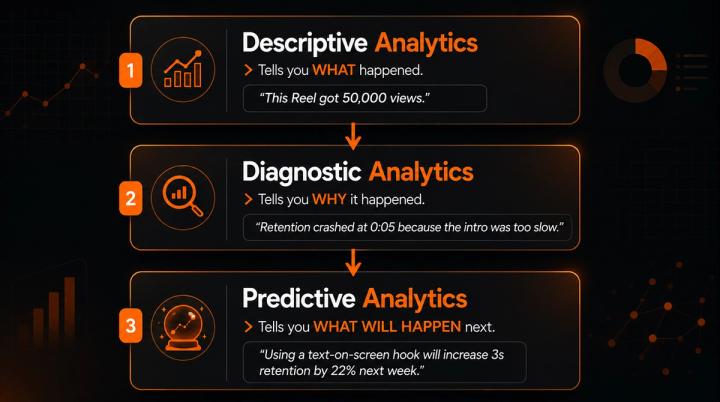
When you look at metrics in isolation, you get misleading data. True predictive analytics happens when you combine multiple data points to diagnose and forecast creative performance:
- High CTR + Low Retention Rate: ➔ The Diagnostic: The thumbnail and title (Packaging) were highly compelling, but the actual video content failed to deliver on the promise, triggering immediate audience drop-off. ➔ The Prediction: Future videos with this packaging format will eventually suffer from algorithmic suppression due to low user satisfaction.
- Low CTR + High Retention Rate: ➔ The Diagnostic: The video content itself is excellent and keeps viewers hooked, but the external cover, visual layout, and title are too weak to stop the scroll. ➔ The Prediction: Upgrading the thumbnail asset retroactively or on the next iteration will unlock massive, dormant viral potential.
- High Comments + Low Conversion Rate: ➔ The Diagnostic: The video topic successfully sparked community discussion, controversy, or emotion, but completely lacked a clear, frictionless transitional path to the commercial offer. ➔ The Prediction: Adding an explicit, high-intent call-to-action (CTA) or automated DM workflow will maximize revenue on the next upload.
🎬 Predicting Better Content Topics & Multi-Modal Formatting
Choosing video concepts based on instinct is a highly inefficient way to scale. Predictive topic selection relies on auditing audience retention and share data to discover what subjects inherently possess Auditory Narrative Value and Emotional Anchoring.
Look for these predictive performance signals across your content catalog:
- High Save Rates: Signals that the topic is perceived as an evergreen, high-utility resource that the user plans to reference later.
- High Share Rates: Indicates deep emotional resonance, strong relatability, or cultural alignment—meaning the user wants the video to represent their own identity to their peers.
- High Comment Depth: Indicates a complex, thought-provoking, or polarizing subject matter that naturally creates community engagement.
If analytics show that videos focusing on "Advanced Content Workflow Automation" generate a 40% higher Save-to-View ratio than videos regarding "General Marketing Tips," the prediction is clear. Your upcoming production cycle should completely phase out generalized overviews and lean heavily into highly technical, step-by-step systemic guides.
🖼️ Predictive Creative Optimization: Covers, Captions, and Hooks
Video optimization extends far beyond the video file itself. Multi-platform success requires precise execution of the secondary creative elements that frame your content. By leveraging modern AI tools, you can predictively optimize your visual and textual wrappers before publishing.
📊 Creative Framework Optimization
- Thumbnails & Covers: What visual layouts, face expressions, color contrasts, or text placements consistently yield higher platform CTRs?
- The First 3 Seconds: What hook variations—visual patterns, instant text overlays, kinetic typography, or immediate audio cues—effectively minimize early user drop-off?
- Caption Structuring: Do long-form storytelling captions drive deeper engagement on Instagram, or do short, keyword-dense captions maximize search indexing on TikTok?
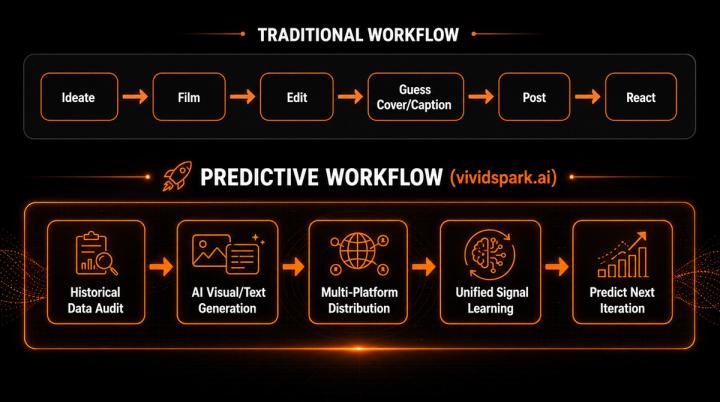
By transitioning to vividspark.ai, creative teams remove the guesswork from asset packaging. The platform dynamically generates data-optimized video covers and platform-specific caption copy, enabling teams to compare, deploy, and evaluate what specific creative combinations win the scroll across every key algorithm.
⏰ Predicting the Best Posting Times via Behavioral Data
Relying on generic internet infographics for the "best time to post" ignores your brand’s actual demographic footprint. True predictive timing analyzes your unique historical data to map out when your target audience transitions from passive scrolling to active interaction.
Through continuous data logging, clear platform-specific behaviors emerge:
- TikTok: High immediate watch time and engagement velocity often spike in the late evening (8 p.m. – 11 p.m.), meaning posting 1 hour prior maximizes early feed push.
- Instagram Reels: Educational, value-heavy infographics and videos see massive Save Rates during midday lunch hours (12 p.m. – 2 p.m.).
- YouTube Shorts: Longer, storytelling-based vertical videos achieve far superior Average View Durations when published ahead of weekend leisure hours (Friday afternoon through Sunday).
- Facebook: Discussion-driven community content achieves its highest comment velocity during standard weekday afternoon downtime.
The goal is not simply to publish when people are online; it is to introduce your content at the exact moment your audience is in the correct psychological state to consume, engage, and convert.
💰 Scaling Organic Data into Meta Ads Predictive ROI
Paid social media advertising should never be a guessing game. Instead of building ad creative from scratch and hoping for a positive return on ad spend (ROAS), brands can utilize organic performance metrics as a predictive testing ground for paid acquisition.
Before allocating ad budget inside Meta Ads Manager or TikTok For Business, look for the following elite organic indicators:
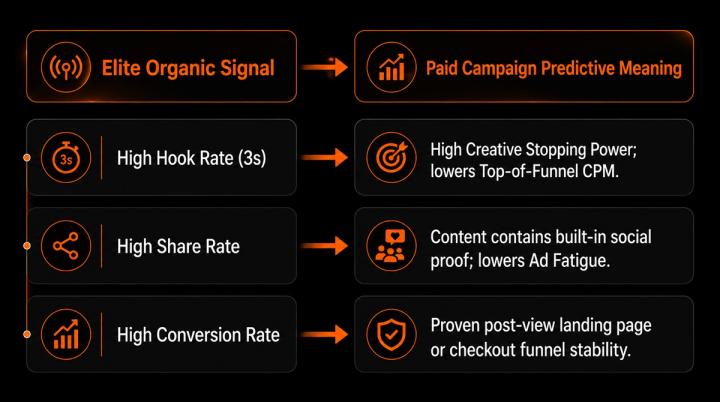
Meta’s Business Help Center explicitly stresses the utilization of deep video engagement metrics to evaluate creative efficiency. When an organic video naturally outperforms your account's average metrics, it sends a strong signal to your team. Promoting that specific asset via automated paid campaigns eliminates testing waste, ensures predictable customer acquisition costs (CAC), and protects your marketing margins.
🔁 The Continuous Predictive Analytics Loop
To turn video data into predictable platform growth, marketing teams should install this cyclical operational workflow every single week:
1.Multi-Platform Distribution:
Step 1
Simultaneously publish your video assets across TikTok, Instagram, YouTube, and Facebook using platform-optimized wrappers.
2.Isolate Key Behavioral Signals:
Step 2
Extract your core data pillars: look past simple view counts and measure exact CTR, Hook Rate, Hold Rate, and Save-to-View ratios.
3.Perform Diagnostic Parsing:
Step 3
Identify performance outliers. Pinpoint exactly where drop-offs occurred and determine which visual cover variations caused spikes in CTR.
4.Analyze Cross-Platform Variances:
Step 4
Evaluate how the same video performed across different algorithmic environments to understand platform-specific audience sentiment.
5.Mine Community Input via Centralized Inbox:
Step 5
Utilize natural language parsing across all platform comments and DMs to identify content requests, product objections, and future video topics.
6.Deploy Paid Amplification:
Step 6
Identify your top-performing organic assets and seamlessly transition them into Meta and TikTok ad campaigns with predictable ROI.
7.Predict Next Week's Creative Blueprint:
Step 7
Lock in next week’s production schedule using proven topics, hooks, visual styles, and posting times derived from this week's data.
❓ FAQ
1. How do I use data to predict if a short video will go viral?
To accurately forecast a video's viral potential, you must isolate the interplay between its Hook Rate (3-second view velocity) and its Hold Rate (retention curve geometry). If your content retains over 60% of viewers past the first 3 seconds, and the overall Average View Duration (AVD) significantly exceeds your channel's historical baseline, the platform's algorithm will automatically trigger broader distribution phases. When paired with a high-CTR visual cover, these specific real-time signals serve as the strongest leading indicators of algorithmic virality.
2. Is predictive video analytics reserved only for large brands with massive budgets?
Not at all. Digital creators, scaling agencies, and small business owners can easily deploy predictive analytics without enterprise-level overhead. The process simply requires moving past surface-level vanity metrics. By consistently auditing your unique retention drops, Save rates, and thumbnail Click-Through Rates (CTR), you build your own forecasting framework. The goal is structural optimization—using the data from your previous upload to mathematically engineer the script structure of your next video.
3. Which precise metrics are most critical for predicting business conversions?
For e-commerce, B2B lead generation, and direct response marketing, Save-to-View Ratios and High-Intent Comment Density are the primary predictive vectors. A high save rate indicates that the viewer perceives the video as a premium, high-utility asset worth returning to, which strongly correlates with deep purchase intent. Furthermore, utilizing natural language processing (NLP) to track the velocity of comments asking specific logistical questions (e.g., "How do I onboard?", "What is the pricing setup?", "Does this support integration?") allows you to accurately forecast downstream sales revenue.
4. Can predictive analytics guarantee a 100% success rate for every single upload?
No. Predictive analytics cannot completely eliminate the inherent variance of social media algorithms. Real-time trend shifts, sudden macroeconomic events, platform updates, and immediate competitive saturation will always introduce external anomalies into the feed. However, what predictive modeling does guarantee is a significantly elevated performance floor and a drastically higher statistical probability of success. It transitions your production workflow from speculative guesswork to a highly repeatable creative science.
5. How exactly does vividspark.ai empower creators to leverage predictive data?
vividspark.ai functions as an all-in-one media orchestration engine that seamlessly bridges the gap between asset creation and algorithmic feedback. Instead of manually parsing disparate data metrics across four separate platform dashboards, the platform unifies your multi-platform publishing, AI-generated covers, and structured caption variants into a single analytical command center. By continuously mapping consumer engagement, comment intent, and retention anomalies back to your creative assets, vividspark.ai automatically reveals the precise algorithmic variables driving your growth, allowing you to instantly turn technical insights into your next high-converting creative decisions.
✨ Conclusion
Predictive analytics represents the inevitable evolution of social media video marketing. Relying purely on speculative trends, chaotic uploading schedules, or erratic creative whims is a strategy designed for stagnation. To unlock reliable, hyper-scalable growth across modern channels, you must master the art of deciphering what your platform performance signals are already trying to tell you.
The most resilient video strategies of 2026 are born at the intersection of cultural creativity and structural analytical rigor. By unifying multi-platform feedback loops—CTR, Hook Rate, retention geometry, comment sentiment, and paid performance—you equip your marketing team with a blueprint for repeatable virality.
For forward-thinking content production teams, brands, and agencies optimizing their positioning on TikTok, Instagram, YouTube, and Facebook, integrating a cohesive toolset like vividspark.ai transforms predictive analysis from a complex mathematical luxury into an effortless, everyday operational advantage. In the modern content landscape, long-term audience dominance belongs to those who do more than just publish. It belongs to the teams that systematically learn from every individual frame and convert those analytics into smarter creative decisions.