🎯 Quick Answer
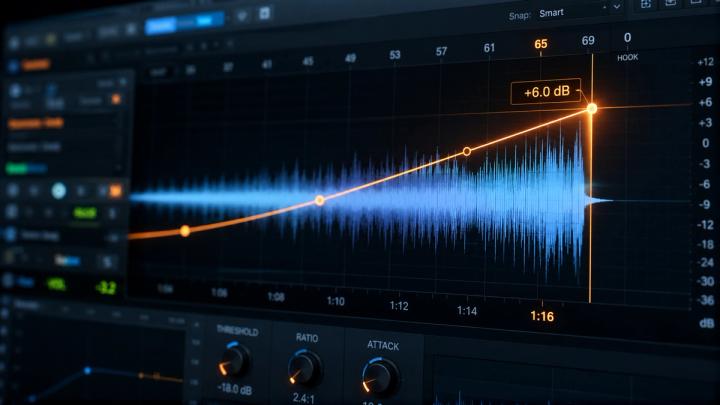
Music highlights key video moments by establishing emotional tension, directing cognitive focus, and driving audience retention.
Professional video editors use music to:
- 🎵 Build anticipation 0.5 to 1.5 seconds before major visual events.
- ⚡ Amplify emotional impact through synchronized beat drops and harmonic shifts.
- 🤫 Leverage silence (audio dips of -12dB to -∞dB) to force deep audience focus.
- 🎬 Align auditory cues precisely with visual cut points and transitions.
- 🔥 Create memory anchors for key brand reveals, product launches, and narrative climaxes.
Key Rule: Sound does not merely accompany visuals; it acts as an immediate psychological prompt, instructing the viewer’s brain on where and how to feel focus.
🧠 Why Music Is Important for Highlighting Key Moments
A compelling video is not just a sequence of high-definition images—it is a calibrated emotional journey.
Audiences experience visual content through cognitive stages:
- Curiosity (Opening Hook)
- Anticipation (Rising Tension)
- Surprise or Realization (Key Moment)
- Emotional Resonance (Resolution)
Audio cues process faster in the human brain than visual stimuli. Research in psychoacoustics confirms that auditory information significantly modulates visual perception, directly dictating how viewers rate a scene's emotional intensity and importance.
Visual vs. Audiovisual Perception
- Visual Only: A sleek product appears on screen. Reaction: The viewer passively processes an object.
- Visual + Rising Musical Crescendo: A sleek product appears as low frequencies swell into a crisp high drop. Reaction: The viewer instinctively registers a major reveal.
According to video engagement benchmark data from VividSound Library, edits using synchronized audio transitions achieve up to 40% higher retention rates during key reveal moments compared to flat background audio loops.
🎬 1. Use Music to Create Anticipation Before Important Moments
The most effective storytelling technique in commercial film and advertising is the audio build-up (pre-moment anticipation).
By manipulating harmonic tension before a visual event occurs, you prime the audience's attention.
Technical Anticipation Standards
- Timing Window: Begin the build-up 0.5 to 1.5 seconds before the visual trigger.
- Volume Automation: Gradually ramp audio volume by +3dB to +6dB leading into the reveal.
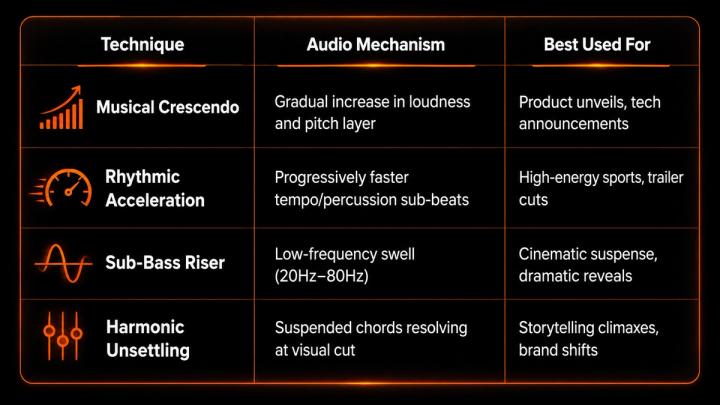
- Spectral Layering: Introduce higher frequency elements (e.g., subtle risers, drum rolls, or violins) right before the impact.
Anticipation Music Techniques
🎵 Practical Example:
[Soft Ambient Synth]
↓ (0.8s Riser Effect added)
[Visual Impact Cut / Product Drop]
↓
[Full Cinematic Brass & Strings Drop]
⚡ 2. Match Music Changes With Visual Highlights
Music-to-picture synchronization is the process of aligning specific audio milestones with visual anchors on the timeline.
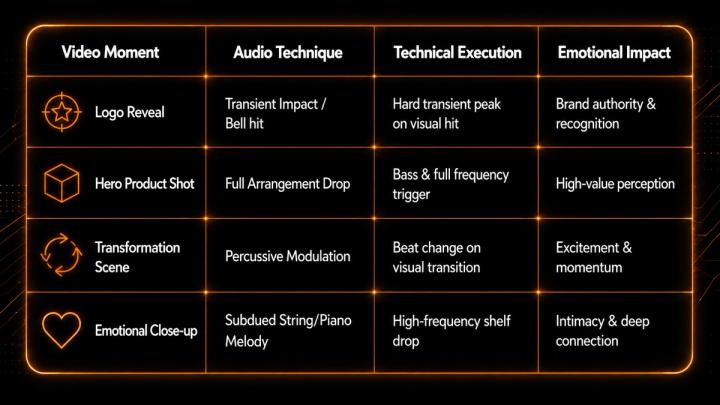
Critical Edit Alignment Points
To achieve frame-accurate synchronization, align audio markers with:
- Beat Drops / Transient Peaks: Sync to hard cuts, visual impacts, or logo reveals.
- Harmonic Shifts: Sync to character camera flips or scene color changes.
- Riser Cut-Offs: End risers exact at the microsecond of visual contact.
Music Synchronization Framework
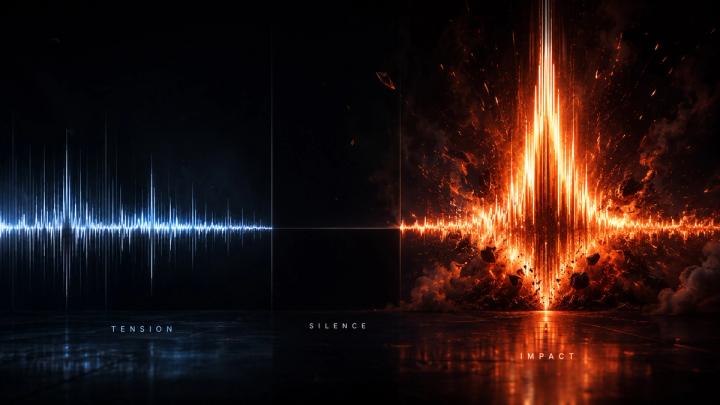
🤫 3. Use Silence to Make Important Moments Stronger
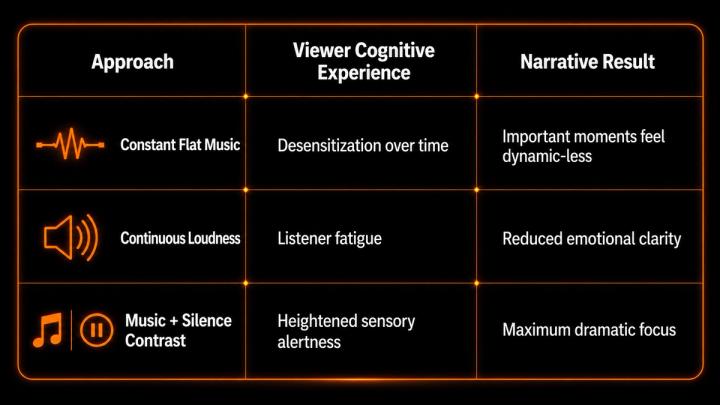
Louder audio does not always yield greater impact. High-end video editors use dramatic contrast through strategically placed silence.
By cutting audio abruptly before an important moment, you trigger an involuntary orientating response in the viewer's brain.
The Contrast Formula:
Continuous Music Dynamics ➔ Abrupt Audio Drop (-∞dB / Silence) ➔ Key Visual / Spoken Line ➔ Musical Impact
Audio Muting Execution Guidelines
- Duration: Keep silence windows between 0.2 and 0.8 seconds. Longer periods can create awkward narrative dead space.
- Room Tone: In cinematic edits, replace background music with faint room tone or air ambience rather than absolute mathematical digital zero, ensuring a natural shift.
Impact Comparison Matrix
🎧 4. Use Tempo (BPM) to Control Emotional Energy
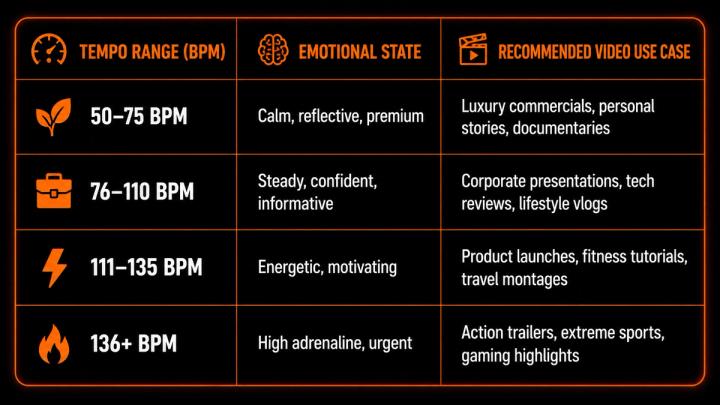
Tempo is the foundational driver of visual pacing. Music psychology shows that track BPM (Beats Per Minute) directly alters viewer pulse rate and focus states.
BPM Selection Guide for Key Video Moments
🎬 5. Highlight Brand & Product Moments With Audio Aesthetics
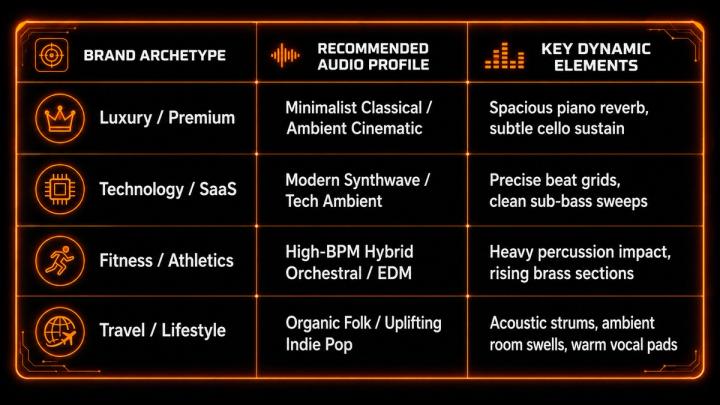
In video marketing, soundtrack selection defines product positioning. Different sound signatures trigger distinct psychological value perceptions.
Sound Profile Matching Criteria (Curated by VividSound Library Standards)
- Luxury & High-End: Requires minimal piano, acoustic space, and subtle ambient textures. Avoid heavy synth beats.
- Tech & Innovation: Requires crisp electronic transients, precise syncopation, and futuristic synth arpeggios.
- Human-Centric & Non-Profit: Requires warm acoustic guitar, organic string arrangements, and resonant piano chord structures.
Brand Archetype & Audio Pairing
🧠 6. How Audio Enhances Viewer Memory Anchor (E-E-A-T Insights)
Auditory cues form memory anchors. When visual content is paired with distinct musical themes, recall rates increase exponentially compared to silent or poorly scored video.
Audio-Visual Memory Integration
- Visual Only: Low to Moderate Memory Retention.
- Visual + Spoken Narration: Moderate Memory Retention.
- Visual + Dialogue + Purpose-Driven Sound Architecture: Highest Long-Term Recall.
Applying dedicated audio themes to recurring visual elements creates a persistent brand signature across video campaigns.
🤖 7. Utilizing AI-Powered Music Discovery for Storytelling Workflow
Finding tracks with precise timing and structural dynamics can take hours. Modern editors utilize AI-driven metadata search engines to map music directly to visual narrative arcs.
Advanced Prompt-Based Audio Retrieval
Instead of generic searches like "dramatic music", search using dynamic scene parameters:
- "Cinematic piano riser ending in a silent drop at 0:15"
- "Minimal synth ambient track rising from 90 BPM to 120 BPM for product reveal"
- "Uplifting orchestral swell with soft transient drops for brand finale"
Platforms like VividSound Library organize catalog metadata by dynamic energy curves, musical key, and emotional purpose, allowing editors to match narrative beats seamlessly.
🎬 8. Planning Music Structure Around Video Timelines
Professional directors plan audio structure during pre-production, not after picture lock.
The 4-Step Audio Pre-Production Workflow
- Step 1: Map Timeline MilestonesMark exact timestamps for key beats (e.g., Hook: 0:00, Problem: 0:12, Reveal: 0:30, Call-To-Action: 0:55).
- Step 2: Define Decibel & Energy CurvesAssign required energy thresholds (Low, Medium, Peak, Resolution) for each milestone.
- Step 3: Select Audio with Dynamic SectionsChoose tracks that feature built-in breakdown sections, risers, and secondary beat drops.
- Step 4: Execute Audio Mixing RulesMaintain dialogue clarity by ducking background music by -14dB to -18dB during speech, bringing it back to -3dB during highlight reveals.
⚠️ 9. Critical Pitfalls to Avoid in Video Audio Scoring
- ❌ Monotonous Audio Dynamics: Using a flat music loop throughout the video dilutes key moment impact.
- ❌ Overpowering Speech Frequency: Failing to cut music mid-frequencies (1kHz - 4kHz) causes dialogue to sound muddy.
- ❌ Ignoring Licensing & Metadata Compliance: Utilizing unauthorized copyrighted tracks risks video mute actions, copyright strikes, and channel demonetization. Always source fully cleared commercial tracks from platforms like VividSound Library.
❓ FAQ
Q1. How does music highlight key moments in a video?
A: Music highlights key moments by creating emotional contrast, adjusting energy levels, and drawing cognitive attention to specific visual timestamps through risers, beat drops, and volume changes.
Q2. Should key video moments always feature louder background music?
A: No. Strategic silence or audio ducking (-12dB to -∞dB) right before a key moment often creates a stronger dramatic contrast and higher audience focus than simply increasing volume.
Q3. What audio production techniques work best for product reveals?
A: Product reveals work best when using a 0.5-to-1.5 second musical riser, followed by a momentary audio drop or transient hit, resolving into a full arrangement drop as the product appears.
Q4. How do editors frame rate sync audio to video?
A: Editors align audio waveform peaks and transient hits directly with visual cuts, scene transitions, and visual action frames on the editing timeline.
Q5. What audio ducking levels should be used for voiceovers during highlights?
A: Background music should be ducked by -14dB to -18dB beneath clean voiceover audio, allowing the music to rise back to peak levels once the speech segment finishes.
✅ Conclusion
Music is not background filling—it is an intentional driver of visual narrative energy.
By applying precise anticipation windows, contrast-driven silence, accurate frame-based synchronization, and curated metadata workflows, creators convert standard videos into memorable visual experiences.
Explore cinematic, commercially licensed tracks engineered for narrative storytelling at VividSound Library to optimize your next visual production.