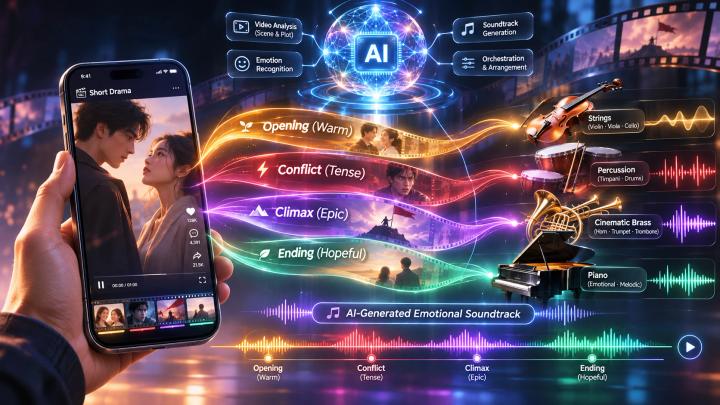
⚡ Quick Answer
To create an emotionally engaging soundtrack for a short-form drama, match background music to the story's emotional progression rather than using one continuous track throughout the entire episode.
Music should support different narrative moments, including:
- Character introductions and opening hooks.
- Emotional conversations and relationship development.
- Conflicts, suspense, and unexpected discoveries.
- Dramatic twists and major reveals.
- Climactic confrontations and emotional resolutions.
An effective soundtrack workflow follows this structure:
Understand the Story → Identify Scene Changes → Match Music to Each Scene → Review → Refine Individual Sections
For example, a short drama might begin with soft emotional music, move into suspenseful music during a conflict, and use a more powerful cinematic track for its final reveal.
The key principle is:
Music should follow the emotional journey of the characters, not simply the length of the video.
🎭 1. Why Background Music Matters So Much in Short-Form Drama
Short-form dramas have a different storytelling structure from ordinary lifestyle videos or travel vlogs.
They often need to establish a character, introduce a conflict, create emotional tension, and deliver a meaningful twist within a relatively short period.
Every scene has a specific narrative purpose.
For example:
- An opening scene introduces the protagonist and their situation.
- A conversation reveals hidden information.
- A confrontation increases emotional tension.
- An unexpected discovery changes the direction of the story.
- The ending delivers a dramatic or emotional payoff.
Music helps connect these moments.
Without appropriate music, a confrontation may feel less intense, a romantic scene may lack emotional warmth, and an important reveal may not receive enough emphasis.
A soundtrack should not simply make every scene sound dramatic. It should help distinguish the emotional importance of different moments.
🎬 2. What Should Music Match in a Short Drama?
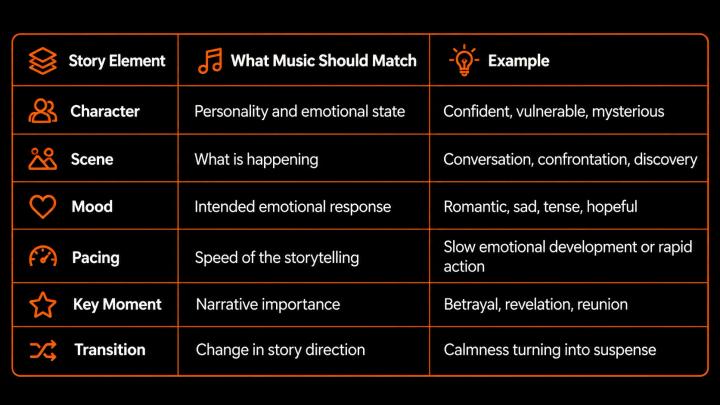
Choosing the right soundtrack requires understanding several elements of the story.
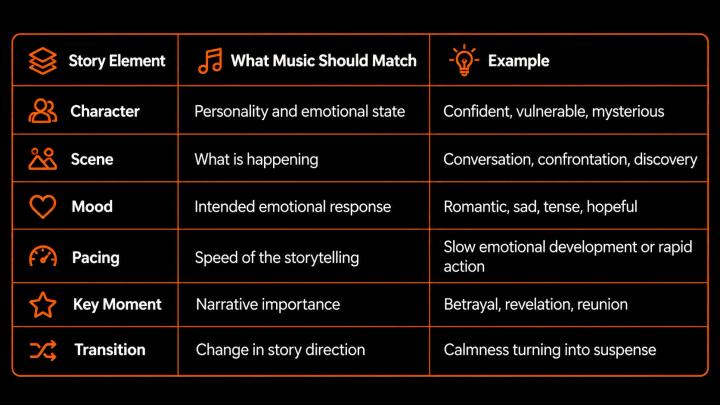
Consider a scene where a woman discovers that someone close to her has been hiding an important secret.
The visual action may be relatively simple: she reads a message, looks up, and realizes something is wrong.
However, the emotional meaning is significant.
A subtle suspenseful soundtrack may be more effective than immediately introducing loud dramatic music.
The best music reflects what the scene means, not just what the camera shows.
🎵 3. How to Match Music to Different Stages of a Short Drama
A useful way to design a short drama soundtrack is to follow its narrative progression.
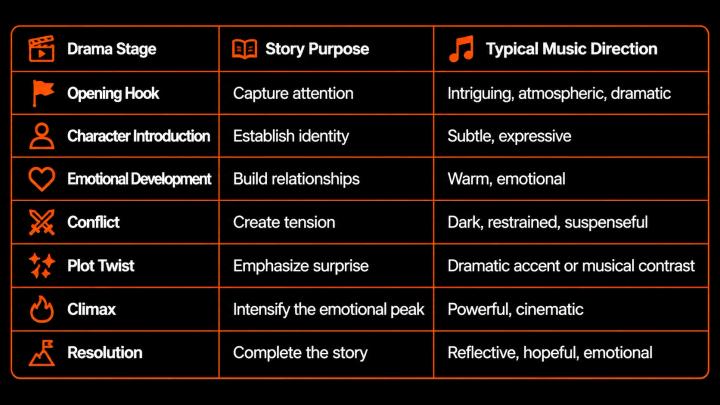
These are creative starting points rather than fixed rules.
A romantic short drama may use gentle piano during a character introduction, while a crime thriller may need darker atmospheric music from the beginning.
The important consideration is whether the soundtrack supports the specific story.
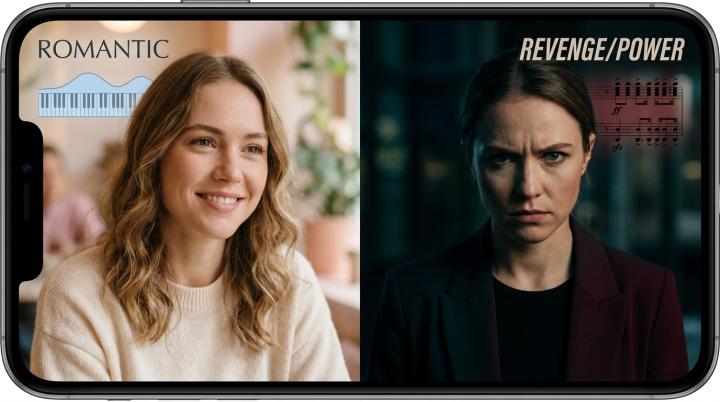
🎬 Example: A Romantic Revenge Drama
Imagine a short drama about a woman who discovers that her fiancé has betrayed her.
Scene 1 — The Relationship
Warm piano establishes the romantic atmosphere.
Scene 2 — The Discovery
The music becomes quieter and more restrained as she discovers the betrayal.
Scene 3 — The Confrontation
Suspenseful music gradually increases tension.
Scene 4 — The Revelation
A stronger cinematic musical moment emphasizes the unexpected truth.
Scene 5 — The Final Decision
The soundtrack becomes more emotional and empowering as the protagonist takes control of her future.
This progression helps the audience experience the changing emotional direction of the story.
❤️ 4. Why Emotional Transitions Matter More Than Simply Choosing Dramatic Music
One common mistake in short drama production is using overly dramatic music throughout the entire episode.
If every scene sounds intense, the audience may lose the ability to distinguish between ordinary moments and important narrative events.
Emotional contrast is essential.
For example:
- Quietness can make the next confrontation feel more powerful.
- Gentle music can make a sudden betrayal more emotionally effective.
- Restrained suspense can make an unexpected reveal more impactful.
- A warm ending can create a stronger sense of resolution after conflict.
A useful soundtrack structure is:
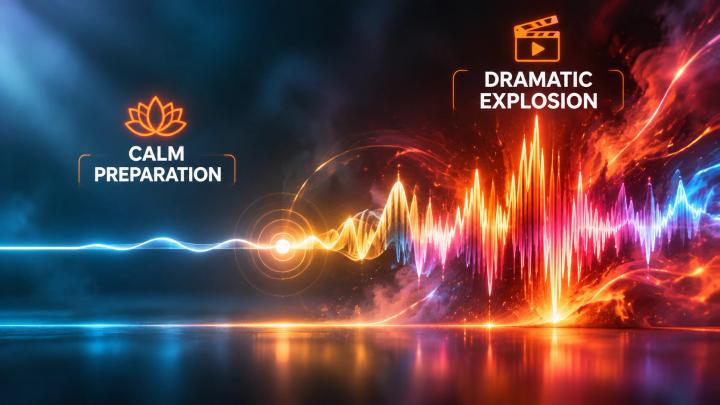
Calm → Emotional Development → Tension → Climax → Resolution
The music should rise and fall with the story.
Not every scene needs a different song, either. Some connected scenes may share a musical atmosphere to maintain continuity.
The objective is to create emotional progression rather than constant musical intensity.
🔬 5. The Science Behind Music and Emotional Engagement in Short Videos
The relationship between music, visual storytelling, and audience engagement is supported by academic research.
A particularly relevant study published in 2025 in the Journal of Theoretical and Applied Electronic Commerce Research examined the interaction between auditory emotional arousal, visual variation, and audiovisual congruence in short-video marketing.
The researchers analyzed 12,842 short videos from Douyin, combining text analysis, sound recognition, and image processing.
The study reported three important findings:
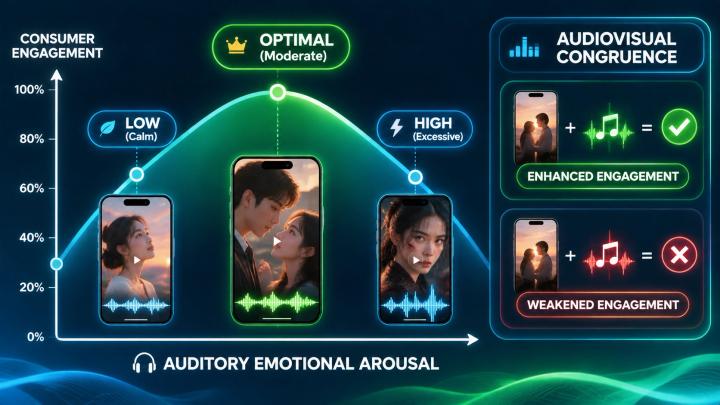
1. Emotional arousal follows an inverted U-shaped relationship with engagement.
Moderate auditory emotional arousal was associated with stronger consumer engagement, while excessively high or low arousal was associated with weaker engagement.
2. Visual variation was positively associated with engagement.
Videos with greater visual variation tended to receive stronger audience interaction in the study.
3. Audiovisual congruence enhanced engagement.
Greater alignment between sound and visual characteristics was associated with better information processing and audience engagement.
This research offers an important insight for short-form drama creators.
More dramatic music is not necessarily better. The emotional intensity of the soundtrack should be appropriate for the visual scene.
For example, using extremely intense music during an ordinary conversation may create unnecessary emotional pressure. A more restrained soundtrack can allow the actual dramatic moment to have greater impact.
Another systematic review published in Psychology of Music examined 24 empirical studies on how music communicates meaning in films.
The review found that music can influence how audiences perceive and interpret film plots and protagonists.
Source: On Music's Potential to Convey Meaning in Film: A Systematic Review of Empirical Evidence.
Together, these findings support a practical approach:
- Match music to the emotional meaning of the scene.
- Use contrast to distinguish important moments.
- Avoid excessive musical intensity.
- Let the soundtrack evolve with the narrative.
These studies do not establish that AI soundtrack matching automatically increases views, retention, or paid episode conversions. They provide a scientific foundation for designing more coherent audiovisual storytelling.
🎞️ 6. Why One Music Track Is Not Enough for Every Drama Scene
A short drama may contain several different emotional situations within just a few minutes.
Using one continuous song can create problems:
- The soundtrack becomes repetitive.
- Emotional transitions feel less distinct.
- Important plot twists receive insufficient emphasis.
- Dialogue-heavy scenes become unnecessarily dramatic.
- The climax may not feel different from the opening.
A scene-based soundtrack provides more flexibility.
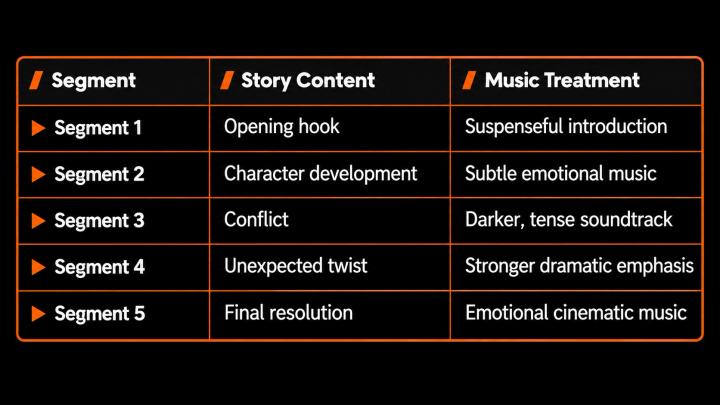
Different segments do not always require completely different songs.
Related scenes can use similar musical styles, while important narrative changes can introduce a new musical direction.
The goal is to make the soundtrack feel like one coherent story rather than a collection of unrelated background tracks.
⏱️ 7. How Scene Duration and Music Timing Influence Drama
Music selection is only part of the soundtrack process. Scene duration also matters.
Consider a short confrontation:
If the scene is too short, the audience may not have enough time to understand the emotional conflict.
If it is too long, the tension may lose its momentum.
The soundtrack should develop alongside the scene.
A useful editing principle is:
Do not shorten a meaningful scene simply to fit the music. Adjust the soundtrack to support the scene's storytelling needs.
When a particular segment needs more time for dialogue or emotional development, its duration can be reviewed as part of the overall editing process.
🎼 8. How to Choose Music for Different Short Drama Genres
Different drama genres require different musical approaches.
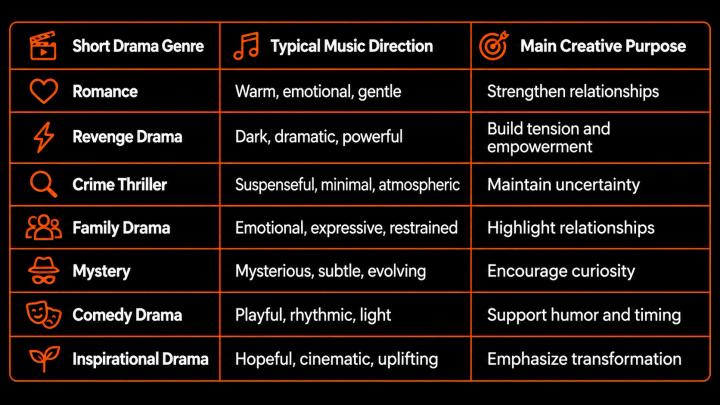
These are not absolute rules.
A romantic story can contain suspenseful music, and a revenge drama may need quiet emotional piano during its most vulnerable moments.
The actual scenes should always determine the final music choices.
🌎 9. Why Soundtrack Quality Matters in the Growing Video Market
Short-form video is an important part of the wider digital content industry.
According to Wyzowl's Video Marketing Statistics 2026, based on a survey of 266 marketers and consumers conducted in late 2025:
- 91% of businesses use video as a marketing tool.
- 93% of video marketers consider video an important part of their strategy.
- 63% of video marketers have used AI tools to create or edit videos, up from 51% in the previous year.
These statistics do not specifically measure short-form drama production or soundtrack performance.
However, they demonstrate the growing importance of video and AI-assisted production.
A reasonable production inference is that as creators and studios produce more short-form content, manually selecting and arranging music for every scene becomes increasingly repetitive.
Automating video segmentation and music matching can help production teams spend more time on storytelling, character development, and creative review.
🎬 10. How Scene-Based Music Matching Works for Short Dramas
A content-aware soundtrack workflow begins by understanding the completed video.
The process can be divided into five stages.
1. Analyze the Video
Examine the video's content, actions, visual changes, and narrative progression.
2. Segment the Scenes
Divide the video into multiple sections according to its content.
3. Understand Each Segment
Identify the emotional direction, pacing, and storytelling purpose of each section.
4. Match Original Music
Select suitable existing music for each segment according to its content and emotional requirements.
5. Review and Refine
Identify sections that need a different musical direction and request targeted replacements.
This approach changes the starting point of soundtrack creation.
Instead of asking creators to search for music before understanding the video, the system first analyzes the story and then matches music to its different sections.
🚀 11. How VividSpark Helps Create Emotionally Engaging Short Drama Soundtracks
For short drama creators, one of the most time-consuming tasks is finding music that fits every emotional transition.
A single episode may contain romantic moments, misunderstandings, confrontations, unexpected discoveries, and dramatic endings.
Finding separate tracks for every section manually can become a repetitive process.
This is where VividSpark AI Soundtrack provides a more structured approach.
Rather than asking creators to manually divide their videos and search for individual songs, VividSpark analyzes uploaded videos and automatically divides them into multiple segments.
It then matches existing original music from VividSpark's own music library to the different sections.
🎬 01Automatic Video Segmentation
Upload a completed short drama episode, and AI analyzes its content before dividing it into multiple segments.
This provides a structured starting point for matching music to character introductions, emotional development, conflicts, and dramatic turning points.
🎵 02 Original Music Matching for Each Segment
Different segments receive music matched to their content and emotional direction.
VividSpark selects existing original tracks from its own music library rather than generating new songs from scratch.
✏️03 Replace Music for a Specific Segment Using Prompts
The initial music match may not always reflect the creator's exact creative intention.
If one section feels too dramatic, too emotional, or insufficiently suspenseful, creators can specify its segment number through a natural-language prompt.
For example:
- "Replace segment 2 with softer romantic piano music."
- "Change segment 3 to a darker and more suspenseful soundtrack."
- "Replace segment 4 with a powerful cinematic track for the dramatic reveal."
- "Make the music in segment 5 more emotional and hopeful."
VividSpark identifies the specified segment and matches replacement music from its own original music library.
This allows creators to refine individual scenes without manually searching for alternative tracks or rebuilding the entire soundtrack.
🎧 04 Preview the Complete Drama Soundtrack
After replacing tracks or adjusting segment durations, review the complete video.
Check whether:
- Character introductions feel appropriate.
- Emotional scenes have the right musical atmosphere.
- Suspense develops naturally.
- Dramatic twists receive enough emphasis.
- Dialogue remains clear.
- The ending provides an appropriate emotional resolution.
🔄 05 Remove or Replace Existing Background Music
VividSpark AI Soundtrack also supports removing or replacing existing background music and detecting potentially copyrighted music.
This is particularly useful when creators already have a completed drama episode but want to replace its original soundtrack before publishing.
VividSpark's music library contains original music with commercial licensing. Creators should select the applicable licensing option according to their intended use.
Explore the dedicated short drama page: VividSpark — Music for Short Dramas.
Learn more about the soundtrack workflow: VividSpark AI Soundtrack.
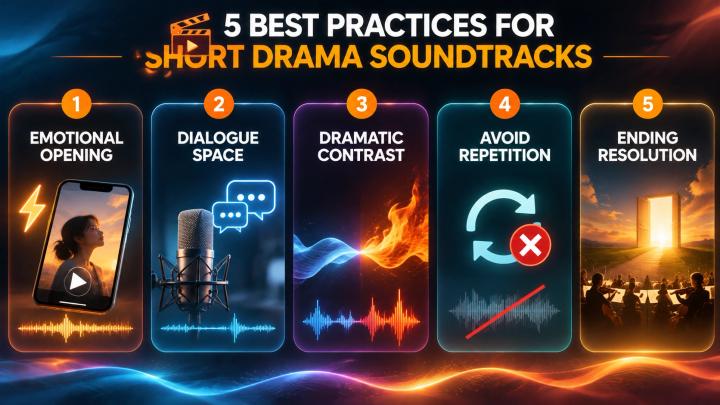
💡 12. Five Best Practices for Better Short Drama Soundtracks
1. Make the Opening Emotionally Clear
The opening should establish the atmosphere and create curiosity. Avoid using overly intense music if the story needs a gradual emotional build.
2. Give Important Dialogue Enough Space
Music should support conversations rather than compete with them. Some emotionally important scenes may benefit from quieter music or no background music.
3. Use Contrast to Strengthen Dramatic Twists
A sudden change in musical atmosphere can help distinguish a major reveal from ordinary story development.
4. Avoid Excessive Musical Changes
Too many different tracks can make a short drama feel fragmented. Maintain musical continuity across related scenes.
5. Let the Ending Resolve Emotionally
The final soundtrack should reflect what the character has experienced and what the story wants the audience to remember.
❓ FAQ
01 How do you create an emotionally engaging soundtrack for a short-form drama?
Start by dividing the story into meaningful scenes, identifying the emotional purpose of each section, and matching music to its narrative role. Use different musical directions for character introductions, conflicts, plot twists, climaxes, and resolutions.
02What music works best for short drama videos?
It depends on the genre and scene. Romantic dramas often use warm piano and gentle strings, revenge stories may use darker cinematic music, and suspense dramas often benefit from restrained atmospheric soundtracks.
03Does VividSpark generate new music for each drama scene?
No. VividSpark AI Soundtrack selects existing original tracks from VividSpark's own music library. It matches and replaces music according to the content and emotional direction of each segment rather than generating a new song every time.
04 Can AI soundtrack matching preserve dialogue in short drama videos?
The soundtrack workflow is designed to preserve important original audio, including dialogue and ambient sounds, while adding or replacing background music. Creators should preview the processed video to confirm speech clarity.
05Can I remove potentially copyrighted music from an existing short drama episode?
VividSpark AI Soundtrack supports removing or replacing existing background music and detecting potentially copyrighted music. These checks help identify potential risks but do not guarantee that a video will never receive a platform claim.
06 What video formats does VividSpark support?
VividSpark supports MP4, MOV, WebM, AVI, and MKV videos, with a maximum duration of eight minutes.
🏁 Conclusion
An emotionally engaging short-form drama soundtrack is not simply a collection of dramatic background tracks.
It is part of the storytelling process.
Music helps establish character identity, build relationships, increase tension, emphasize unexpected discoveries, and give emotional meaning to the ending.
Scientific research shows that music can influence how audiences interpret visual stories, while recent short-video research involving more than 12,800 videos highlights the importance of balancing auditory emotional intensity with visual content.
For short drama creators, the most effective approach is to make music follow the emotional progression of the story rather than applying one continuous soundtrack to every scene.
VividSpark AI Soundtrack makes this approach more accessible by automatically analyzing uploaded videos, matching original music from its own music library, and allowing creators to replace a specific segment through natural-language prompts.
Creators can refine individual soundtrack sections and adjust segment durations without manually searching for every track or rebuilding the entire soundtrack.
Whether you are producing romantic dramas, revenge stories, suspense thrillers, family dramas, or cinematic short films, the right soundtrack can help every scene communicate its intended emotion.
Make every scene feel different. Let every musical transition tell part of the story. Create a soundtrack your audience can feel.