⚡ Quick Answer
To choose music for monetized videos or client projects, select original tracks with a clear license that explicitly covers your intended use, including commercial distribution, monetization, client delivery, and social media publishing.
Do not choose music based only on whether it is described as free, royalty-free, or original. Check who controls the relevant rights and what the license actually permits.
A reliable selection process involves five steps:Identify Your Usage → Choose Original Music → Verify License Coverage → Match Music to Your Video → Keep License Records
For creators, the most important distinction is between personal-use music and music licensed for commercial or client work. If you create monetized YouTube videos, sponsored content, advertisements, or videos for paying clients, you should select music with permissions that cover those activities.
💡 Quick Recommendation: Modern workflows on VividSpark streamline this process through AI Soundtrack, using content-aware analysis to map legally pre-cleared, original licensed tracks directly to your video timeline—helping minimize copyright uncertainty and manual search friction.
🎬 1. Why Is Music Licensing Important for Monetized Videos?
Many creators spend hours recording, editing, and optimizing their videos, but overlook the licensing status of the background music. A video may be entirely original, yet still contain music that the creator does not have permission to use commercially.
This can create problems when:
- A YouTube video becomes monetized.
- A brand uses the video in an advertising campaign.
- A creator delivers a finished video to a client.
- The same content is published across multiple platforms.
- A business reuses the video in future promotional materials.
According to Wyzowl's Video Marketing Statistics 2026:
- 91% of businesses use video as a marketing tool.
- 69% of video marketers create social media videos.
- 42% of businesses use external video creators in some capacity, including agencies, freelancers, and mixed in-house/external production arrangements.
These figures illustrate why music licensing is not only a concern for individual YouTubers—it is an essential operational consideration for marketing teams, production studios, and freelance creators delivering commercial work. When a video is created for someone else, music rights must be handled as part of the primary project deliverables.
🎼 2. Original Music, Royalty-Free Music, and Licensed Music: What Is the Difference?
These terms are often confused, but they describe entirely different aspects of music and its usage rights:
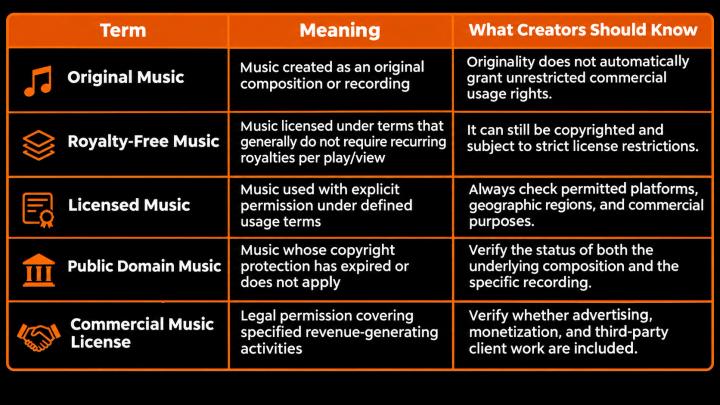
One vital distinction: Royalty-free does not mean copyright-free. A royalty-free track is still protected by copyright; the license simply defines how you are allowed to use it. Likewise, an original track is not automatically free for commercial use until explicit rights are granted. You can explore curated tracks directly via Music Search.
⚖️ 3. Understand the Two Copyright Layers Behind Music
One of the most important concepts for creators to understand is that a recorded song involves two separate copyright-protected works.
According to official guidance from the U.S. Copyright Office, these two layers are:
- Musical Work: The underlying musical composition, including melody, harmony, and lyrics.
- Sound Recording: The specific recorded performance of that musical composition.
These two rights may belong to different entities and are commonly licensed separately.
📌 Source: U.S. Copyright Office — What Musicians Should Know About Copyright.
For video creators, sync licensing requires authorization for both layers. A license that covers only the composition or only the sound recording is legally insufficient for commercial distribution. When selecting music, ensure your provider holds clear authority to grant commercial rights across both layers.
💼 4. What Type of Music License Do Different Creators Need?
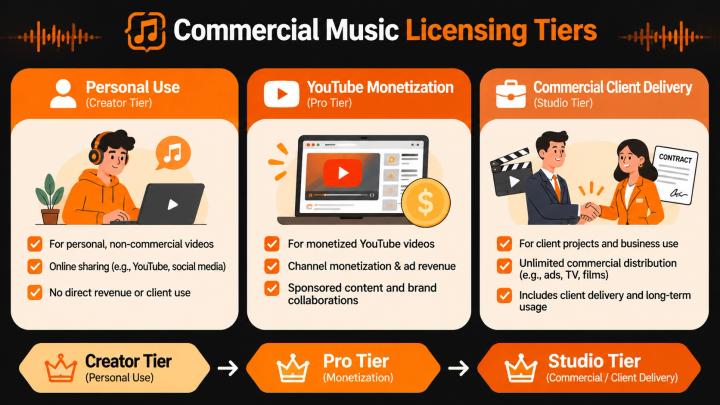
Different projects require distinct scope coverages. A personal vlog, a monetized YouTube channel, and a paid brand advertising campaign cannot share the same basic license terms.
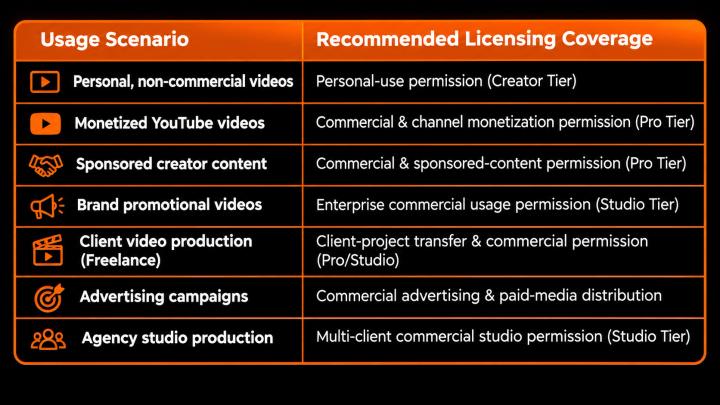
To review specific subscription options and rights structures, consult the official Pricing & Licensing Tiers.
🔍 5. Seven Things to Check Before Purchasing a Music License
Before licensing a soundtrack for commercial delivery, verify these seven critical factors:
- Commercial Use: Is commercial video distribution explicitly permitted?
- Monetization: Can the music be used in revenue-generating content (AdSense, sponsorships)?
- Platform Coverage: Are major platforms supported? (Supported publishing channels include TikTok, Instagram Reels, YouTube including Shorts, and Facebook).
- Advertising & Paid Media: Can the finished video be run as a paid digital ad?
- Client Rights Transfer: Can you safely transfer or deliver the finished work to paying clients?
- Territorial Scope: Is the license worldwide, or restricted by country/region?
- Perpetual Coverage: Does permission for published videos remain valid after subscription cancellation?
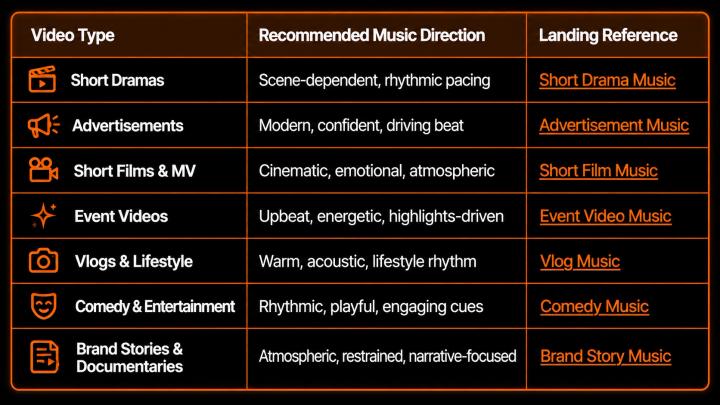
🎥 6. How to Choose the Right Original Music for Different Commercial Videos
Legal compliance is the baseline; artistic alignment determines video performance. Creators exploring specific video formats can visit the centralized Video Types Hub for tailored guidance:
🎬 7. Why Original Music Matters for Long-Term Content Production
Utilizing pre-cleared original music from a professional audio library establishes a predictable, scalable production pipeline:
- Predictable Usage Permissions: Helps minimize copyright risks through explicit legal terms.
- Production Quality Consistency: Maintains unified audio mastering standards across multi-platform video assets.
- Efficient Client Handoff: Allows freelancers and production agencies to include verified license documentation in client deliverables.
- Dynamic Content Flexibility: Provides instrumentals and mood options tailored for storytelling changes.
🤖 8. How AI Helps Creators Match Licensed Music to Their Videos
Traditional music discovery is notoriously time-consuming: searching libraries → filtering tracks → downloading previews → manually aligning cuts → repeating.
AI-driven video-aware soundtrack workflows streamline this into a semantic understanding process:
- Scene Segmentation: Automatically detecting cuts and visual beats.
- Emotional Arc Mapping: Aligning dynamic build-ups to narrative shifts.
- Pacing & Dialogue Awareness: Suppressing background audio during voiceovers and amplifying hooks during visual transitions.
🎵 9. How VividSpark Combines Original Music and AI Soundtrack Matching
Finding legally secure music is essential; pairing it quickly to video timelines enhances production efficiency. VividSpark bridges this gap by combining intelligent scene analysis with a curated, pre-cleared original music library.
Key Capabilities of VividSpark Tools:
- AI Soundtrack: Upload your edited video (supporting up to 800 MB, 8 minutes, and formats including MP4, MOV, WebM, AVI, and MKV), and AI analyzes narrative scenes, pacing changes, and emotional tone shifts to segment and match tracks.
- Verified Original Library Matching: Instead of generating unpredictable AI audio synthetics, VividSpark matches real, studio-grade original tracks (produced via a combination of human curation and AI-assisted tools under valid commercial licensing) directly to your video segments.
- Precision Segment Prompting: Customize specific scene audio using natural-language prompts without altering the rest of your timeline.
- Post Studio: Once your soundtrack is ready, use Post Studio to analyze your video, generate vertical (9:16) and horizontal (16:9) covers, write tailored platform copy, and publish directly to supported channels (TikTok, Instagram Reels, YouTube, and Facebook)[cite: 1, 4].
- Transparent Commercial Licensing: Available in Creator ($15/mo), Pro ($39/mo), and Studio ($79/mo) tiers. Upon purchase, users receive WAV + MP3 audio files, unwatermarked full tracks, instant downloads, and an official licensing PDF as verifiable proof.
❓ FAQ
Q1: Can I use royalty-free music for client videos and commercial advertisements?
A: Only if the specific royalty-free license explicitly includes commercial client delivery and paid advertising rights. Standard or personal royalty-free licenses usually restrict client handoffs. Platforms like VividSpark provide dedicated commercial licenses designed to authorize client project deliverables.
Q2: What should I do if my video receives a Content ID claim?
A: While tracks are professionally cleared, if you still encounter unexpected platform flags, you can review our guidance on handling claims or contact our support team via the Support Center to get assistance.
Q3: Will my client get a copyright claim if I edit their video using licensed original music?
A: When licensing music through commercial tiers on VividSpark, your license covers the final video asset, shielding you and your client from distribution issues. If any platform misidentifies a track, our support team is available to assist you.
🔒 Conclusion & Final Checklist
Before publishing or delivering any commercial project, perform a final audit: verify that your license explicitly covers commercial monetization, platform distribution, and client rights transfer. Combining pre-cleared original music with AI content-aware tools like VividSpark helps ensure your workflow remains creative, efficient, and fully compliant with intellectual property guidelines.