
⚡ Quick Answer
The right background music for a product video or brand advertisement should match the brand's personality, the product's positioning, the campaign objective, and the emotional message of the visuals.
Rather than choosing a popular song simply because it sounds attractive, consider what you want the audience to feel and remember.
A practical selection process is:
Define the Advertising Goal → Identify the Brand Personality → Understand the Visual Scenes → Choose the Musical Direction → Match the Music → Review and Refine
For example:
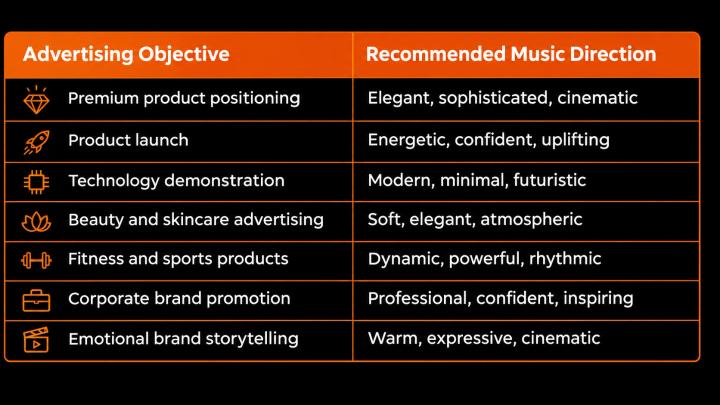
The most effective background music does more than fill silence. It reinforces the product's identity, supports the advertising message, and creates a consistent emotional experience
🎯 1. Start With the Advertising Objective, Not the Music Genre
Before searching for music, identify what the advertisement is supposed to achieve.
A product demonstration, a luxury brand film, and a limited-time promotional campaign may all require completely different soundtracks.
Start by answering one question:
What should viewers think, feel, or do after watching this video?
Different advertising objectives call for different musical approaches.
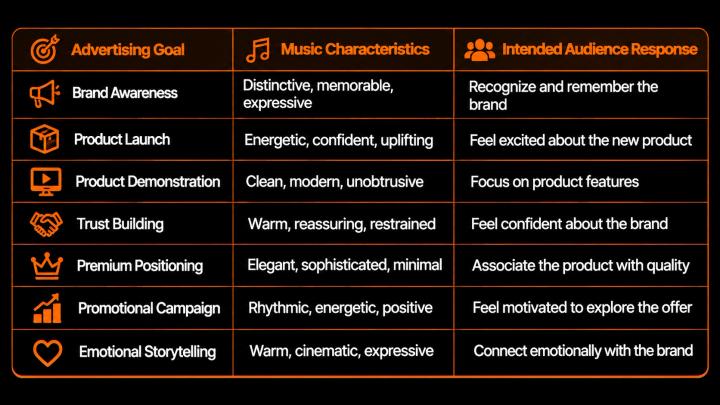
For example, an advertisement introducing a new smartphone may benefit from modern electronic music with a gradual build.
However, a luxury skincare advertisement may work better with gentle piano, subtle ambient textures, and a more restrained musical atmosphere.
The goal is not to choose the most impressive music. It is to choose music that supports the campaign's objective.
🏷️ 2. Match Background Music to Your Brand Identity
Background music can influence how people perceive a brand.
A brand that positions itself as premium, innovative, youthful, or environmentally conscious should consider whether its soundtrack reinforces that identity.
Think of music as part of your brand's visual and verbal communication system.
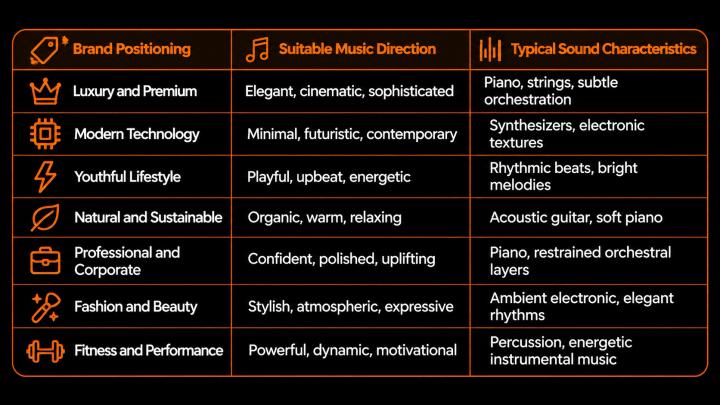
Why Brand Consistency Matters
Imagine a luxury watch brand using extremely playful cartoon-style music in its main product advertisement.
Even if the music is enjoyable, it may create a mismatch between the soundtrack and the product's positioning.
Similarly, an innovative technology brand may weaken its intended identity if the music feels outdated or unrelated to the visual presentation.
A useful rule is:
Your soundtrack should sound like an extension of your brand, not an unrelated addition to your video.
For brands producing multiple campaigns, maintaining a consistent musical direction can also help create a recognizable audiovisual identity.
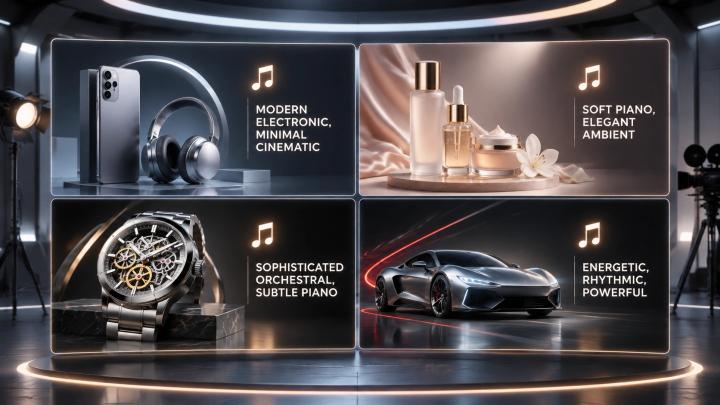
🎵 3. How to Choose Music for Different Types of Product Videos
Different products communicate different benefits and emotional associations.
The music should reflect both what the product does and how the brand wants customers to perceive it.
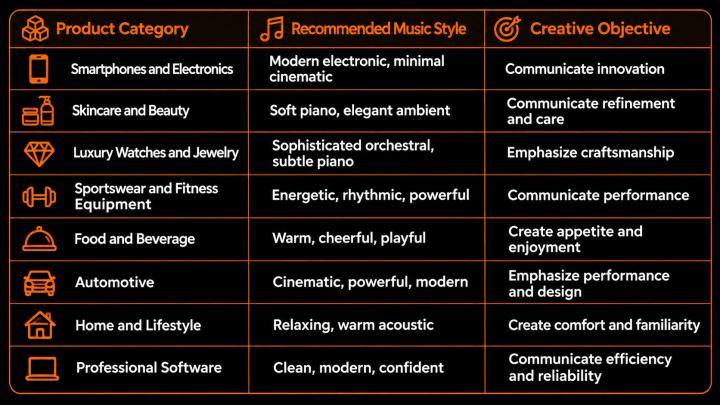
These are creative guidelines rather than fixed rules.
For example, a sports car advertisement may use quiet cinematic music to communicate elegance rather than speed.
The important consideration is the emotional promise of the product.
⏱️ 4. Why Music Tempo Matters in Product Advertising
Music tempo influences the energy and perceived pace of an advertisement.
A fast-paced soundtrack can support dynamic editing, quick product demonstrations, and promotional messages.
Slower music may be more appropriate for premium products, detailed explanations, and advertisements that require careful consideration.
However, faster music is not automatically more effective.
A 2025 study published in the Journal of Advertising Research examined how music tempo influences consumer preferences in video advertisements.
The researchers analyzed 26,025 video advertisements and conducted three experiments.
The study found that:
- Fast-tempo music increased purchase intention in promotion-focused advertisements.
- Music tempo did not have a significant effect in prevention-focused advertisements.
- Time pressure and decision-making strategies helped explain the relationship.
In simple terms, advertisements emphasizing positive benefits and opportunities may benefit from faster musical energy, while advertisements emphasizing safety, reliability, or risk reduction should not rely on tempo alone.
This provides a useful distinction for marketers:
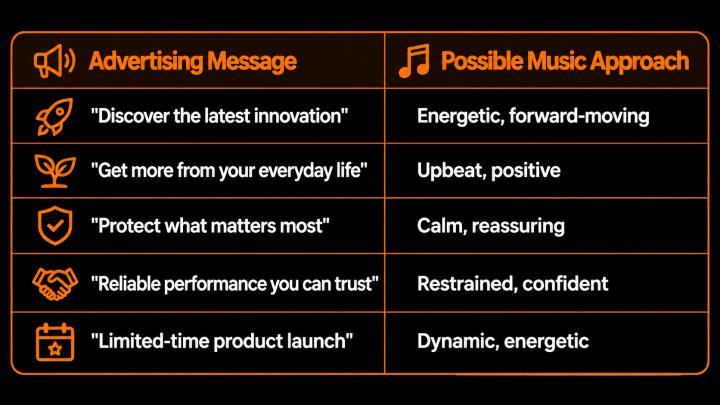
The practical lesson is to match tempo to the psychological purpose of the advertisement, not simply the speed of the video editing.
❤️ 5. How Music Emotion Influences Brand Recognition and Purchase Intention
Music does not influence every advertising outcome in the same way.
A particularly interesting 2024 study published in Acta Psychologica investigated how happy and sad background music affected consumer responses to advertisements.
The experiment involved 134 female participants, who watched the same four advertisements accompanied by either happy or sad music.
Researchers measured brand recognition, advertisement recall, and purchase intention.
The results revealed an important distinction:
- Advertisements accompanied by sad music produced higher brand recognition.
- Advertisements accompanied by happy music produced higher purchase intention.
- Sad music also improved overall advertisement recall, but did not significantly affect recall of the specific products.
This finding suggests that different emotional musical directions may support different advertising objectives.
For example:
- A brand awareness campaign may benefit from a distinctive emotional atmosphere that helps the brand stand out.
- A product promotion campaign may test more positive music that supports the intended buying message.
However, this study used a specific sample of female participants and four advertisements. Its results should not be treated as a universal rule for every product, audience, or advertising platform.
The key takeaway is that music selection should begin with the desired audience response, not with the assumption that one emotional style works for every advertisement.
🔬 6. Should Background Music Always Match the Advertising Visuals?
Generally, music should support the meaning of the advertisement, but exact emotional matching is not the only possible strategy.
A 2021 study published in European Research on Management and Business Economics investigated the relationship between background music and the content of television advertisements.
The researchers used electroencephalography (EEG) and eye-tracking to examine the responses of 90 female participants watching six advertisements.
The study reported that:
- Incongruent music generated higher attention and advertisement recall.
- Congruent music produced stronger frontal asymmetry measurements.
- Incongruent music was associated with higher cognitive workload.
- There was no significant difference in advertisement likeability between the congruent and incongruent conditions.
This research highlights an important creative distinction.
Music that differs from the visual content may attract attention, but that does not automatically make the advertisement more persuasive or more likable.
For most product videos, clear communication and a coherent brand experience should take priority.
A deliberate musical contrast can be useful when a campaign has a specific creative reason for using it, but random mismatch can distract viewers from the product message.
🎬 7. How to Match Music to Different Scenes in a Product Advertisement
A product advertisement often contains several stages, each with a different purpose.
Instead of choosing one song and applying it to the entire video, consider how the soundtrack should develop throughout the advertisement.
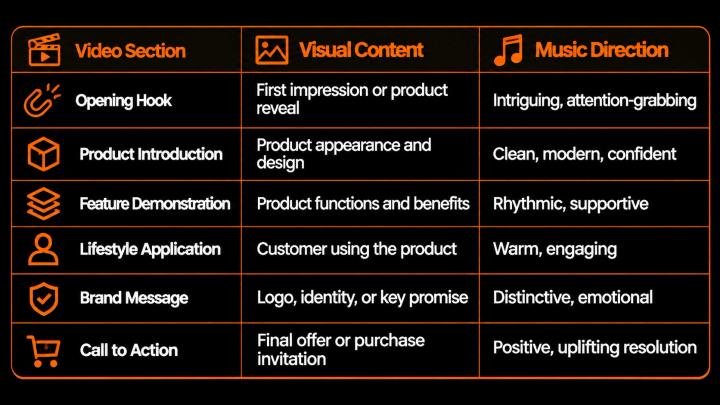
Example: A New Smartphone Advertisement
Scene 1 — Opening Hook
A cinematic close-up introduces the smartphone.
Music: Minimal electronic atmosphere.
Scene 2 — Product Reveal
The camera reveals the complete design.
Music: A gradual musical build.
Scene 3 — Feature Demonstration
The advertisement highlights the camera, display, and performance.
Music: Modern rhythmic electronic music.
Scene 4 — Lifestyle Experience
The phone is used in everyday situations.
Music: Warm, uplifting instrumental.
Scene 5 — Final Brand Message
The brand logo and product message appear.
Music: A confident, memorable ending.
The objective is to create a soundtrack that develops with the advertisement rather than remaining emotionally unchanged.
🎙️ 8. How to Balance Background Music With Product Narration
Many product advertisements contain voiceovers, demonstrations, and spoken explanations.
In these situations, background music should support the narration rather than compete with it.
Consider the following principles:
Keep Important Dialogue Clear
If the advertisement explains product specifications, pricing, or important benefits, music should remain unobtrusive during those moments.
Use Instrumental Music When Words Matter
Instrumental tracks can be useful when viewers need to concentrate on spoken information.
Lyrics are not always inappropriate, but they can compete with narration when both contain important language.
Build Music Around Key Visual Moments
A gradual musical build can support a product reveal or transition into the main benefit demonstration.
Allow Space for the Final Message
The final brand statement or call to action should remain easy to hear and understand.
A well-balanced soundtrack does not need to be loud to be effective.
📊 9. Why Product Videos and Brand Advertising Continue to Grow
Video has become an important part of modern brand communication.
According to Wyzowl's State of Video Marketing 2026, based on a survey of 266 marketers and consumers conducted in late 2025:
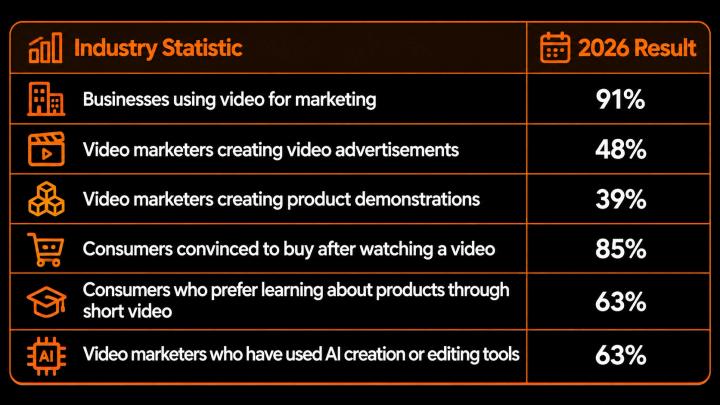
The report also found that 82% of marketers said video had delivered a good return on investment.
These figures demonstrate why product videos and brand advertisements deserve careful creative planning.
They do not directly measure the impact of background music on advertising performance. However, they provide useful industry context.
As more businesses invest in video advertising, soundtracks become part of a broader creative system that includes visual storytelling, brand positioning, messaging, and audience experience.
A reasonable production inference is that music selection should be treated as a deliberate part of advertising design rather than a final decorative step.
🧪 10. How to Test Whether Your Advertising Music Is Effective
Choosing music based on creative intuition is a good starting point, but testing different versions can provide more useful evidence.
A simple approach is to create two versions of the same advertisement:
- Version A: Energetic background music.
- Version B: Warm, emotional background music.
Keep the visuals, narration, copy, duration, and audience targeting consistent.
Then compare the results.
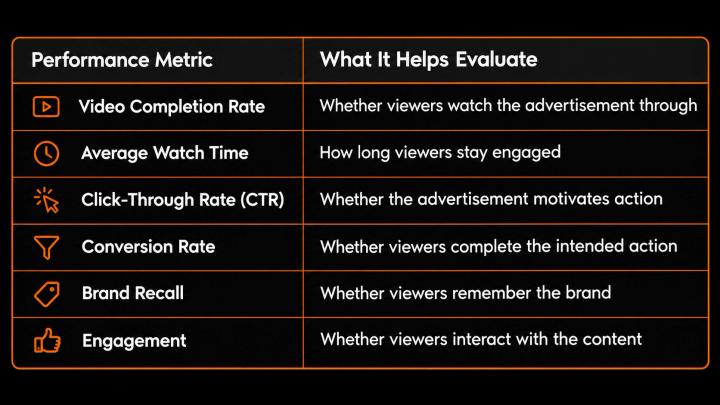
For a product launch, an energetic track may perform better with a promotion-focused message.
For a premium brand film, a slower and more sophisticated soundtrack may better support the intended positioning.
These are hypotheses to test, not guaranteed outcomes.
When comparing versions, change the music while keeping other variables as consistent as possible. This makes it easier to understand whether the soundtrack contributed to the observed difference.
🎵 11. How VividSpark Helps Match Original Music to Product Videos and Brand Ads
Finding suitable background music for a product advertisement is only part of the challenge.
The music must also match the individual scenes, product demonstrations, emotional transitions, and final brand message.
This is where VividSpark AI Soundtrack provides a practical workflow.
Instead of requiring creators to manually divide their videos and search for individual tracks, VividSpark analyzes uploaded videos and automatically divides them into multiple segments.
It then matches existing original music from VividSpark's own music library to the different sections.
🎬 Automatic Video Segmentation
Upload a completed product video or brand advertisement.
AI analyzes the video content and automatically divides it into multiple segments.
This provides a structured starting point for matching music to the product introduction, feature demonstration, lifestyle scenes, and final brand message.
🎵 Original Music Matching for Different Advertising Scenes
Different segments can receive music according to their content and emotional direction.
For example:
- Product reveal: Modern, cinematic music.
- Feature demonstration: Clean, rhythmic music.
- Lifestyle scenes: Warm, uplifting music.
- Final brand message: Confident, memorable music.
VividSpark selects existing original tracks from its own music library rather than generating a new song from scratch.
✏️ Replace Music in a Specific Segment Using Prompts
The initial music selection may not always match the creative direction of the campaign.
If one section feels too dramatic, too energetic, or insufficiently refined, creators can specify its segment number through a natural-language prompt.
For example:
- "Replace segment 2 with elegant and sophisticated music."
- "Change segment 3 to modern electronic background music."
- "Replace segment 4 with warmer, more uplifting music."
- "Make the final segment more confident and cinematic."
VividSpark identifies the specified segment and matches replacement music from its own original music library.
This allows creators to refine individual advertising scenes without manually searching for alternative tracks or rebuilding the entire soundtrack.
⏱️ Adjust Segment Duration
Product demonstrations and brand advertisements often contain scenes with different timing requirements.
Creators can manually adjust segment durations when:
- A product feature needs more demonstration time.
- A voiceover requires additional space.
- A product reveal needs a longer visual moment.
- A transition feels too rushed.
- The final brand message needs more time to register.
This helps align the soundtrack with the actual pacing of the advertisement.
🎧 Preview the Complete Advertisement
After replacing music or adjusting segment durations, preview the complete video.
Check whether:
- The opening captures attention.
- The product presentation feels appropriate.
- The music supports the advertising message.
- Voiceovers remain clear.
- Scene transitions feel natural.
- The final brand message has the intended emotional impact.
🔄 Remove or Replace Existing Background Music
VividSpark AI Soundtrack also supports removing or replacing existing background music and detecting potentially copyrighted music.
This is useful when a brand already has a completed advertisement but wants to update its soundtrack before a new campaign or distribution.
Explore the dedicated advertising music page:
VividSpark — Music for Advertisements.
Learn more about the technology:
VividSpark AI Soundtrack — Add Music to Video.
💼 12. Which VividSpark Music License Is Right for Your Product Video or Brand Advertisement?
Choosing music that fits an advertisement is only one part of the process. Creators must also make sure that the selected license covers the intended use.
VividSpark provides different licensing options for personal creators, monetized channels, brands, freelancers, and production teams.
There are two separate ways to obtain music licensing.
Monthly Subscription Plans
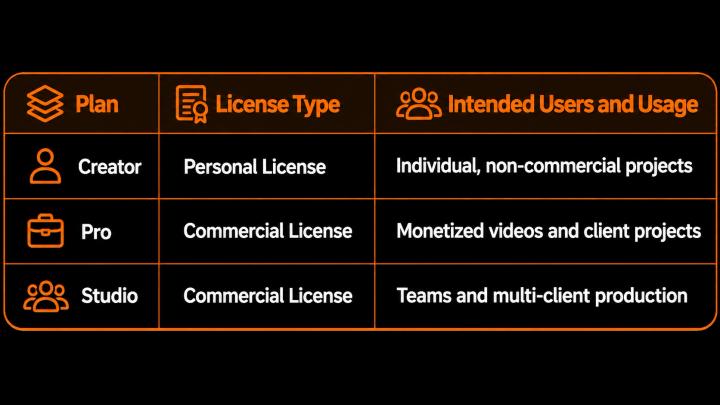
The important distinction is that Creator is for personal, non-commercial use, while Pro and Studio provide Commercial licensing within their respective usage scopes.
Individual Music Licenses
VividSpark also offers individual track licensing options.
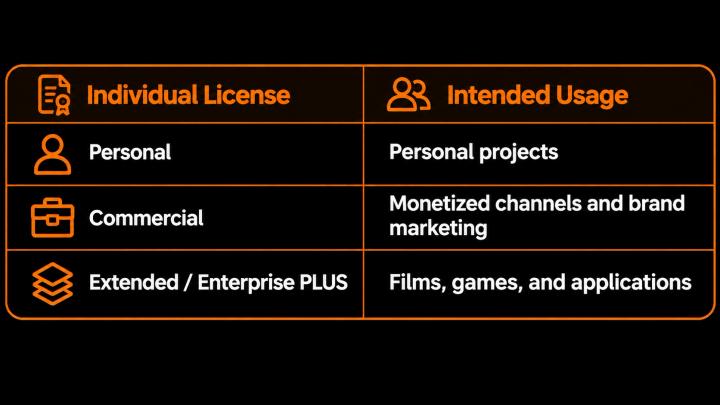
For example:
- A personal, non-monetized video may use a Personal License.
- A monetized creator video or client project should use an appropriate Commercial subscription or track license.
- A brand marketing advertisement should use the applicable Commercial music license.
- Specialized uses involving films, games, or applications may require Extended / Enterprise PLUS licensing.
A subscription and an individual track purchase are separate licensing options. Do not assume that purchasing any plan automatically grants every type of commercial permission.
What Do You Receive When Purchasing an Individual Track?
An individual track purchase includes:
- WAV audio file.
- MP3 audio file.
- Full-length music without watermarks.
- Immediate download access.
- Official PDF music license.
The general individual-track licensing principles are:
- Non-exclusive usage.
- One-time purchase without recurring renewal.
- No attribution required.
The applicable license still determines which uses are permitted. The PDF is the licensing document supplied with the purchase; it should be retained with project records and is not a platform whitelist or a guarantee against copyright claims.
For detailed usage terms, visit:
For current subscription options:
⚖️ 13. Traditional Music Selection vs. AI Scene-Based Soundtrack Matching
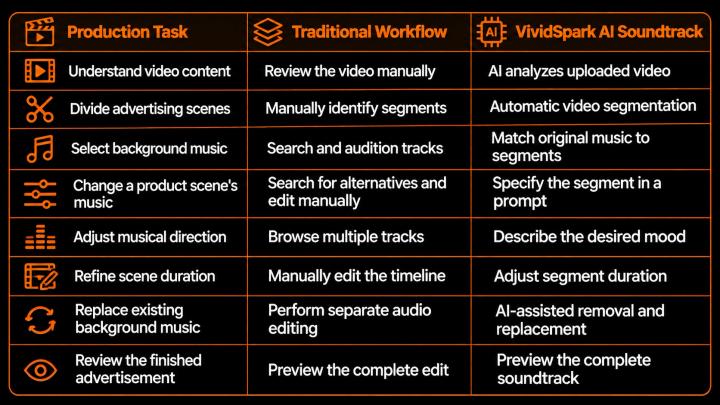
The main advantage is that music selection begins with an understanding of the actual video rather than a manual search through a music library.
AI provides an initial music-matching workflow, while marketers and creators retain control over the final creative direction.
💡 14. Seven Practical Tips for Better Product Video and Brand Ad Music
1. Start With the Brand Message
Understand what the advertisement wants to communicate before selecting music.
2. Match Music to the Product's Positioning
Premium products, everyday consumer goods, and innovative technology products may require very different musical styles.
3. Use Tempo Strategically
Fast music can support promotion-focused advertising, while more considered messaging may benefit from restrained musical direction.
4. Do Not Overpower the Voiceover
The product message should remain clear and understandable.
5. Use Musical Contrast for Important Moments
A change in musical atmosphere can help emphasize a product reveal or campaign message.
6. Keep the Brand Experience Consistent
When producing multiple advertisements, maintain a recognizable musical direction across related campaigns.
7. Check Commercial Music Licensing
Before publishing, confirm that the selected music license covers your intended commercial use, client delivery, and advertising distribution.
❓ FAQ
01Should product advertisements use fast or slow background music?
It depends on the advertising objective. Research published in the Journal of Advertising Research in 2025 found that fast-tempo music increased purchase intention in promotion-focused advertisements, but did not have a significant effect in prevention-focused advertisements.
02Does background music influence purchase intention?
Yes, research indicates that musical characteristics can influence consumer responses. A 2024 study in Acta Psychologica found higher purchase intention with happy background music and higher brand recognition with sad background music in its experimental advertisements. Results should not be generalized to every product or audience.
03Does VividSpark generate new music for each advertising scene?
No. VividSpark AI Soundtrack matches existing original tracks from its own music library. It does not generate a new song every time a segment needs replacement.
04Can I use VividSpark music for commercial product advertisements?
VividSpark provides different licensing options. Its individual Commercial music license is intended for monetized channels and brand marketing. Pro and Studio subscriptions provide Commercial licensing for their specified usage scopes. Review the applicable license terms before publishing.
05What is the difference between VividSpark Pro and Studio?
Both provide Commercial licensing. Pro is intended for monetized videos and client projects, while Studio is designed for teams and multi-client production.
06Can I remove existing background music from a product advertisement?
Yes. VividSpark AI Soundtrack supports removing or replacing existing background music and detecting potentially copyrighted music. This is useful when updating an existing advertisement with a different soundtrack.
🏁 Conclusion
Choosing the right background music for product videos and brand advertisements is more than a creative editing decision.
It is part of how a brand communicates its identity, presents its products, and creates an emotional connection with its audience.
The most effective soundtrack depends on several factors:
Brand Identity → Advertising Objective → Product Positioning → Scene Content → Musical Direction → Audience Response
Academic research shows that music tempo, emotional valence, and audiovisual relationships can influence different aspects of advertising response, including brand recognition, attention, and purchase intention.
However, there is no single musical style that works for every brand or campaign. The right choice depends on what the advertisement is trying to achieve.
VividSpark AI Soundtrack makes scene-based music selection more accessible by automatically analyzing uploaded videos, dividing them into segments, matching existing original music from its own library, and allowing creators to replace specific sections through natural-language prompts.
Marketers and creators can focus on refining the soundtrack to match their brand message and advertising strategy rather than manually searching for music for every product scene.
VividSpark also provides different licensing options, allowing creators to select Personal, Commercial, or Extended / Enterprise PLUS permissions according to their intended use.
Whether you are producing a luxury product film, a technology launch, a beauty advertisement, or a social media campaign, the right soundtrack can make the entire presentation feel more cohesive and purposeful.
Choose music that reflects your brand. Match every scene to your message. Make every product video sound intentional.