🎯 Quick Answer
The best background music for documentary videos must support the story, enhance genuine human emotion, and preserve authenticity without overpowering real-life moments.
Professional documentary creators usually choose music based on:
- 🎵 Story Emotion → Match the underlying feeling of the scene.
- 🎬 Narrative Purpose → Support the message rather than manipulate it.
- 🎹 Instrumentation → Use organic instruments aligned with the subject.
- 🌿 Pacing & Dynamics → Follow the natural rhythm and quiet spaces of the story.
- 🔊 Subtle Audio Mixing → Keep dialogue and environmental audio clear.
👉 The ultimate goal of documentary sound design is not to make viewers notice the soundtrack, but to make them feel deeply connected to the truth of the story. Filmmakers can use AI-powered soundtrack platforms like VividSound Library to instantly match music by emotional tone, scene intensity, and narrative function.
🧠 Why Background Music Matters in Documentary Videos
Documentaries are built around real people, unscripted events, authentic environments, and raw human emotions. Unlike fictional films, documentaries must balance two critical elements:
- Authenticity (Realism)
- Emotional Engagement
Music acts as a psychological catalyst, bridging the gap between raw footage and viewer empathy.
According to empirical research in music psychology (Cohen, 2001; Congruence-Association Model), background music directs visual attention, helps viewers process emotional context, and shapes the narrative interpretation of non-fiction media without altering the factual reality on screen.
Consider the dynamic difference music creates:
- Raw Interview Scene: A subject discussing personal hardship provides factual information.
- With Minimalist Piano/Strings: The same narrative evokes immediate vulnerability and deep empathy.
- Landscape Visuals: Visuals show raw terrain.
- With Ambient Organic Textures: The scene expands into a meditation on scale, history, and human perspective.
Great documentary music does not tell viewers what to think—it helps them experience the story more profoundly.
🎵 1. Understand the Purpose of Music in Documentary Storytelling
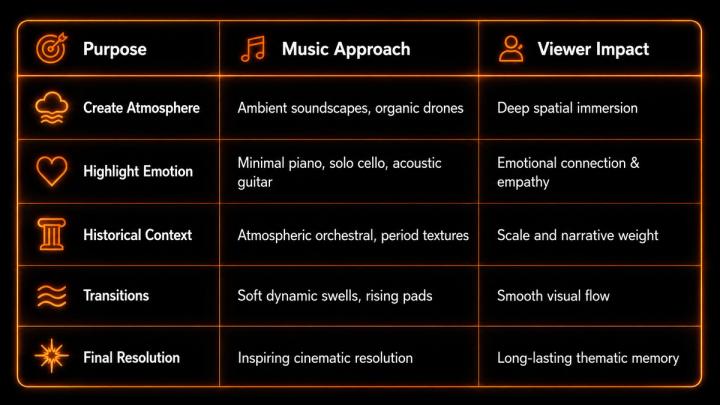
Before searching for audio tracks, creators should define the exact narrative purpose of each piece of music. In documentary filmmaking, music serves five primary storytelling functions:
🎬 Establishing Atmosphere
Music anchors the audience into a specific setting or era (e.g., subtle ambient pads for environmental non-fiction or historical string textures for biographical archives).
❤️ Supporting Human Emotion
Minimalist instrumentation highlights human connection during interviews, personal reflections, or key turning points.
⏱️ Controlling Narrative Flow & Transitions
Music creates seamless bridges between scenes, introducing new thematic chapters or building subtle anticipation.
🧠 Enhancing Viewer Immersion
A carefully mixed soundtrack keeps audiences present inside the environment without pulling focus from speech.

📊 Narrative Functions of Documentary Music
🎹 2. Choose Music Based on Documentary Genre
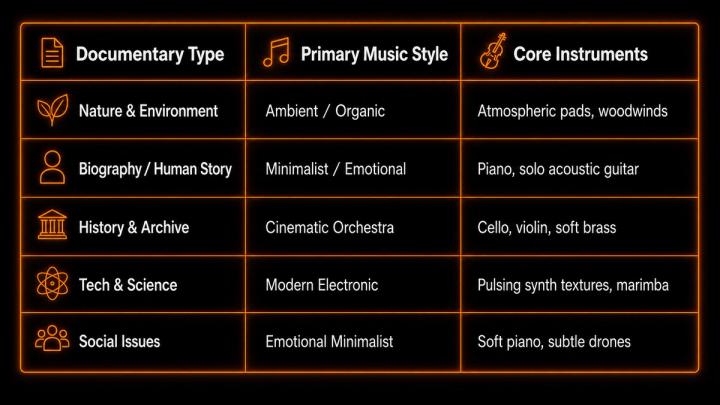
Different documentary styles require distinct sonic identities to remain credible and emotionally authentic.
🌿 Nature and Wildlife Documentaries
- Recommended Music: Ambient soundscapes, organic textures, subtle orchestral layering.
- Goal: Enhance natural beauty while giving acoustic priority to real-world wildlife and environmental audio.
👥 Human Interest & Biographical Documentaries
- Recommended Music: Minimalist piano, acoustic guitar, soft solo strings.
- Goal: Build empathy, intimacy, and personal authenticity.
🏛️ Historical & Archival Documentaries
- Recommended Music: Cinematic orchestral arrangements, hybrid atmospheric tracks.
- Goal: Communicate historical weight, scale, and emotional resonance.
💼 Brand & Corporate Documentaries
- Recommended Music: Modern inspiring ambient, subtle electronic textures.
- Goal: Establish credibility, forward-thinking vision, and trust.
📊 Genre-to-Music Selection Matrix
🎧 3. Match Instrumentation to the Story
The acoustic timbre of specific instruments fundamentally influences how an audience perceives reality.
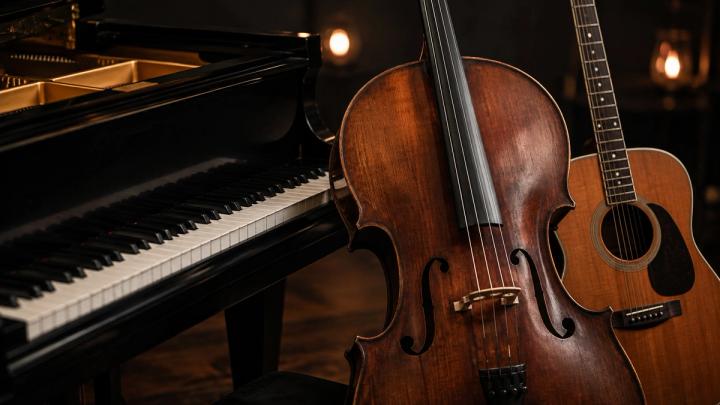
🎹 Piano → Intimacy, Reflection, Personal Vulnerability
🎻 Strings → Drama, Emotional Depth, Historical Significance
🎸 Acoustic Guitar → Warmth, Authenticity, Human Connection
🌊 Ambient Pads → Space, Immersion, Environmental Calm
🎹 Piano
- Emotional Perception: Intimacy, nostalgia, deep reflection.
- Best Used For: Personal interviews, reflective memories, quiet realisations.
🎻 Cello & String Ensembles
- Emotional Perception: Gravitas, sorrow, hope, dramatic importance.
- Best Used For: Major narrative turning points, archival photo montages.
🎸 Acoustic Guitar
- Emotional Perception: Warmth, honesty, raw human experience.
- Best Used For: Travel stories, community-focused documentaries, lifestyle pieces.
🌊 Ambient Soundscapes & Drones
- Emotional Perception: Calmness, neutral space, timelessness.
- Best Used For: Underlaying dialogue, scientific breakdowns, environmental scenery.
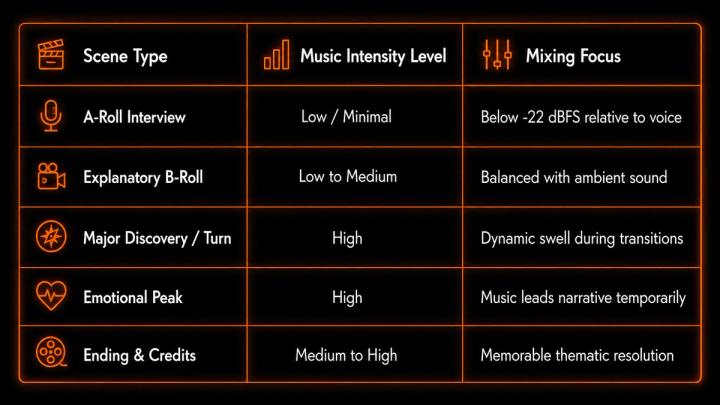
🎬 4. Match Music Intensity to Scene Dynamics
Using high-intensity cinematic tracks throughout an entire film causes viewer emotional fatigue. Professional filmmakers rely on dynamic contrast.
[Interview Scene] ➔ Soft, minimal piano (Low Intensity)
[Discovery Phase] ➔ Layered strings swell (Medium Intensity)
[Climactic Moment] ➔ Full atmospheric arrangement (High Intensity)
[Resolution Scene] ➔ Inspiring resolution (Medium-High Intensity)
📊 Scene Intensity Framework
🤫 5. Silence as an Intentional Sound Design Tool
Silence is one of the most underused tools in sound design. Removing music entirely often creates greater dramatic impact than adding a soundtrack.
In non-fiction audio design, strategic silence signals truth, gravitas, and unfiltered reality.
When to remove music entirely:
- During raw emotional confessions or intense personal revelations.
- When ambient real-world sound (e.g., wind, rain, footsteps) tells the story better.
- Right before a major scene transition to reset the viewer’s emotional baseline.
🎧 6. Audio Mixing: Balancing Music with Real Dialogue
Overpowering dialogue with loud background music is a primary reason non-fiction videos feel amateurish.
🎚️ Recommended Audio Hierarchy (Priority Order)
- 🗣️ Dialogue / Voiceover (Highest Priority): Must always remain crisp and intelligible (typically around -6 dB to -12 dB).
- 🍃 Natural / Environmental Sound (High Priority): Captures ambient reality and presence.
- 🎵 Background Music (Supporting Layer): Sits underneath dialogue (typically ducked to -18 dB to -26 dB).
- 🔊 Foley & Sound Effects (Enhancing Layer): Accentuates specific actions.
Pro Tip: Use Frequency Ducking (Dynamic EQ) to carve out frequencies between 1 kHz and 4 kHz in your background music. This leaves exact space for human voice clarity without reducing overall music volume.
🤖 7. AI-Powered Music Search for Filmmakers
What is VividSound Library?
VividSound Library is an AI-powered royalty-free music licensing platform specifically engineered for video creators, documentary filmmakers, and commercial storytellers who require emotion-driven, high-fidelity background tracks with clear copyright licensing.
Manual music curation across massive libraries often leads to hours of unproductive searching. AI-powered search allows creators to discover soundtracks based on narrative intent rather than generic genres.
Instead of searching generic terms like "documentary music", creators using VividSound Library can search by highly specific storytelling parameters:
- "Reflective minimalist piano for biographical interview"
- "Atmospheric ambient drones for environmental nature scene"
- "Inspiring cinematic build for social issue documentary resolution"
By matching tracks through emotional resonance, energy levels, and instrument density, creators save hours in post-production.
⚠️ 8. Common Mistakes When Choosing Documentary Music
- ❌ Over-dramatizing Neutral Facts: Adding epic music to simple dialogue can make the story feel emotionally manipulative.
- ❌ Ignoring Environmental Audio: Muting ambient natural sound makes scenes feel clinical and fake.
- ❌ Lack of Dynamic Variation: Playing a single continuous track under 10 minutes of editing creates audience fatigue.
- ❌ Using Unlicensed / Royalty Music: Distributing non-fiction content on platforms like YouTube, Vimeo, or film festivals without explicit commercial licensing risks copyright strikes and distribution takedowns.
❓ FAQ
Q1. What type of music works best for documentary videos?
A: Minimalist piano, ambient soundscapes, acoustic guitar, and modern orchestral textures work best because they evoke authentic emotion without overpowering dialogue or reality.
Q2. Should documentaries always have background music?
A: No. Strategic silence and natural audio are vital storytelling tools that create emotional contrast and reinforce realism during serious or intimate moments.
Q3. How loud should background music be under documentary dialogue?
A: Background music should generally sit between -18 dBFS and -26 dBFS relative to spoken dialogue, ensuring human voices remain perfectly clear and dominant.
Q4. Does background music reduce documentary objectivity?
A: It can if used to force emotional reactions. Professional creators select neutral, organic instrumentation that supports authentic human experiences without over-sensationalizing facts.
Q5. How does AI help filmmakers find documentary background music?
A: AI music platforms analyze emotional tone, instrument density, pacing, and scene suitability, allowing creators to search by specific narrative prompts instead of vague music categories.
Q6. Why is proper royalty-free licensing necessary for documentary films?
A: Proper commercial licensing ensures your documentary can be distributed safely across streaming services, social media platforms, and film festivals without legal disputes or copyright claims.
✅ Conclusion
Choosing background music for documentary videos is not about selecting the most dramatic soundtrack available. It is about choosing music that respects the narrative truth.
The best documentary music:
- Supports real human experience and vulnerability.
- Respects natural audio and spoken dialogue.
- Uses dynamic variation and intentional silence.
- Maintains emotional authenticity and narrative flow.
With intelligent discovery tools like VividSound Library, filmmakers can quickly find professional, fully licensed soundtracks that transform real footage into unforgettable, emotionally resonant stories.