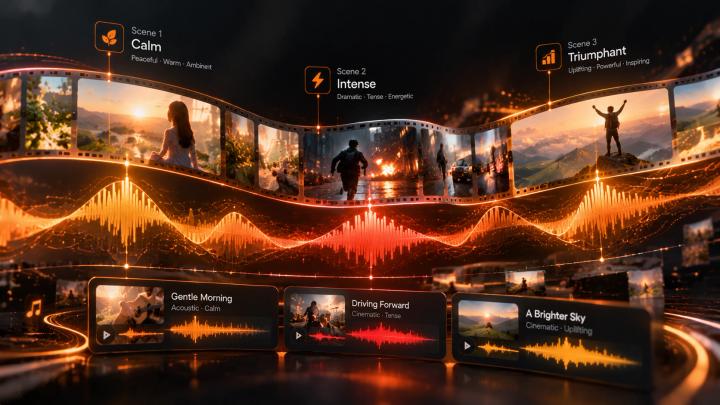
⚡ Quick Answer: How Can AI Choose Music That Fits My Video?
The right music for a video depends on more than its general category. It depends on what the video shows, how each scene feels, how quickly the story moves, and which moments deserve emphasis.
Content-aware AI music matching analyzes these characteristics before selecting suitable music from a library. Instead of asking creators to guess which song fits, the system uses the video's actual content to guide its recommendations.
The process is:
Analyze Content → Identify Scenes → Understand Emotion → Match Music → Preview and Refine
For videos with distinct narrative changes, AI can match different music to different sections rather than forcing one soundtrack across the entire video.
The goal is simple: understand the video first, then match the music to the content.
🎬 1. What Should Music Match in a Video?
Choosing suitable background music requires understanding five important elements.
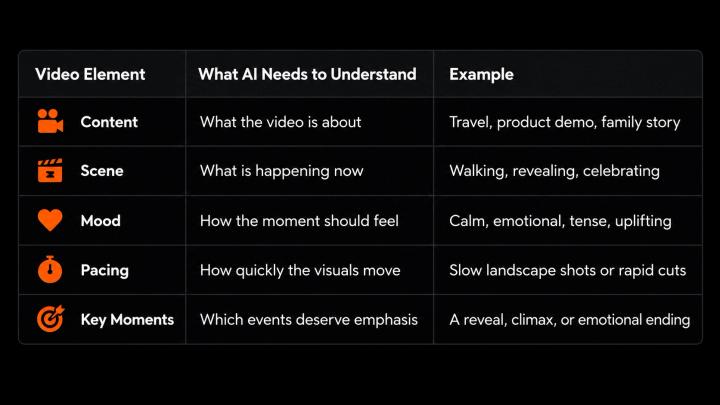
These elements work together. A travel video can contain excitement, quiet reflection, and celebration. A product advertisement can move from curiosity to demonstration and finally to a confident reveal.
Therefore, searching for “travel music” or “commercial music” may not be specific enough.
AI content-based music matching goes further by considering the actual scene and its role in the story.
🧠 2. How Does AI Understand Video Content?
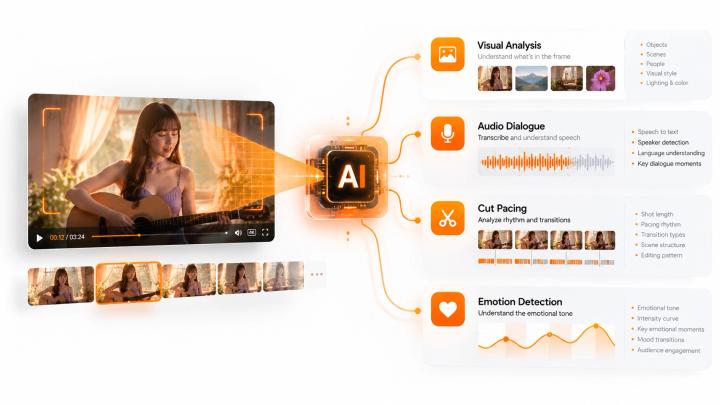
Modern AI systems can analyze multiple types of information to interpret a video.
Visual analysis helps identify people, objects, locations, movement, and scene changes.
Audio and speech analysis can help identify dialogue, narration, ambient sounds, and important spoken information.
Temporal analysis examines how scenes develop over time, including pacing, transitions, and important moments.
Emotional analysis estimates the scene's emotional direction, such as calmness, tension, excitement, or nostalgia.
These signals help the system build a more complete understanding of the video than a simple keyword search can provide.
For example, a scene showing a person running could represent an exciting race, a frightening escape, or a joyful reunion. The visual action alone does not determine the ideal soundtrack; the surrounding context matters too.
🎭 3. Why One Song May Not Fit an Entire Video
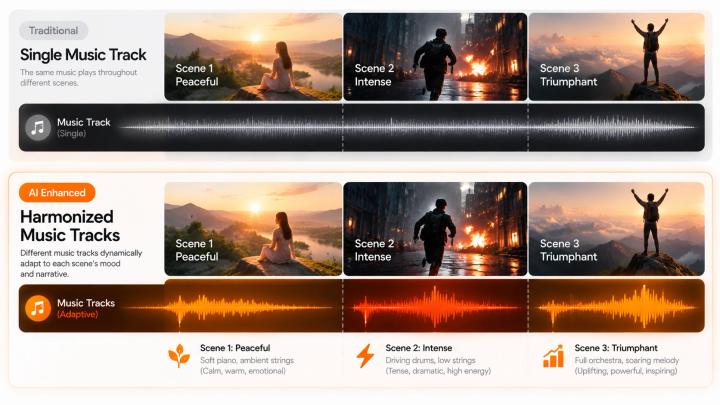
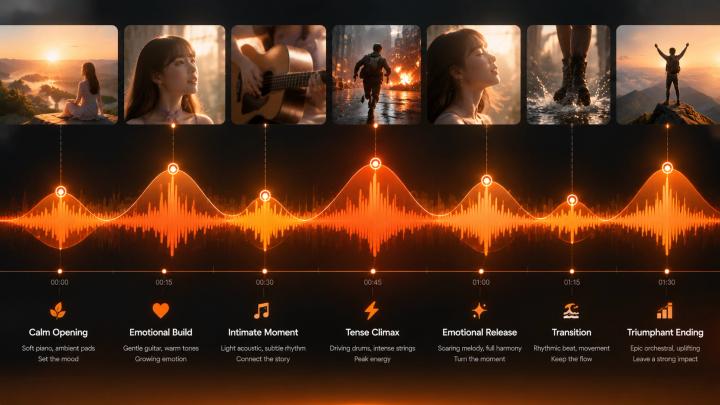
One of the most common soundtrack mistakes is using a single song throughout a video even when its emotional direction changes significantly.
Consider a short cinematic story:
Scene 1 — Calm
The character stands quietly beside a lake at dawn.
Music direction: soft, spacious, restrained.
Scene 2 — Tension
The character notices something unexpected and begins moving quickly.
Music direction: darker textures, controlled tension, gradual build.
Scene 3 — Climax
The character reaches the destination and sees the sunrise.
Music direction: uplifting progression, emotional release.
If the same low-energy track plays throughout all three scenes, it may fail to support the tension and final emotional release.
A scene-aware soundtrack could instead follow this structure:
Scene 1 → Music A → Scene 2 → Music B → Scene 3 → Music C
These tracks do not necessarily need to sound completely different. They should work together as a coherent musical experience.
Importantly, not every scene change requires a new song. The objective is to change music when the narrative calls for it, not simply whenever the camera cuts.
🎵 4. What Music Works Best for Different Types of Videos?
The most suitable soundtrack depends on the specific footage, intended audience, and storytelling goal. The following are common starting points, not fixed rules.
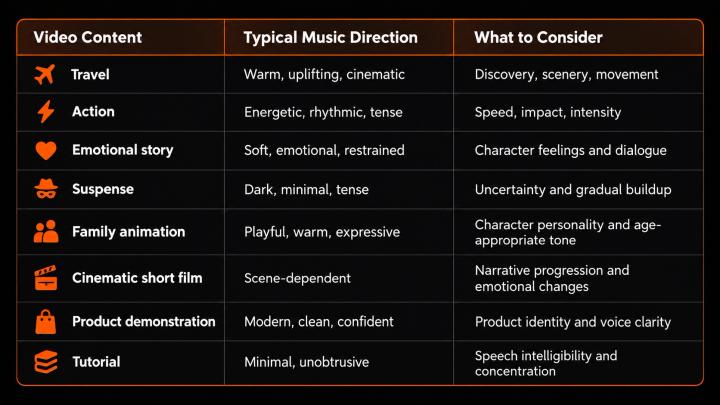
The important distinction is between selecting music for a category and selecting music for a specific moment.
For example, a cinematic short film may need gentle piano during a reflective scene, restrained tension during a confrontation, and a fuller arrangement at the climax.
AI should account for those differences rather than applying a generic “cinematic” label to the entire video.
🔬 5. Why Matching Music to Visuals Has a Scientific Basis
Music can influence how viewers experience and interpret visual content.
A 2019 peer-reviewed study published in PLOS ONE investigated the emotional effects of combining music with congruent and incongruent visual information. The researchers found that congruent audiovisual presentations could produce stronger subjective emotional responses than music presented alone.
A separate 2022 study published in Neuroscience Letters examined the timing between musical beats and video cuts. Its findings indicated that temporally aligned audio and visual events produced greater perceptual pleasure than misaligned presentations.
Source: Subliminal audio-visual temporal congruency in music videos enhances perceptual pleasure.
Together, these studies support two practical principles:
- Emotional congruence: music should support the emotional direction of the scene.
- Temporal congruence: musical events should work naturally with the timing of the visuals.
These studies do not prove that AI music matching automatically increases views, retention, or sales. They explain why the relationship between music and visuals deserves attention when creating a compelling audiovisual experience.
📊 6. Why AI Music Matching Matters for Modern Creators
Video production is now a mainstream marketing activity. According to Wyzowl's Video Marketing Statistics 2026, based on a survey of 266 marketers and consumers conducted in late 2025:
- 91% of businesses use video as a marketing tool.
- 63% of video marketers have used AI tools to create or edit marketing videos, up from 51% in the previous year's report.
- 93% of video marketers consider video an important part of their marketing strategy.
These figures demonstrate the importance of video and the growing use of AI in production. They do not specifically measure automatic music matching.
However, there is a practical implication: when creators publish more video content, repeatedly searching for music and adjusting it scene by scene can become a significant production burden.
Automating music discovery and matching can reduce that repetitive work, leaving creators more time to review storytelling, improve quality, and prepare content for distribution.
🤖 7. How AI Automatically Matches Music to Video Content
1. Analyze
Examine the video's visual content, dialogue, pacing, and narrative context.
2. Segment
Identify meaningful sections and transitions rather than splitting the video at arbitrary intervals.
3. Understand
Estimate the mood, energy, pacing, and purpose of each section.
4. Match
Compare the video characteristics with music features and assign suitable tracks or sections.
5. Preview
Let the creator review the result, rematch unsuitable sections, and approve the final soundtrack.
This workflow explains why content-aware music matching is different from a basic “add music” feature. The system uses the video as the starting point for music selection.
This scenario-based music composition workflow is precisely the core design logic behind modern tools such as VividSpark AI Soundtrack.
🚀 8. How VividSpark Matches Music to Video Content
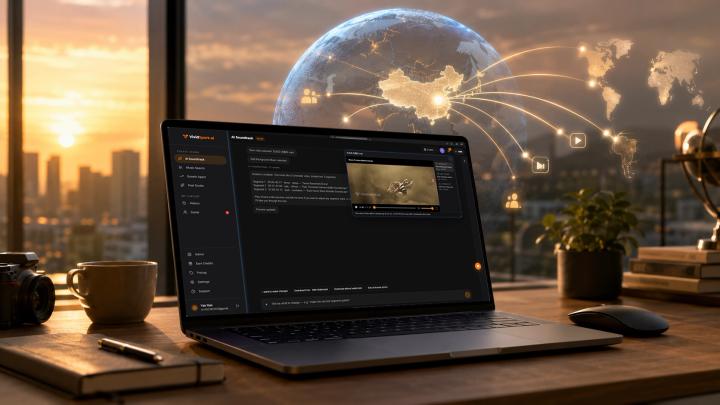
VividSpark AI Soundtrack is designed to analyze video content and match licensed music to its scenes, emotional changes, pacing, and key moments.
Rather than asking creators to choose a genre and manually search through tracks, VividSpark starts by understanding the uploaded video.
🎬 Scene-Aware Matching
VividSpark analyzes the video's content and identifies meaningful changes that may require different musical treatments. When appropriate, different sections can receive different music instead of relying on a single soundtrack from beginning to end.
🎵 Licensed Music Selection
VividSpark matches videos with existing tracks from its licensed music library rather than generating a new song from scratch. Creators can preview the actual music and review the applicable license terms for their intended use.
🎙️ Dialogue and Original Audio
The workflow is designed to preserve dialogue and ambient sound while adding or replacing background music. This is especially useful for interviews, tutorials, travel videos, and product demonstrations.
🔄 Preview and Rematch
If a section sounds too dramatic, too energetic, or emotionally mismatched, creators can refine the music selection without restarting the entire workflow.
VividSpark supports videos up to eight minutes in formats including MP4, MOV, WebM, AVI, and MKV.
Explore the feature: VividSpark AI Soundtrack — Match Music to Your Video.
❓ FAQ
01 How does AI match music to a video?
AI analyzes the video's content, scenes, emotional direction, pacing, and key moments, then compares those signals with the mood, energy, tempo, and instrumentation of available music.
02 How do I choose music that fits my video?
Start by identifying what the video communicates, how each scene feels, and what the audience should experience. Then consider the pacing, dialogue, and important moments before selecting music. AI content-aware matching can help automate this process.
03 Can AI understand the mood of a video?
AI can estimate emotional characteristics from visual content, dialogue, context, and temporal changes. These are computational estimates, not perfect interpretations of human emotion.
04 Can different scenes have different music?
Yes. Scene-aware systems can match different tracks to different sections when the narrative or emotional direction changes. A single track may still be preferable when continuity is more important than variation.
05 What music works best for cinematic videos?
There is no universal answer. Reflective scenes may suit sparse piano or atmospheric textures, tense scenes may need restrained rhythmic elements, and climactic scenes may benefit from a gradual musical build. The best choice depends on the specific story.
06 Is AI music matching the same as AI music generation?
No. AI music generation creates new audio, while AI music matching selects suitable existing tracks and places them within a video based on content analysis.
🏁 Conclusion
Choosing the appropriate music for a video is not as simple as finding a popular song or selecting a certain music genre.
The music needs to match the content of the video's visuals, the emotional tone of the scene, the rhythm of the story, and the most crucial moments that deserve emphasis.
This is the difference between AI music matching based on video content and traditional music search: it starts with the video rather than from the music library.
The entire workflow can be summarized as:
Understand the video → Identify the scene → Match the music based on the content → Listen to it → Adjust
Scientific research supports the importance of emotional consistency and time synchronization between audio and visuals, and industry data also indicates that AI-assisted video production is gradually becoming more widespread.
For creators who don't know what music suits their video, VividSpark AI Soundtrack integrates video content analysis, authorized music matching, scene-specific music composition, and music adjustment into the same workflow.
Creators no longer have to rely solely on repeated listening and manual trial and error; instead, they can let the AI understand the video first, and then make adjustments based on the actual results.
Understand the video first, then match the music. Let the music follow the story, rather than having the story adapt to the music.