🎯 Quick Answer
Music drives video storytelling by triggering immediate emotional responses in the human brain, regulating narrative pacing, and guiding cognitive interpretation of visual content. According to neuroscientific studies, audio tracks do not merely accompany imagery—they determine how audiences decode a story's subtext.
By strategically aligning sound design with visuals, digital creators and marketing professionals can:
- Trigger Psychoacoustic Responses: Induce immediate empathy, tension, or inspiration through precise tempo and harmonic alignment.
- Optimize Viewer Retention: Elevate audience engagement and watch time by matching the music’s energy curve with the video's narrative arc.
- Solidify Brand Equity: Anchor corporate identity in the consumer's memory through recurring melodic motifs and curated acoustic profiles.
🧠 The Neuroscience of Audio-Visual Integration
A compelling video narrative is an interconnected ecosystem of visuals, dialogue, pacing, and sound design. However, among these variables, music possesses a unique evolutionary advantage: it bypasses analytical filters to communicate emotion instantly.
In cognitive psychology, this is known as cross-modal transfer. When an audience views a visual scene, the accompanying audio dictates their emotional interpretation. For example, consider a continuous shot of a character walking alone down a city street:
- Soft Minimal Piano: Communicates intimacy, internal reflection, or profound isolation.
- Dissonant Ambient Pads: Instantly shifts the genre to psychological thriller or suspense.
- Uplifting Orchestral Crescendo: Transforms the sequence into a journey of triumph and personal growth.
- Acoustic Guitar Strums: Conveys a sense of comfort, authenticity, and casual lifestyle.
The visual assets remain identical, yet the audience’s emotional reality changes entirely. Music provides the psychological context, instructing the viewer exactly how to feel about what they see.
🎵 1. The Psychoacoustic Triggers: Creating Emotional Meaning
The most successful brand campaigns and cinematic narratives are rarely remembered for informational content alone—they resonate because of emotional impact. Sound waves directly stimulate the brain's amygdala (the emotional processing center) and hippocampus (the memory center), creating an involuntary neurological connection.
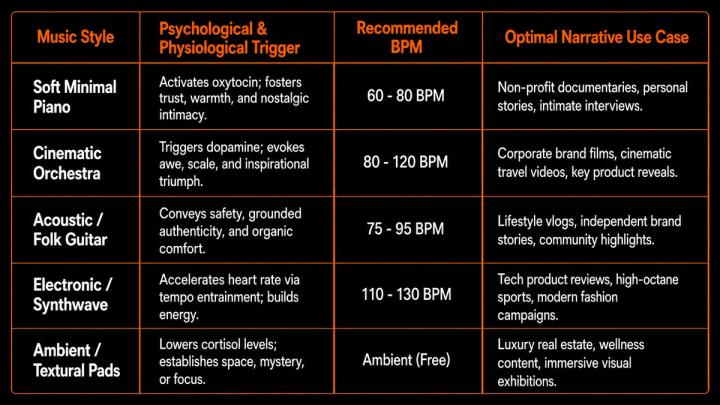
To systematically evoke specific emotional states, creators must understand the relationship between musical composition and audience psychology:
📊 Cinematic Music Alignment & Psychological Triggers

🎬 2. Engineering the Narrative Energy Curve
Every powerful story follows a rhythmic structure. In professional video editing, music serves as the invisible architect that controls narrative pacing—determining when an audience experiences tension, anticipation, and emotional release.
To maintain optimal viewer retention, the soundtrack's arrangement must align precisely with the video's pacing structure:
[Introduction]---> [Development] ---> [Climax / Peak] ---> [Resolution] (Soft Hook / Ambient) (Gradual Build) (Full Arrangement) (Subtle Outro)
- The Introduction (Establishing the Tone): A subtle audio hook captures attention within the critical first three seconds without overwhelming the viewer.
- The Development (Building Tension): Introducing additional layers—such as an acoustic rhythm or low-frequency percussion—increases cognitive anticipation.
- The Climax (The Musical Peak): The full arrangement hits precisely at the key visual revelation, maximizing the emotional payoff.
- The Resolution (The Sonic Outro): A gentle musical resolution leaves a lasting impression, anchoring the video’s call-to-action (CTA).
⚡ 3. Diegetic Sound vs. Non-Diegetic Music: Highlighting Pivotal Moments
Professional directors differentiate between diegetic sound (audio originating from within the story's world, like footsteps or dialogue) and non-diegetic music (the background score added for emotional impact).
When these two elements interact dynamically, they signal to the viewer's brain: "This exact moment matters."
To emphasize high-value visual assets—such as a product reveal, an emotional facial expression, or an expansive landscape—editors deploy specific sonic techniques:
- The Drop (Sudden Arrangement Shifts): Removing low-end frequencies immediately before a major reveal creates an auditory vacuum, making the visual arrival feel significantly more impactful.
- Cinematic Impacts & Sub-Booms: Adding low-frequency sub-bass drops beneath key visual transitions triggers a visceral, physical response in the audience.
- Melodic Leitmotifs: Recurring musical phrases associated with a specific character or product line subconsciously reinforce visual recognition and memory retention.
🤫 4. The Power of Sonic Contrast: Silence as a Storytelling Tool
Effective audio integration is not about continuous sound. In fact, unyielding background music leads to sensory fatigue, causing viewers to disengage. Silence is the ultimate contrast.
A calculated moment of absolute silence immediately preceding a narrative climax focuses 100% of the audience's cognitive attention onto the visual screen.
The Cinematic Sequence:
Continuous Music Layer ---> Sudden Audio Mute
--->Core Visual Reveal ---> Powerful Musical Re-entry
By utilizing silence as a deliberate design choice, you make the subsequent musical re-entry feel exponentially more powerful, maximizing the narrative's psychological depth.
🛍️ 5. Acoustic Branding across Diverse Video Platforms
Different distribution channels require distinct audio-visual strategies to optimize performance and comply with platform algorithms.
🎥 Long-Form YouTube & Documentary Content
- Acoustic Strategy: Supportive, non-intrusive background tracks with dedicated mid-range frequency pockets to leave room for voiceover narration.
- Primary Objective: Maintain prolonged viewer attention, lower bounce rates, and support deep narrative continuity.
📱 Short-Form Social Media (TikTok, Reels, Shorts)
- Acoustic Strategy: High-energy, rhythm-driven tracks featuring instantaneous hooks and prominent transients (sharp beats).
- Primary Objective: Stop the user from scrolling within the first 1.5 seconds and synchronize visual cuts to the exact rhythm of the track.
🏢 Corporate & Commercial Advertisements
- Acoustic Strategy: High-production, brand-aligned compositions backed by comprehensive commercial licensing to ensure complete legal compliance.
- Primary Objective: Shape consumer perception, elevate brand authority, and drive specific purchasing decisions.
🤖 6. Transforming Workflows with AI-Powered Music Search
For digital content creators and marketing professionals, searching manually through thousands of generic stock tracks is a notorious bottleneck. Modern production workflows demand smart, context-aware curation.
Advanced generative discovery models allow editors to bypass rigid genre tags. Instead, creators can search for music using semantic, intent-driven descriptions:
- “Cinematic orchestral music with an emotional build for a travel documentary”
- “Minimal luxury ambient pads with a premium feel for a timepiece commercial”
- “Upbeat electronic indie track with sharp transients for high-energy tech reviews”
Platforms like VividSound Library solve this production bottleneck by offering intuitive, emotion-driven search infrastructure. By matching royalty-free tracks directly to the psychological requirements of your video's timeline, it bridges the gap between technical sound design and creative storytelling—reducing editing overhead while ensuring consistent narrative quality.
🛠️ 7. Professional Best Practices for Audio-Visual Syncing
To achieve professional-grade cohesion between your visuals and your soundtrack, implement these industry-standard workflows:
- Establish the Narrative Intent First: Never choose a track based solely on personal preference. Select audio that matches the core psychological objective of the visual scene.
- Manage Frequency Allocations: Human dialogue occupies the range between 250 Hz and 4 kHz. Use equalization (EQ) to attenuate these mid-range frequencies in your music track, ensuring the voiceover remains perfectly crisp and intelligible.
- Sync Cuts to Transients: Align major visual cuts, scene transitions, and graphical text overlays with the primary downbeats or rhythmic shifts of the music.
- Verify Global Licensing Clearances: Protect your brand or platform from copyright strikes, algorithmic muting, and demonetization by ensuring every track is fully cleared for commercial distribution across global networks.
❓ FAQ
1. How does music improve viewer retention in video marketing?
Music mitigates sensory monotony by continually introducing new acoustic elements (such as instrument layers and rhythm shifts). This keeps the audience's brain engaged, directly resulting in longer watch times and higher video completion rates.
2. What is the frequency management rule for video voiceovers?
Because human speech is centered in the mid-range frequencies (250 Hz – 4 kHz), editors should use a parametric equalizer to subtly lower these frequencies within the background music. This prevents audio masking and keeps dialogue perfectly clear.
3. Should a video ever rely entirely on silence or ambient sound?
Yes. High-stakes emotional scenes, raw documentary interviews, and ultra-premium luxury branding frequently utilize silence or minimalist ambient textures to emphasize realism and focus maximum attention on the visual nuance.
4. What is the difference between royalty-free music and copyright-free music?
Royalty-free music requires a one-time licensing fee (or subscription) for legal use without ongoing payouts to the creator, though the copyright remains owned by the author. Copyright-free music exists in the public domain, meaning anyone can use it without restrictions, though it often lacks professional production quality.
5. How does semantic AI search accelerate post-production workflows?
Instead of forcing users to browse by generic genres like "Rock" or "Pop," semantic AI search understands context and emotion. It allows creators to type descriptive narrative prompts—like “building tension for a product reveal”—and instantly uncovers tracks that fit that exact psychological curve.
✅ Conclusion
In the realm of digital media production, visual components show the story, but music dictates how the audience experiences it. From triggering subconscious emotional states via psychoacoustic principles to engineering structural tension and pacing, the soundtrack is the true conductor of your video’s narrative.
By treating audio as a foundational storytelling pillar rather than an afterthought, brands and creators can transform standard video files into unforgettable, conversion-driving cinematic experiences.
When planning your next digital asset, remember: music isn't just what your audience hears—it is the gateway to what they feel. Discover the perfect sonic match for your next project at VividSound Library.