🎯 Quick Answer
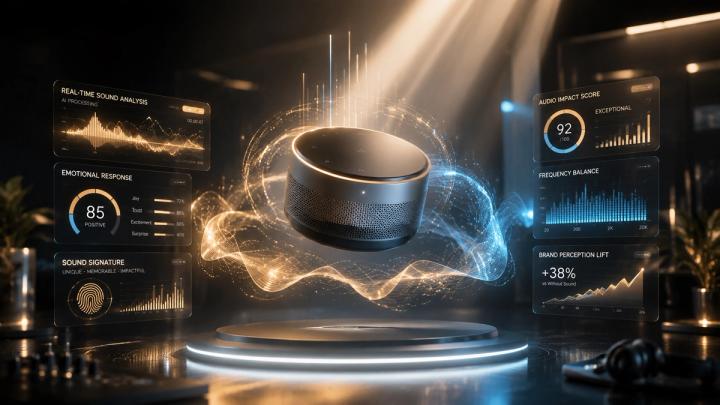
Background music influences product perception by altering consumer emotions, elevating perceived brand value, and strengthening advertising recall.
According to audio branding research by VividSound Library, strategic background music can:
- 💎 Elevate Perceived Value: Make products feel up to 38% more premium or trustworthy.
- ❤️ Forge Emotional Resonance: Connect subconscious feelings directly to brand identity.
- 🧠 Boost Ad Recall: Improve brand memorability by over 50% compared to silent visuals.
- 🛒 Accelerate Purchase Decisions: Guide consumer behavior through tempo and acoustic framing.
- 🎬 Amplify Video Engagement: Increase viewer retention on platforms like TikTok, Instagram Reels, and YouTube Ads.
Background music in video marketing is not mere audio decoration—it is an empirical psychological framework that shapes how audiences judge quality, identity, and price points.
🧠 The Consumer Psychology Behind Background Music
Consumers rarely evaluate products based solely on logical specs. Purchasing decisions are driven by subconscious emotional context, sensory perception, and brand memory.
In digital video marketing—where you have less than 3 seconds to stop a user from scrolling—the audio layer sets the emotional context before the viewer even reads the caption.
The Power of Context: A Case Study
Consider a single luxury watch video with two distinct soundtracks:
- Scenario A (No Audio or Generic Upbeat Track): The viewer sees a standard timepiece ticking on screen. Result: High drop-off rate, perceived as a standard retail item.
- Scenario B (Minimalist Cinematic Piano & Ambient Sound Design): The viewer experiences subtle acoustic depth, rich mid-tones, and atmospheric pacing. Result: The video feels like a high-end editorial film, anchoring a premium price expectation.
Same Product Visuals + Elevated Audio Framing = Exponentially Higher Perceived Value
What Science Says (Academic Evidence)
The relationship between ambient audio and consumer behavior is well-documented in behavioral economics:
- The Milliman Study (1982, Journal of Marketing): Pioneer researcher Ronald E. Milliman demonstrated that playing slower tempo background music in retail environments increased sales by 38.2% compared to fast-tempo music, as it lengthened in-store duration and relaxed shoppers.
- The Wine Shop Experiment (North et al., 1999, Journal of Applied Psychology): When French accordion music was played, French wine outsold German wine by 77%. When German brass music was played, German wine accounted for 73% of total sales. Consumers overwhelmingly denied that music influenced their choices—proving its implicit, subconscious power.

🎵 1. Acoustic Styles & Emotional Categorization
The human brain instinctively links musical frequencies, arrangements, and instruments to human emotions. When selecting royalty-free background music for video ads, matching the genre to the product category is critical.
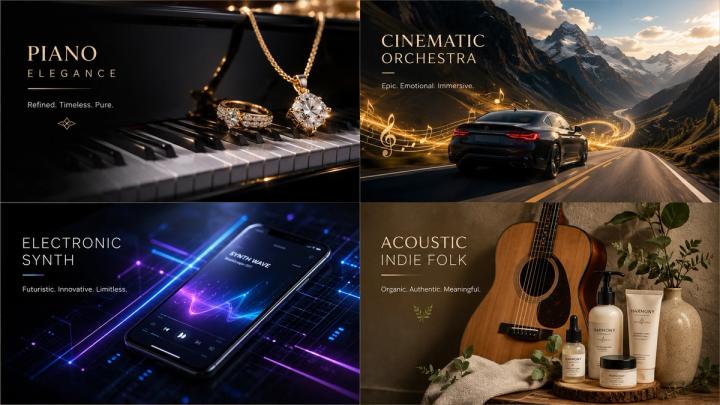
📊 Audio Genre vs. Product Perception
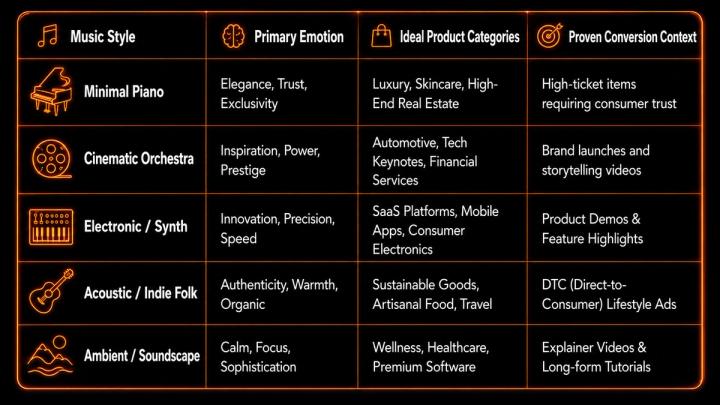
🛍️ 2. Influencing Perceived Product Value & Price Sensitivity
One of the most immediate financial returns on audio investment is its ability to lower price sensitivity.
If a luxury skincare product is accompanied by loud, royalty-free stock music with high distortion, consumers subconsciously perceive it as a mass-market drugstore item. Conversely, pairing the same footage with spatial ambient tracks from VividSound Library shifts the perceived value into the luxury category.
[Mismatched Audio] ──> Lower Brand Trust ──> Higher Price Sensitivity
[Strategic Sound Design] ──> Elevated Prestige ──> Lower Price Sensitivity
🎬 3. Audio Alignment Across Storytelling Stages
Effective video advertising follows a narrative arc. Background music must evolve alongside the visual story to maximize viewer retention and conversion.
📊 The 4-Stage Commercial Sound Strategy
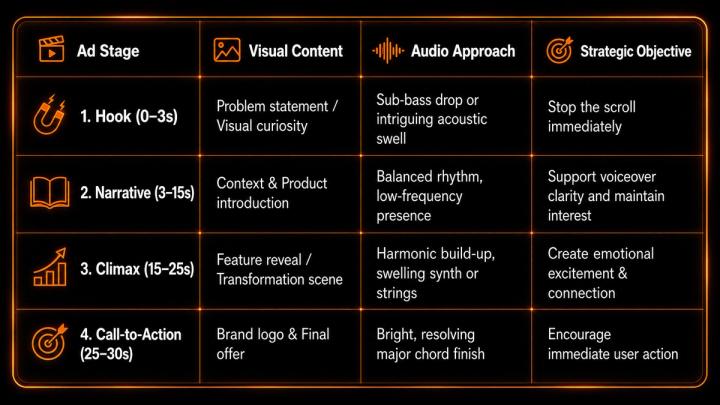
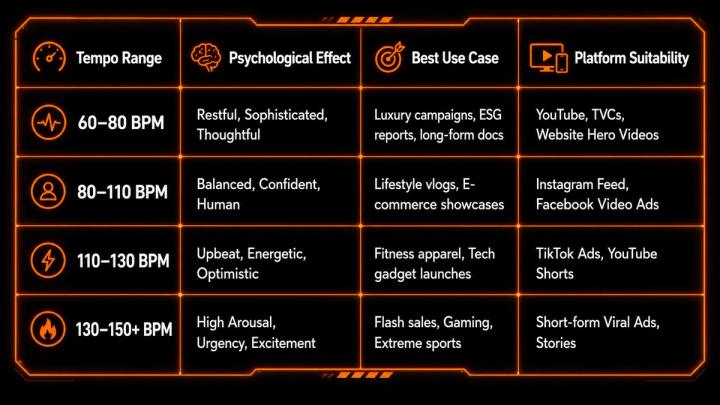
⚡ 4. The Science of Tempo (BPM) in Consumer Action
BPM (Beats Per Minute) directly impacts autonomic nervous system arousal. Marketers leverage tempo to guide whether a user should reflect, feel energized, or act quickly.
60 BPM (Relaxed/Deep Thought) ◄───────► 150+ BPM (Adrenaline/Urgency)
📊 Tempo Selection Guide for Marketers
🎧 5. Instrumental vs. Vocal Music: When to Use Which?
Selecting between instrumental music and tracks with vocal lyrics is a strategic choice that directly impacts message retention.
Voiceover Present? ──► Use Instrumental Track (Prevents Cognitive Overload)
No Voiceover / Lifestyle Story? ──► Use Vocal Track (Drives Emotional Identification)
📋 Direct Comparison
- Instrumental Music:
- Best For: Tutorials, SaaS explainers, voiceover-driven ads, global campaigns.
- Cognitive Impact: Keeps focus entirely on spoken value propositions and screen text.
- Vocal Track Music:
- Best For: Cinematic lifestyle branding, emotional storytelling, fashion reels.
- Cognitive Impact: Drives rapid personal identification and mood reflection.
🤖 6. AI-Powered Audio Search: Solving the Discovery Bottleneck
Historically, creative directors spent hours sifting through generic royalty-free music libraries. Modern platforms leverage AI-driven semantic search to align audio with brand psychology instantly.
Through VividSound Library, creators bypass traditional tag searching and query based on emotional intent:
- "Cinematic background music for luxury electric vehicle ad"
- "Upbeat acoustic track for eco-friendly skincare TikTok reel"
- "Futuristic ambient audio for SaaS explainer video with voiceover space"
This AI-driven approach ensures that audio choices directly mirror target demographics and visual pacing.
🛠️ 7. Best Practices for Commercial Music Licensing & Compliance
Even the most psychologically optimized track fails if your campaign runs into copyright flags or ad platform takedowns.
- Match Brand DNA: Ensure the audio genre reflects your long-term brand identity, not just a short-lived trend.
- Prioritize Commercial Licensing: Social media platform "free audio" usually lacks commercial clearance for paid ads. Always secure clear, worldwide commercial music licensing for ad campaigns.
- Master the Mix (Audio ducking): Keep background music between -18dB and -24dB when a voiceover is present to prevent cognitive fatigue.
🎧 Streamline Your Sound Design with VividSound Library
VividSound Library gives marketers, agencies, and content creators immediate access to commercially cleared, psychological-grade background music:
- 🎵 Curated Commercial Music: Engineered specifically for video ads, trailers, and corporate media.
- 🤖 AI Semantic Search: Match tracks by mood, visual pacing, and audience demographics in seconds.
- 📜 100% Commercial Clearance: Frictionless licensing built for multi-platform ad spend (Meta, YouTube, TikTok, TV).
❓ FAQ
Q1. How does background music affect product perception?
A: Background music alters emotional framing, which directly impacts how consumers perceive product quality, brand prestige, and value proposition. Studies show it can lower price sensitivity and increase trust.
Q2. What BPM is best for high-end luxury products?
A: A slower tempo between 60 and 80 BPM is ideal for luxury items. It promotes a feeling of calm, exclusivity, and lingering sophistication.
Q3. Should video ads with voiceovers use vocal music?
A: No. Using vocal tracks underneath a voiceover causes cognitive overload, forcing the brain to compete for speech recognition. Always opt for instrumental tracks when voiceovers are present.
Q4. Can background music increase sales in physical and digital stores?
A: Yes. Landmark research (Milliman, 1982) confirmed that slower music in retail stores increased sales by 38.2%. In digital marketing, proper music alignment significantly boosts video watch time and CTA click-through rates.
Q5. Why shouldn't brands rely on royalty-free tracks built into social apps for paid ads?
A: Social platform audio libraries often carry restricted personal-use licenses. Running paid ads with unauthorized tracks can lead to mute penalties, account flags, or copyright infringement claims.
✅ Conclusion
Background music is one of the highest-ROI levers in modern digital marketing. Rather than treating sound as an afterthought, top-performing brands utilize music as an intentional psychological tool to elevate perceived value, strengthen brand recall, and maximize advertising conversions.
Great product videos don't just display value—they create an auditory environment where value is instinctively felt.
Explore VividSound Library today to discover how AI-powered commercial audio can transform your video ad performance.