
⚡ Quick Answer
AI soundtrack matching is an automated video post-production technology that uses multimodal AI to analyze visual scene changes, dialogue, emotional shifts, and narrative pacing in a video, dynamically selecting, synchronizing, and editing licensed background music for each individual section.
Instead of selecting a single background track based solely on total video duration, an advanced scene-aware AI soundtrack system executes a multi-stage workflow:
Analyze video → Detect scene transitions → Estimate emotion & pacing → Extract music features → Match scene characteristics → Synchronize entry points → Build dynamic soundtrack
This process enables background music to actively support the visual narrative rather than simply filling empty audio space.
🎬 What Is AI Music Matching for Video and How Does It Work?
AI music matching for video is the computational process of analyzing the semantic, visual, emotional, and temporal characteristics of video content to select and align music tracks whose musical features directly correspond to those scene dynamics.
Traditional music selection requires a manual multi-step workflow:
- Review the video edit
- Determine the intended emotional direction
- Search music catalogs using generic keywords
- Manually preview dozens of candidate tracks
- Download audio files and place them on the timeline
- Manually trim, edit keyframes, and adjust volume curves
AI soundtrack matching automates this analytical reasoning. Instead of relying solely on broad genre queries such as "cinematic background music," a scene-aware system evaluates:
- What specific action or event occurs in this scene?
- How does the emotional tone transition between cuts?
- Is speech or voiceover present in this segment?
- Is the visual pacing accelerating or slowing down?
- Where does the narrative climax take place?
- Should the music swell, drop back, or pause entirely?
A professional soundtrack must adapt to the structure of the story rather than forcing a static track across dynamic visual cuts.
🧠 How Does AI Understand Video Content Before Selecting Music?
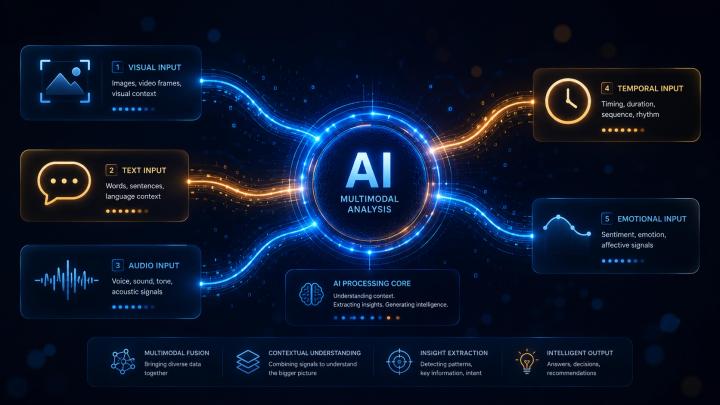
Modern AI soundtrack platforms rely on multimodal video analysis—the simultaneous processing of multiple data signals inside a video container rather than evaluating images or text in isolation.
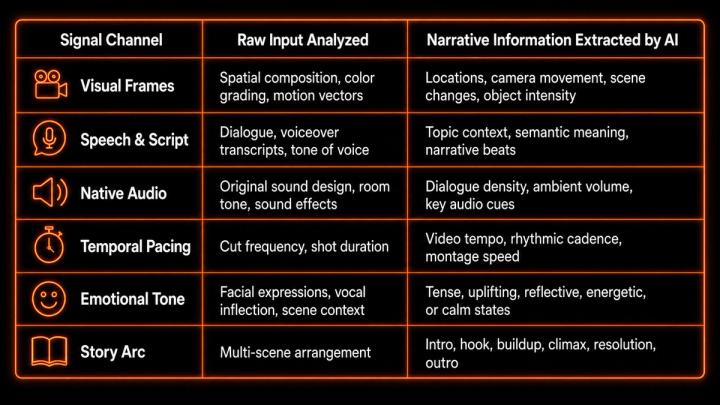
Research in multimodal emotion recognition confirms the necessity of this approach. A peer-reviewed study on audiovisual emotion classification demonstrated that emotional interpretation requires integrated processing of visual, acoustic, and textual signals, showing that multimodal architectures significantly outperform single-signal models in predicting contextual emotion.
✂️ Step 1: How Does AI Divide Video Into Meaningful Sections?
The initial challenge in automated scoring is determining exactly where musical transitions should occur. Naive automation tools divide timelines at arbitrary time intervals (e.g., every 15 or 30 seconds). However, narrative editing rarely follows fixed clock intervals.
Scene-aware AI algorithms identify structural narrative transitions, including:
- Environment or location shifts
- Speaker transitions or interview cuts
- Emotional pivots within a narrative
- Product reveals and feature highlights
- Transitions between action and dialogue
- Dramatic climaxes and final resolution scenes
Consider a 90-second travel documentary video:
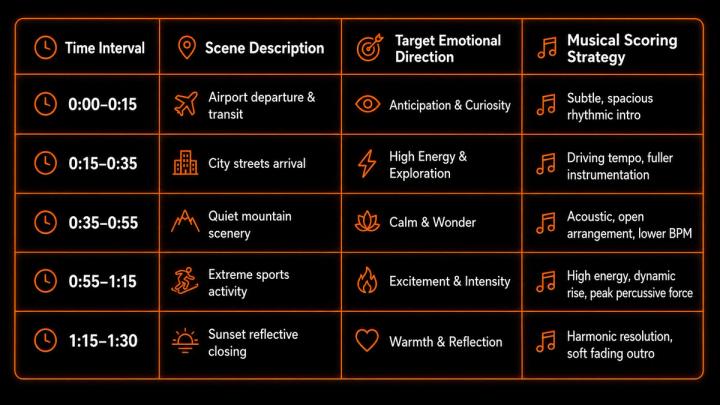
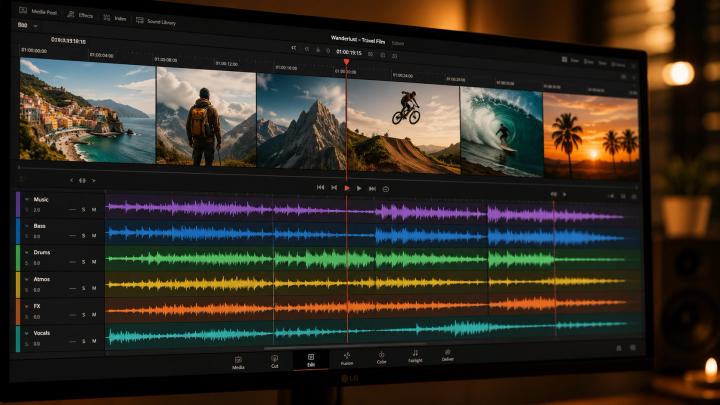
Applying a single static music loop across all five sections flattens the emotional arc. Scene-aware AI scoring allows musical direction to evolve in lockstep with visual storytelling.
❤️ Step 2: How Does AI Estimate the Emotional Direction of Each Scene?
After segmenting the video, the system maps each section onto standardized emotional dimensions such as tension, joy, calm, excitement, nostalgia, or suspense.
This emotional alignment is grounded in cognitive research. A controlled audiovisual study published in psychological literature demonstrated that emotionally congruent visual and musical information generates significantly stronger subjective emotional responses than mismatched combinations. In empirical testing, the impact of audiovisual congruence on viewer ratings achieved statistical significance at p < 0.001.
When background music dynamically reinforces the precise emotional vector of a visual scene, viewer engagement and narrative retention increase measurably.
🎭 Can Changing the Music Change How Viewers Interpret a Video Scene?
Background music does not simply accompany visuals; it actively dictates viewer interpretation.
A study published in Frontiers in Psychology evaluated how distinct musical soundtracks altered audience perception of identical visual footage. In an initial experiment with 118 participants, contrasting soundtracks (melancholic vs. anxious) produced statistically significant shifts in how audiences perceived:
- The moral intentions and personality of the main character
- The perceived safety or threat level of the environment
- Anticipated plot developments in subsequent scenes
- Viewer empathy toward on-screen subjects
A follow-up laboratory experiment involving 92 participants—incorporating eye-tracking and pupillometry measurements—replicated these findings, proving that visual attention and cognitive processing are directly steered by auditory cues.
Selecting an incongruent soundtrack does not merely create an aesthetic flaw; it fundamentally alters the narrative meaning conveyed to the audience.
🎚️ Step 3: How Does AI Analyze and Index Music Tracks?
Evaluating video context represents only half of the matching equation. The AI must possess an equally detailed acoustic index of the available music catalog.
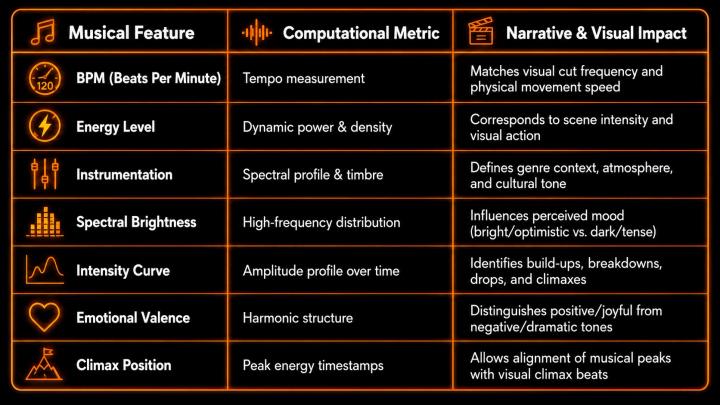
Generic metadata tags like "cinematic" are insufficient for precision scoring. Two tracks categorized as "cinematic" can exhibit opposing structural behaviors: one may feature a 45-second ambient swell, while another opens with immediate orchestral percussion. Precise matching requires mapping where energy shifts occur inside the track structure.
🔄 Step 4: How Does AI Match Video Features With Music Characteristics?
Once both video segments and music catalogs are indexed, the AI model calculates compatibility vectors between visual inputs and musical candidates.
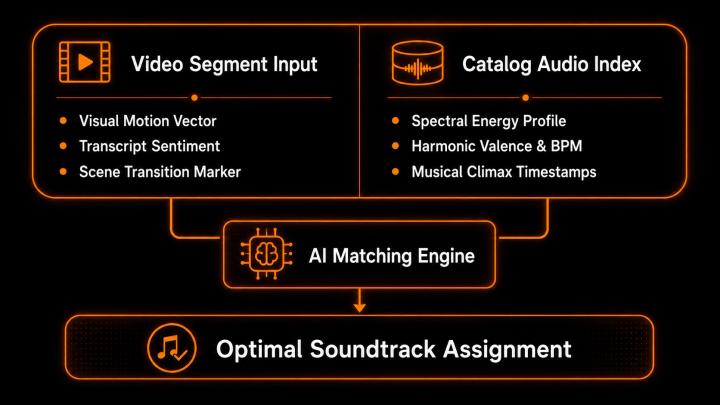
- Peaceful landscape: Paired with low-BPM, spacious acoustic or ambient arrangements.
- Fast product showcase: Paired with high-energy, rhythmic, bright instrumentation.
- Emotional interview: Paired with warm, low-density, non-intrusive musical beds.
- Suspenseful reveal: Paired with rising chromatic textures, low-end swells, and structural drops.
Recent advancements in computer vision and music information retrieval (MIR) have formalized this process. A 2025 peer-reviewed study on Automatic Music-Video Affective Matching introduced a deep learning model specifically designed to measure cross-modal emotional compatibility. The architecture achieved a Mean Absolute Error (MAE) of 0.109 on benchmark matching tasks, outperforming traditional single-modal baselines.
⏱️ Step 5: AI Finds the Right Moment Inside the Song
Choosing the correct song is not enough.
The system must also decide:
Where should that song begin?
Consider a video with a major reveal at 1:20.
If the music reaches its strongest point at 0:30, the soundtrack and story may feel disconnected.
A more advanced system can compare the video's emotional curve with the track's energy curve.
The objective becomes:
Video climax ≈ Musical climax
This is closer to the way professional editors think about scoring.
The AI is not merely selecting music.
It is selecting a usable section of music.
🎵 Why Standard One-Song Trimming Fails Complex Video Edits
Traditional automated video tools rely on a simplified model: select a single stock track, trim it to total video length, and apply basic fade-ins and fade-outs.
While adequate for basic 15-second social clips, this approach fails across multi-scene narrative edits such as documentaries, corporate stories, travel vlogs, and product launches.
Traditional Approach: [ Single Music Track (Trimmed & Faded) ] ───> Fixed Energy Across All Cuts
Scene-Aware AI: [ Intro Cue ] ──> [ Tension Bed ] ──> [ Peak Climax ] ──> [ Resolving Outro ]
Music should transition when the narrative transitions—not arbitrarily on fixed camera cuts.
🎙️ How Does AI Preserve Dialogue and Voiceover Sound Quality?
Background music must support speech rather than obscure it. AI multimodal systems identify audio zones containing spoken dialogue, voiceovers, or critical sound effects (SFX).
During speech-heavy segments, the scoring engine automatically:
- Selects tracks with lower mid-range frequency density
- Reduces percussive elements and complex vocal hooks
- Applies dynamic ducking to preserve vocal intelligibility
- Reserves high-energy, complex arrangements for dialogue-free montages
This establishes a professional audio hierarchy: Voiceover/Dialogue > Key Sound Effects > Background Music Bed.
📊 Industry Trends: The Rise of AI Post-Production Workflows
AI-assisted video workflow adoption is expanding rapidly across marketing and content creation sectors. According to Wyzowl’s 2026 Video Marketing Statistics Report (surveying 266 industry professionals and consumers):
- 91% of businesses utilize video as a primary marketing channel.
- 63% of video marketers leverage AI tools for video creation or editing workflows (up from 51% in the previous annual study).
- 92% of marketing teams plan to maintain or increase video budgets in 2026.
As video generation speeds accelerate, post-production bottlenecks shift toward music licensing, track timing, audio mixing, and scene synchronization—making automated AI soundtrack matching an essential efficiency driver.
🆚 Feature Comparison: AI Soundtrack Matching vs. Stock Libraries vs. AI Music Generators
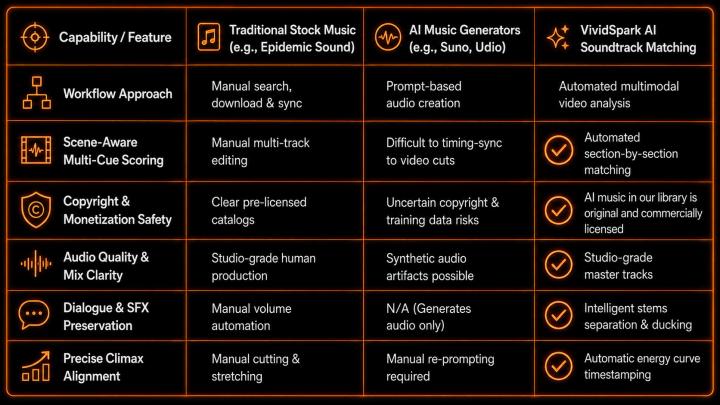
🚀 How VividSpark Automates Scene-by-Scene AI Scoring
VividSpark is an AI-powered video publishing and growth platform featuring a specialized AI Soundtrack Engine designed to analyze video structures and synchronize licensed music automatically.
Unlike basic audio overlays, VividSpark's workflow:
- Accepts video inputs up to 8 minutes in length across standard formats (MP4, MOV, WebM, AVI, MKV).
- Performs automated scene segmentation, emotional trajectory mapping, and speech detection.
- Preserves original dialogue, ambient noise, and native sound effects.
- Matches visual segments with curated tracks from a pre-licensed royalty-free music library.
- Scans for potential copyright risk indicators prior to final export.
Creators can also provide natural language prompts to refine specific segments
💡 Understanding the Difference: AI Matching vs. AI Music Generation
It is important to distinguish between two distinct AI audio technologies:
- AI Music Generation: Generates novel audio signals from text prompts using generative diffusion or autoregressive models.
- AI Music Matching: Analyzes video characteristics to curate, edit, and synchronize finished, pre-licensed master tracks from a verified library.
VividSpark utilizes AI Music Matching. This approach ensures creators work with studio-quality audio arrangements, guaranteed commercial licensing clearance, and full manual control over individual scene track assignments prior to publishing.
🧩 The Role of Human Creative Control in AI Scoring
Automated soundtrack matching is designed to assist, rather than replace, creative judgment. Music selection remains inherently subjective; different directors may choose contrasting musical directions for the same scene to achieve different narrative goals.
The most effective editing workflow combines computational analysis with human oversight:
[ Upload Video ] ──> [ AI Scene & Emotion Analysis ] ──> [ Automated First Pass Score ] ──> [ Creator Fine-Tuning ] ──> [ Final Export ]
This hybrid workflow eliminates tedious music library searching and keyframe timing while keeping final creative approval with the editor.
❓ FAQ
Q1 How does AI know what background music fits a video scene?
A: AI analyzes visual motion, scene transitions, transcript semantics, vocal inflection, and temporal pacing using multimodal deep learning models. It compares these extracted features against an indexed acoustic library covering metrics such as BPM, emotional valence, spectral brightness, and dynamic energy profiles.
Q2 Can AI automatically use different music for different scenes in one video?
A: Yes. Scene-aware soundtrack platforms segment a video timeline at meaningful narrative transitions (such as location changes, topic shifts, or emotional climaxes) and assign distinct, harmonically compatible musical tracks or cues to each section.
Q3 How does AI detect the emotional tone of a video?
A: Multimodal AI platforms process facial expressions, visual color palettes, camera movement speeds, spoken transcript sentiment, and original audio signals simultaneously to calculate a composite emotional trajectory across the timeline.
Q4 Is AI music matching the same as AI music generation?
A: No. AI music generation produces raw synthetic audio from text prompts. AI music matching analyzes video content to select, trim, and align pre-recorded, professionally mastered, and commercially licensed tracks from a music library.
05 Can AI synchronize a musical climax with a specific key moment in a video?
A: Yes. Advanced matching engines analyze both the structural energy curve of a video edit and the dynamic amplitude profile of a music track, selecting an precise internal start time so that the musical peak aligns automatically with visual keyframes.
Q6 Can AI match background music while preserving existing video dialogue?
A: Yes. Professional AI soundtrack systems isolate dialogue, voiceovers, and native sound effects, applying dynamic ducking and frequency management to ensure music tracks remain non-intrusive behind spoken audio.
🏁 Conclusion
Selecting and editing background music has traditionally been one of the most labor-intensive tasks in post-production. Editors must manually review footage, search through extensive music databases, audit licenses, cut tracks to length, and build keyframe fades.
Multimodal AI transforms this process. By combining scene detection, emotional trajectory mapping, acoustic indexing, and dynamic timestamp alignment, AI shifts the core workflow question from "What stock track should I loop under this video?" to "What precise music cue fits this exact moment—and where should it enter?"
As empirical research demonstrates, emotionally aligned audio directly heightens viewer engagement and shapes narrative perception. With scene-aware platforms like VividSpark AI Soundtrack, background music seamlessly follows the visual story: when the narrative changes, the soundtrack evolves with it.