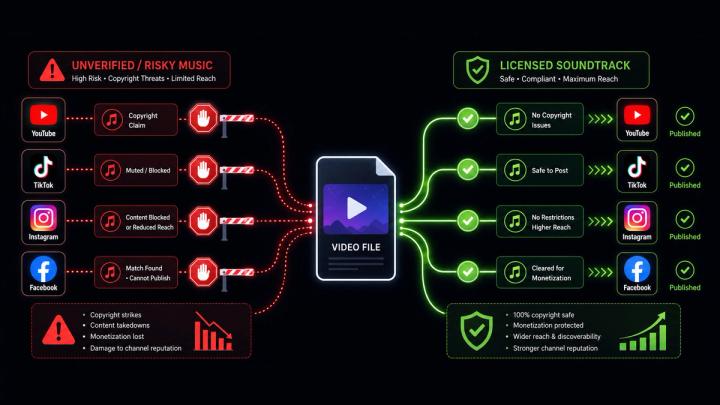
⚡ Quick Answer
A safer video publishing workflow eliminates music copyright risk before posting by:
(1) scanning audio for potential copyright flags
(2) using AI audio stem separation to remove risky music while preserving dialogue and ambience
(3) matching licensed, scene-aware soundtracks.
Tools like Vividspark.ai automate this process end-to-end, protecting videos across YouTube, TikTok, Instagram, and Facebook from being muted, claimed, or blocked.
🎯 Why Copyright Risk Should Be Solved Before Publishing
Many creators only discover music copyright problems after a video goes live. That is usually the worst time to fix the issue.
By then, the creator may already have:
- Published the post and shared the link.
- Sent the video to a client or started a paid campaign.
- Scheduled cross-platform distribution.
- Built the video’s rhythm around a soundtrack that later becomes unusable.
Music is not a small finishing detail. It directly dictates whether a video stays audible, monetizable, usable in ads, or suitable for commercial publishing.
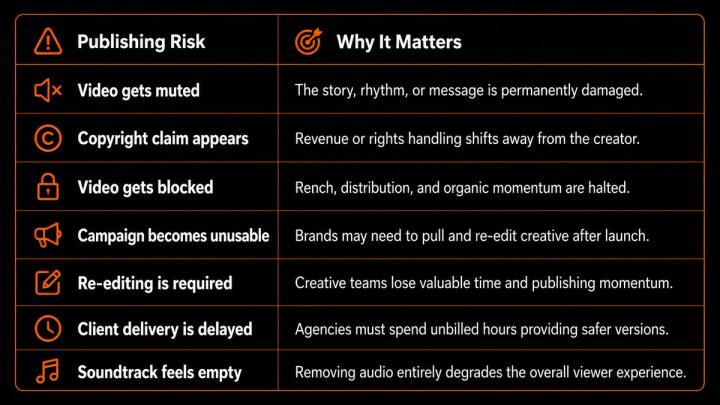
The better approach is to move copyright checking earlier in the workflow. Instead of asking, "What do we do now that the platform flagged our video?", creators should ask, "Can we detect and replace risky music before publishing?"
📌 Why Multi-Platform Publishing Makes Music Risk More Complicated
Video is now multi-platform by default. A creator may upload the same video to YouTube Shorts, TikTok, Instagram Reels, Facebook Reels, a website landing page, and a paid Meta campaign.
That creates a challenge: music that appears safe in one environment may not be cleared for every platform, account type, region, or commercial use case.
DataReportal’s Digital 2026 research shows that social media reaches more than two-thirds of the global population, with online adults using an average of several social platforms each month. If audiences move seamlessly across platforms, creators need video assets that can move safely across platforms too.
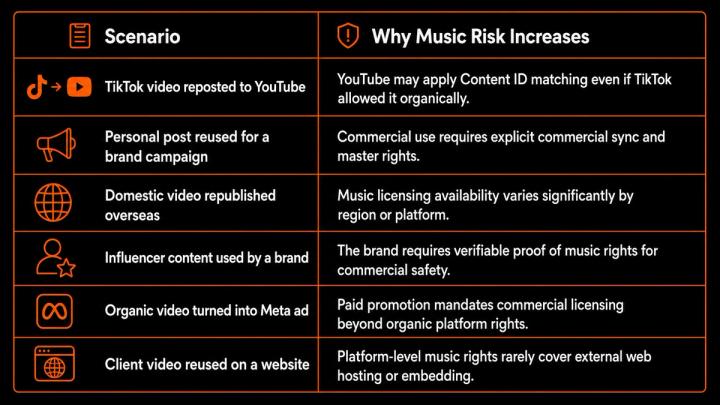
This is why a safer video workflow treats music not as platform-specific decoration, but as an integral part of the publishable asset.
🚨 What Platforms May Do When Risky Music Is Detected
Different platforms enforce copyrighted music in different ways, but the underlying mechanics are consistent: platforms deploy automated identification systems to manage protected audio.
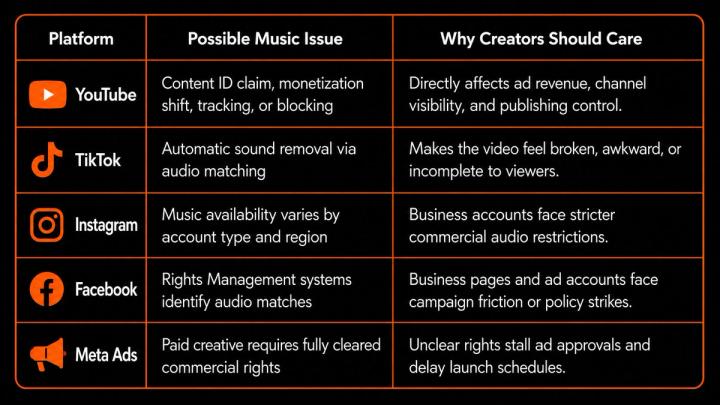
YouTube’s Content ID documentation explains that copyright owners can set policy actions to monetize, track, or block claimed content. Similarly, TikTok’s support documentation confirms that users are notified when a video is muted due to copyright infringement or Community Guidelines violations.
For brands and agencies, music rights are not merely a legal detail—they are a core campaign-readiness requirement.
🎼 Music Licensing Is More Than “Can I Use This Song?”
A common pitfall is assuming music permission is a simple binary choice. In reality, music rights involve multiple distinct legal layers.
Reuters Legal Industry notes that social media music usage involves both the musical composition and the sound recording, emphasizing that commercial entities must verify proper licensing rather than assuming in-app platform licenses extend to brand promotion.
COMPLETE MUSIC LICENSING
- Composition Rights (Sync) ,Melody, lyrics, & songwriting
- Sound Recording (Master) ,The specific recorded audio
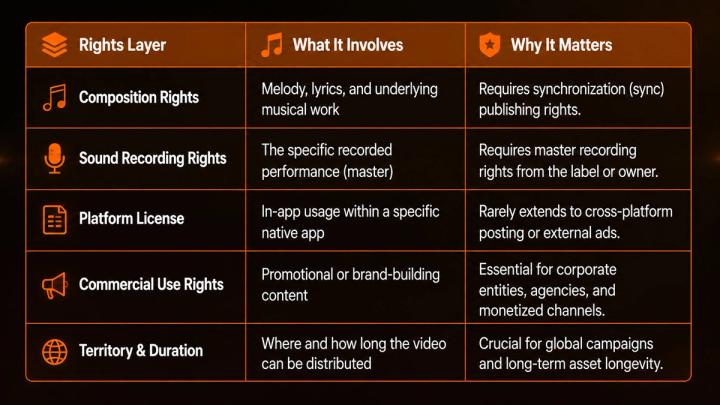
A safer workflow bridges the gap between unknown copyright exposure and clear, licensed soundtrack options.
📊 Weak Workflow vs. Safer Licensed Soundtrack Workflow
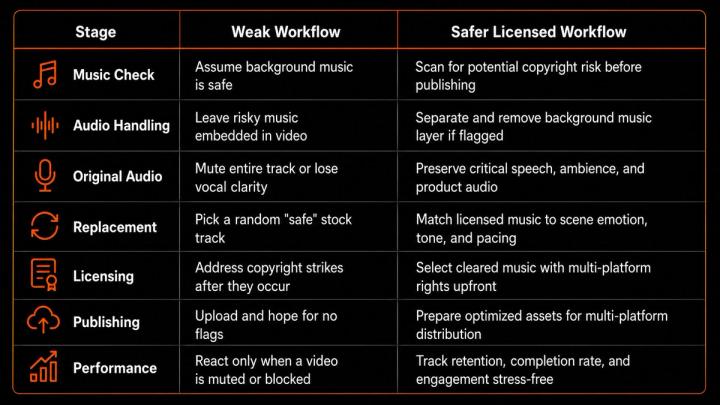
The fundamental difference is timing: a safer workflow resolves copyright uncertainty before distribution rather than reacting after a video goes live.
🔍 Step 1: Detect Copyright Risk in the Uploaded Video
The first step is identifying whether an uploaded video contains risky background music. Risky audio frequently originates from common, everyday production scenarios:
- Trending Audio: Viral tracks popular on short-form feeds that lack commercial clearances.
- Event Ambience: Unintentional background music captured at conferences, retail stores, or venues.
- Client-Provided Edits: B-roll or agency cuts supplied with unverified audio stems.
- Repurposed Social Posts: Historical posts published under obsolete or platform-limited licenses.
- Stock Footage Bundles: Pre-edited video clips containing embedded, non-cleared background music.
An AI Copyright Risk Detector identifies exactly where potential music conflicts exist in the timeline, providing creators with visibility before hitting publish.
🔇 Step 2: Remove Risky Background Music Using AI Audio Stem Separation
When risky music is detected, muting the entire video is rarely acceptable. The objective is to remove the background music layer while maintaining essential audio elements.
Essential Stems to Preserve:
- Human Speech & Dialogue: Clear spoken messaging and voiceovers.
- Product Sounds: Mechanical, tactile, or operational audio that builds authenticity.
- Natural Ambience: Environmental cues in travel, lifestyle, and documentary footage.
- Testimonials: Organic voice recordings that foster viewer trust.
- Sound Effects (SFX): Audio accents that drive visual pacing and transitions.
Recent research in AI audio signal processing highlights the efficacy of Audio Stem Separation (Music Source Separation) pipelines. These algorithms isolate arbitrary background music from vocal and ambient stems without degrading speech clarity or introducing phase distortion.
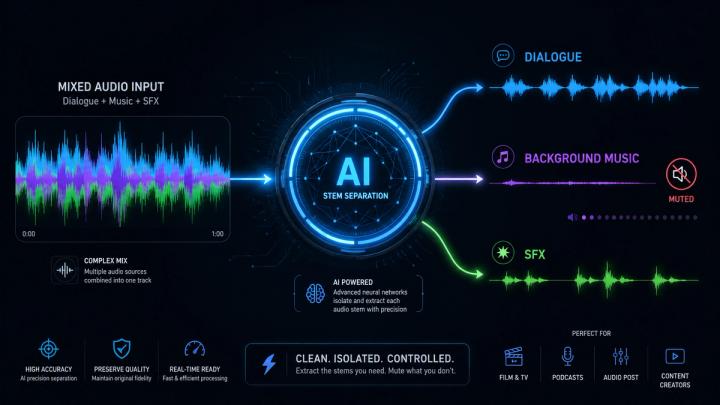
🎵 Step 3: Replace Risky Music with Licensed Soundtrack Options
Once risky background music is separated, the video requires a replacement track that complements its pacing and structure.
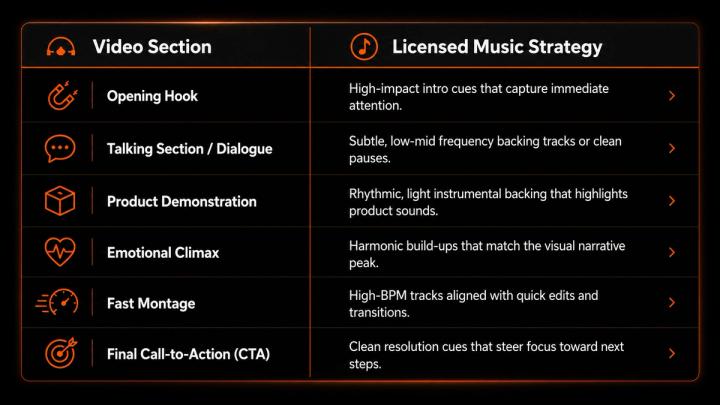
TikTok’s Commercial Music Library guidelines illustrate how platforms maintain pre-cleared audio pools for business usage, noting that custom audio or external music requires explicit confirmation of cleared commercial rights. A robust replacement strategy balances creative alignment with licensing assurance.
🧠 Step 4: Match Music to Scenes, Not Just the Full Video
Applying a single, static track across an entire video often weakens narrative engagement. Advanced AI soundtrack workflows analyze multi-modal video signals to match audio dynamically:
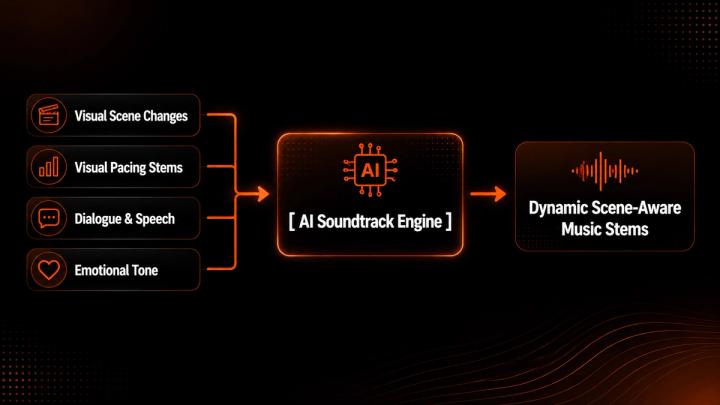
- Scene Boundary Detection: Segments the video into distinct narrative chapters.
- Visual Pacing Analysis: Calculates edit density to determine required track energy (BPM).
- Spectral Dialogue Ducking: Automatically lowers background music frequencies during speech.
- Emotional Classifier: Aligns musical key and mood with visual tone (e.g., energetic vs. somber).
- Segment Length Fitting: Adapts musical intro, loop, and outro points to match exact scene durations.
Platforms like Vividspark.ai AI Soundtrack process videos up to 8 minutes long, automating stem separation, scene-based music selection, and manual timeline adjustments.
📱 Step 5: Prepare the Final Video for Multi-Platform Publishing
A safe soundtrack is the core of a complete, platform-ready publishing package. To maximize performance, creators also require native distribution assets:
- Vertical Covers (9:16): Optimized for TikTok, Instagram Reels, YouTube Shorts, and Facebook Reels.
- Horizontal Covers (16:9): Tailored for YouTube long-form, web embeds, and Facebook posts.
- Platform-Specific Captions: Crafted to fit native feed behaviors and search indexing.
- Clear Call-to-Action (CTA): Structured to drive comments, link clicks, or direct messages.
- Verifiable Music Rights: Cleared for commercial monetization across multi-channel campaigns.
Wyzowl’s 2026 Video Marketing Report highlights that marketers measure video ROI via engagement, lead conversion, brand awareness, and sales. Eliminating copyright strikes ensures video assets maintain their performance value uninterrupted.
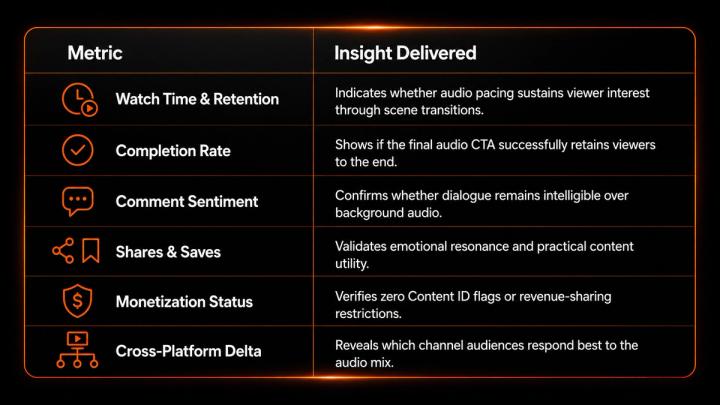
📈 What to Measure After Replacing the Soundtrack
Tracking post-publish metrics helps validate whether soundtrack adjustments support audience engagement:
🛠️ A Safer Video Publishing Checklist
- Upload the master video edit to the processing workflow.
- Scan the audio track for potential copyright flags and non-cleared matches.
- Identify specific timestamp intervals containing risky audio.
- Isolate audio layers using AI stem separation to detach background music.
- Preserve primary dialogue, product interactions, and natural ambience stems.
- Select cleared, commercially licensed replacement music options.
- Align soundtrack pacing, emotion, and frequency ducking to visual scenes.
- Fine-tune track choices, segment lengths, and stem volume balances manually.
- Generate platform-native cover art, captions, and metadata assets.
- Publish confidently across YouTube, TikTok, Instagram, and Facebook.
- Monitor analytics, audience retention curves, and monetization health.
- Iterate insights into future content production and ad amplification strategies.
❓ FAQ
Q1. What does “copyright risk” mean in video publishing?
A: Copyright risk refers to the likelihood that a video contains musical compositions or master sound recordings for which the uploader lacks verified distribution rights across specific platforms, account types, geographical regions, or commercial applications.
Q2. Why should creators check music copyright risk before publishing?
A: Checking copyright status prior to upload prevents post-publish penalties such as video muting, Content ID claims, channel strikes, revenue diversion, campaign disruption, or required takedowns.
Q3. Can risky background music be removed without muting human speech?
A: Yes. Modern workflows utilize AI Audio Stem Separation algorithms to isolate and extract music frequencies while preserving original speech, dialogue, and natural environmental sound.
Q4. How does Vividspark.ai differ from standard royalty-free music libraries?
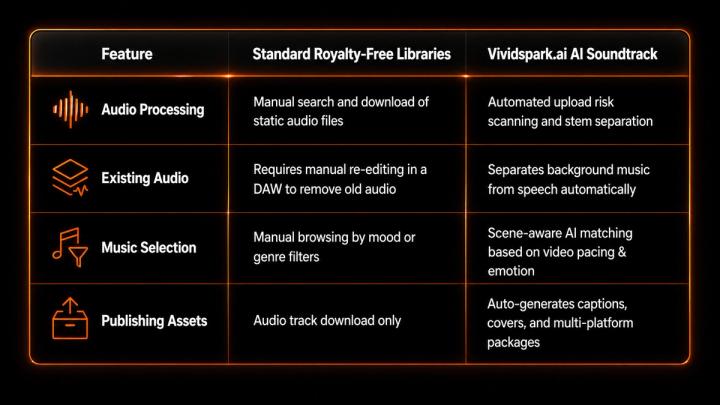
Q5. Why is commercial licensing necessary for brand and agency videos?
A: Personal or organic social licenses rarely cover commercial, promotional, or paid ad placements. Using music without commercial sync and master rights exposes brands to legal liability, ad account suspensions, and campaign takedowns.
Q6. How does Vividspark.ai streamline the publishing workflow?
A: Vividspark.ai integrates copyright detection, AI stem separation, speech preservation, scene-aware licensed soundtrack matching, and multi-platform asset preparation into a single pipeline—enabling creators to publish safe, high-performing videos efficiently.
✨ Conclusion
A safer video publishing workflow begins long before a post goes live. Brands, agencies, and creators no longer need to risk post-upload copyright flags on YouTube, TikTok, Instagram, or Facebook. By detecting potential risks early, separating background music from core dialogue, and integrating scene-matched licensed soundtracks, creators safeguard both legal compliance and viewer engagement.
With Vividspark.ai AI Soundtrack, moving from copyright uncertainty to a fully cleared, commercially ready video is a seamless, automated process—ensuring every published video is clear, compelling, and built for growth in 2026.