⚡ Quick Answer
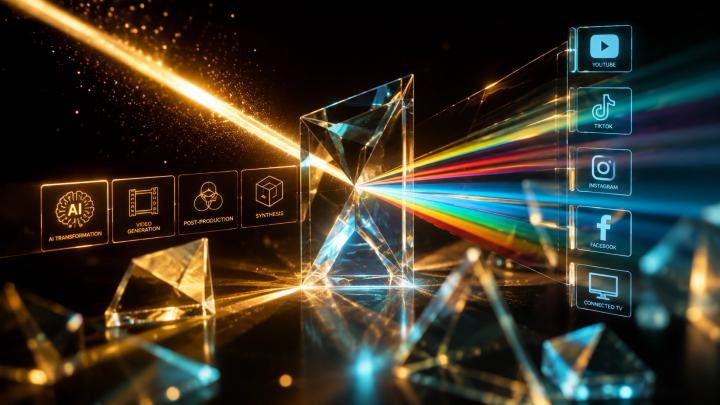
The AI video landscape in 2026 has evolved far beyond standalone text-to-video generators. Leading content creators and digital publishers now deploy connected AI stacks across the full production pipeline:
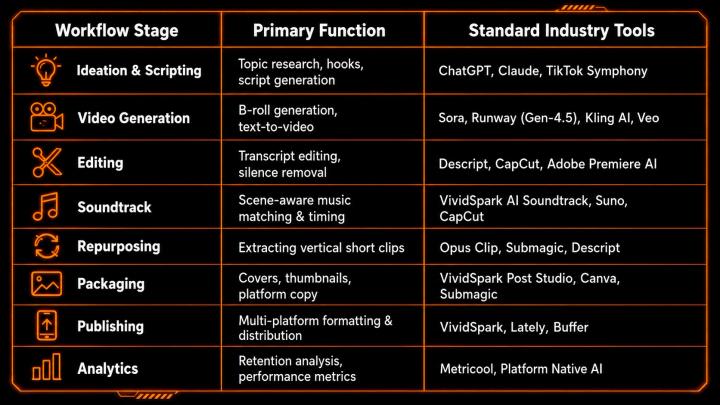
Idea → Script → Generate/Record → Edit → Match Soundtrack → Repurpose → Publish → Analyze
Key AI video tool categories and industry standards in 2026 include:
- Ideation & Scripting: ChatGPT, Claude, TikTok Symphony
- AI Video Generation: OpenAI Sora, Runway (Gen-4/4.5), Kling AI, Google Veo, Pika
- AI Video Editing: Descript, CapCut, Adobe Premiere AI
- AI Soundtrack & Audio Matching: VividSpark AI Soundtrack, Suno, Epidemic Sound
- Repurposing & Short Clips: Opus Clip, Submagic, Descript
- Post Studio & Social Packaging: VividSpark Post Studio, Canva, CapCut
- Multi-Platform Publishing & Distribution: VividSpark, Lately, Buffer
- Performance Analytics: Metricool, AI Platform Analytics
The primary shift in 2026 is moving away from single-function software toward unified post-production and distribution pipelines. Specialty post-production engines (such as VividSpark, CapCut, and Submagic) bridge the operational gap between rendered video clips and multi-platform growth.
🌎 Why AI Video Workflows Matter in 2026
AI technology has shifted from experimental novelty into essential infrastructure for modern media production.
According to Adobe’s 2026 Creators' Toolkit Report (surveying 16,000+ global creators) [[Source: Adobe 2026 Report]]:
- 75% of creators describe generative AI tools as integrated or essential to their daily workflow.
- 87% of AI-enabled creators report accelerated business or audience growth.
- 60% of respondents utilize more than one specialized creative AI tool within any given 90-day window.
These findings highlight a clear industry consensus: the future is not defined by a single monolithic software replacing all human effort, but rather by modular toolchains where specialized AI tools handle distinct stages of production and distribution.
📊 Data & Adoption: AI in Video Marketing (2026)
The Wyzowl Video Marketing Statistics 2026 Report [[Source: Wyzowl 2026 Survey]] reveals widespread industry adoption across marketing departments and independent creators:
- 91% of businesses leverage video as a primary marketing channel.
- 63% of video marketers actively integrate AI tools for video creation or editing (up from 51% in the previous year).
- 69% prioritize short-form social media content as their highest-frequency format.
Furthermore, HubSpot’s 2026 State of Marketing Report [[Source: HubSpot 2026 Data]] identifies short-form video as the highest ROI content format, with 49% of marketers ranking it ahead of long-form video and live streaming.

🧠 1. AI Tools for Ideas, Research, and Scripts
Effective video production starts well before camera recording begins. Modern creators utilize LLM assistants to:
- Analyze audience intent and search trends
- Generate high-retention hooks and story arcs
- Draft platform-tailored scripts (YouTube, TikTok, Instagram)
- Reframe existing articles into short-form video concepts
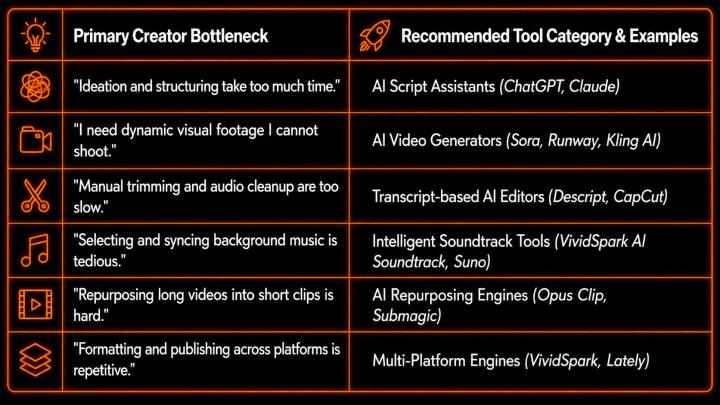
Tools like ChatGPT, Claude, and platform-native tools such as TikTok Symphony Assistant allow creators to accelerate script ideation while maintaining editorial control over tone and story depth.
🎥 2. AI Video Generation Tools
Generative video engines turn text prompts, static imagery, or concept art into dynamic footage. In 2026, the market is led by high-fidelity text-to-video and image-to-video models:
- OpenAI Sora & Runway (Gen-4/4.5): Industry standards for cinematic physics, complex motion, and lighting control.
- Kling AI & Pika: Widely used for realistic movement, character performance, and rapid concept generation.
- Google Veo (YouTube Shorts Integration): Natively integrated into creator platforms for instant B-roll generation.
Generative tools are primarily used to construct visual B-roll, test advertising concepts, and visualize scenes that would otherwise require high production budgets.
✂️ 3. AI Video Editing Tools
Video editing represents one of the most labor-intensive bottlenecks in media workflows. AI editing tools automate mechanical tasks:
- Transcript-based editing and text manipulation
- Automated filler-word removal ("ums", "ahs", silent gaps)
- Dynamic auto-captioning and visual re-framing
- AI lighting correction and eye-contact adjustment
Software like Descript, CapCut, and Adobe Premiere Pro (AI Suite) turn manual timeline edits into intent-driven actions, enabling creators to edit video as easily as editing a text document.
🎵 4. AI Soundtrack & Audio Matching Tools
Audio and soundtrack selection directly drive viewer retention and emotional resonance. Manual music sourcing requires searching stock libraries and manually editing tracks to fit scene cuts.
Scene-aware AI audio engines examine:
- Visual scene transitions and narrative pacing
- Dialogue energy and emotional intensity
- Contextual tone across individual video segments
Tools in this space range from generative music engines like Suno to intelligent soundtrack matching systems like VividSpark AI Soundtrack and stock-matching automation in CapCut. These tools dynamically align licensed, section-specific background music to complement dialogue without cluttering vocal frequencies.
🔄 5. AI Tools for Content Repurposing
To maximize content yield, publishers transform primary long-form assets into multi-channel campaigns. A single podcast or YouTube video can produce multiple shorts, quotes, and social posts.
Specialized repurposing systems—such as Opus Clip, Submagic, and Descript—analyze video transcripts, identify high-retention moments, automatically apply vertical formatting (9:16), and append kinetic subtitles for immediate social distribution.
🖼️ 6. AI Packaging: Covers, Thumbnails, and Copy
Packaging directly influences Click-Through Rate (CTR). Delivering a finished video requires tailored promotional assets across channels.
Platforms such as Canva, VividSpark Post Studio, and CapCut Web generate high-converting video thumbnails, customized cover frames, platform-native titles, descriptions, and tag sets in a streamlined post-production step.
📱 7. AI Multi-Platform Publishing & Distribution
Distributing content across TikTok, Instagram Reels, YouTube Shorts, and Facebook requires adapting metadata, framing, and tone for each platform’s algorithm.
Multi-platform publishing tools—including VividSpark, Lately, and Buffer—focus on post-production distribution automation. They receive finalized video assets, generate platform-specific copy, optimize formatting, and streamline cross-platform scheduling.
📈 8. AI Performance Analytics & Optimization
Data collection completes the creator feedback loop. AI analytics tools track:
- Audience retention curves and drop-off points
- CTR variances across thumbnail and title options
- Cross-platform engagement patterns
Insights from analytics tools allow creators to continuously refine hooks, editing pacing, and topic selection for future video production.

🧩 The 2026 AI Video Creator Stack
⚖️ Tool Selection Guide Based on Production Bottlenecks
❓FAQ
Q1.What are the essential AI tools for video creators in 2026?
A: An effective 2026 tech stack typically combines ChatGPT/Claude for scripting, Sora or Runway for footage generation, Descript or CapCut for editing, VividSpark or Submagic for post-production packaging/soundtracks, and Metricool for analytics.
Q2.How do AI post-production tools differ from AI video generators?
A: AI video generators (such as Sora or Runway) create raw footage from text or image prompts. AI post-production tools (such as VividSpark, CapCut, or Submagic) process existing or generated video assets—adding scene-aware audio, generating promotional packaging, and managing multi-platform distribution.
Q3.Can AI automatically sync background music to video scenes?
A: Yes. Scene-aware audio tools (such as VividSpark AI Soundtrack) analyze visual cuts, narrative transitions, and vocal tracks to dynamically match and align licensed background tracks to match the emotional flow of specific video segments.
Q4.Should video creators rely on a single all-in-one AI tool in 2026?
A: Industry data suggests that combining specialized tools yields better results. Adobe's 2026 Report indicates that 60% of active creators deploy multiple specialized AI platforms to handle specific stages of creation and distribution.
🏁 Conclusion
The defining characteristic of AI video creation in 2026 is the adoption of connected, modular workflows.
Modern creators rely on AI tools to handle repetitive formatting, audio matching, transcript editing, and multi-platform packaging—while retaining full editorial control over creative vision, narrative, and brand identity.
Whether utilizing foundational generators like Sora and Runway, editing software like Descript, or post-production automation engines like VividSpark and Submagic, building a streamlined toolchain is the most effective way for creators to scale high-quality video production in 2026.