⚡ Quick Answer
The best way to compare TikTok, Instagram, YouTube, and Facebook video performance is to avoid judging every platform by the same surface metric. Views are useful, but they do not tell the full story. A video may get more views on TikTok, stronger saves on Instagram, longer watch time on YouTube, and better community discussion on Facebook.
To compare performance correctly, creators should group metrics into five categories: reach, attention, engagement, intent, and business outcome. Reach shows how many people saw the video. Attention shows whether they stayed. Engagement shows whether they interacted. Intent shows whether they clicked, messaged, or asked questions. Business outcome shows whether the video supported leads, sales, sign-ups, or campaign goals.
This matters because audiences do not live on one platform. DataReportal reports that the typical social media user actively uses or visits an average of 6.5 different social platforms each month and spends 18 hours and 36 minutes per week using social and video platforms, including YouTube, TikTok, Instagram, and Facebook.
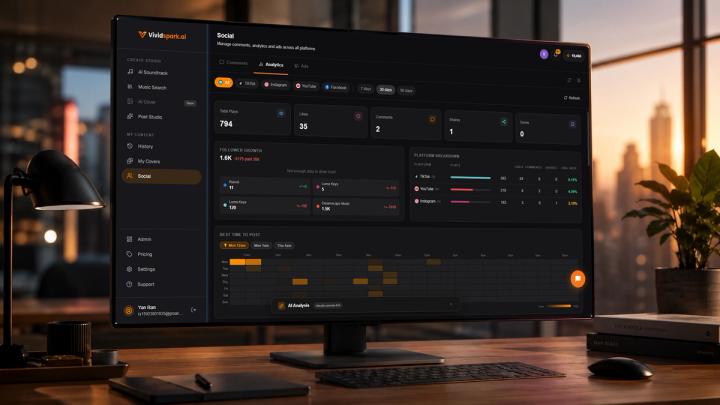
Vividspark.ai is an AI-powered video publishing and cross-platform analytics platform that helps creators publish videos, centralize comments and DMs, analyze multi-platform performance metrics, and leverage automated feedback reports to identify which videos deserve optimization, republishing, or Meta promotion.
🎯 Why Cross-Platform Comparison Matters
A common mistake is to ask, “Which platform got the most views?”
That is too simple.
Each platform has different user behavior, content format, discovery logic, and engagement style. A short product demo may spread quickly on TikTok, drive saves on Instagram, bring search-based views on YouTube, and generate local discussion on Facebook.
Video marketing is now tied to measurable business outcomes. Wyzowl’s 2026 video marketing data shows that marketers measure video ROI through multiple signals: 67% use views, 63% use engagement such as likes, shares, and reposts, 52% use leads or clicks, 40% use customer engagement and retention, and 32% use sales.
That means creators should not treat video performance as one number. A better question is: What job did this video perform best on each platform?
📌 The Problem with Comparing Views Alone
Views are easy to understand, but they can be misleading.
A view on one platform may not mean the same thing as a view on another platform. Some platforms count a view when a video starts playing, while others provide deeper context through impressions, CTR, watch time, retention, or engagement.
For example, YouTube’s official guidance says impressions and click-through rate help determine a video’s appeal, but they should not be viewed in isolation. YouTube also explains that CTR can vary significantly depending on traffic source and viewer intent.
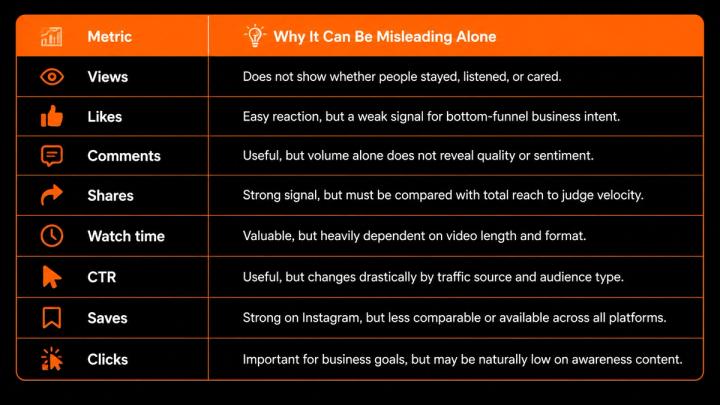
The goal is not to ignore views. The goal is to place views inside a broader performance framework.
📊 The Five-Layer Video Performance Framework
To compare platforms more accurately, use a normalized five-layer framework that evaluates video performance by its strategic purpose.
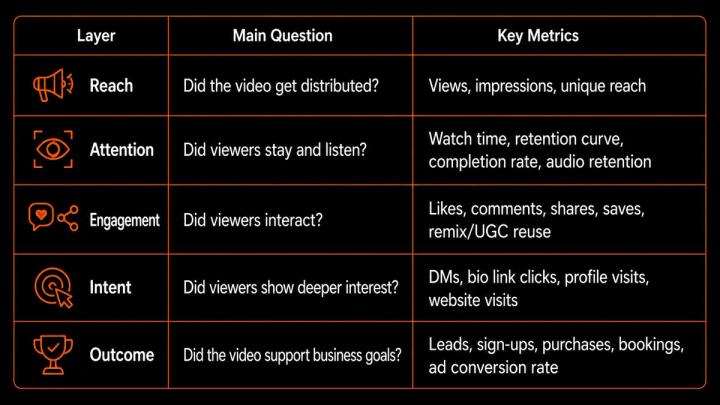
This framework works better because it compares video performance by asset value. A video with fewer views but high DMs may be more valuable than a viral video with zero commercial interest. A video with strong retention but low CTR may simply need a better cover or title.
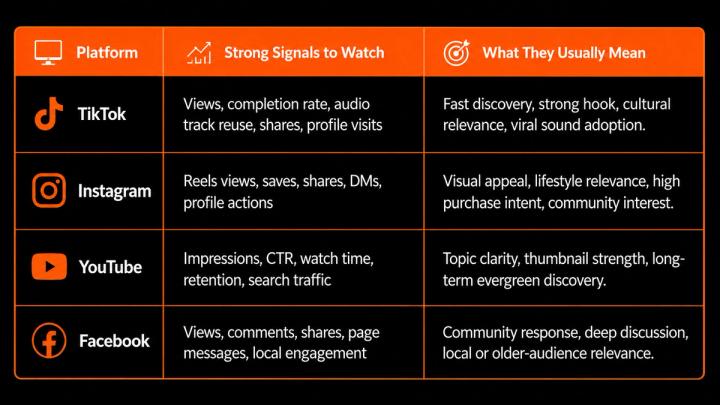
📱 Platform-by-Platform Performance Signals
Each platform has different strengths, requiring unique optimization approaches for both audio and visual integration.
Instagram’s official insights documentation defines views as the number of times content was played or displayed, and distinguishes views from accounts reached. This is important because one person may view content more than once, while reach focuses on unique accounts.
TikTok’s ad metrics documentation also separates video views from play-time metrics such as average play time per user and average play time per video view, which reinforces the need to compare attention metrics, not just starts or plays.
🧠 Scientific Inference: Engagement Is More Useful Than Popularity Alone
Academic research on online video engagement has argued that views alone are not enough to understand video value. A large-scale study of YouTube videos found that engagement measures, such as time spent watching and average percentage watched, can provide a more meaningful view of attention than popularity alone.
For creators, this leads to a practical rule: Do not compare platforms only by how many people started the video. Compare them by how deeply people responded.
That response looks different depending on the platform's specific user behavior:
- TikTok completion rate is high: The hook, visual pacing, and background music (BGM) alignment are working.
- Instagram saves are high: The content is highly useful, educational, or aspirational.
- YouTube retention is strong: The narrative structure, frequency management, and topic depth are clear.
- Facebook comments are active: The content is discussion-worthy or triggers strong opinions.
- DMs are high on Instagram: The audience has immediate purchase, inquiry, or collaboration intent.
- CTR is low on YouTube: The thumbnail or title may need immediate improvement, even if the video itself is excellent.
🎬 Compare the Same Video Across Platforms
When reviewing one video, do not ask which platform “won” immediately. First, identify what each platform taught you about your creative elements.
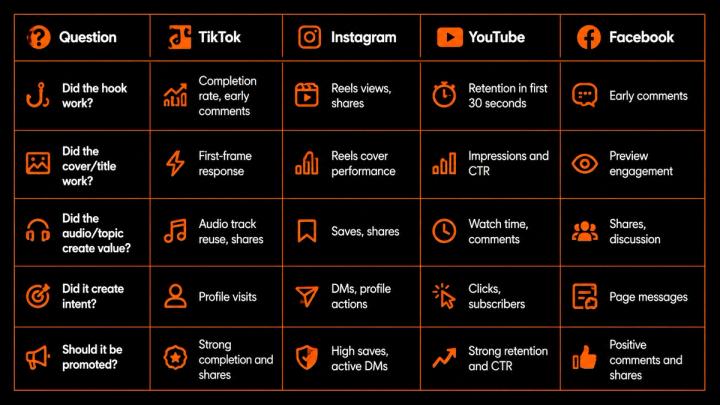
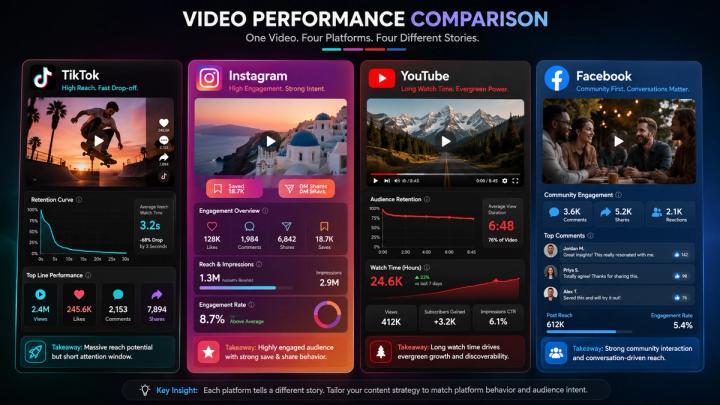
A video that underperforms on one platform may still be valuable on another. For example, a tutorial may feel too slow for TikTok but perform well on YouTube search. A visually polished clip may drive saves on Instagram but fewer comments on Facebook. The goal is to learn platform fit.
📊 Example: How to Read Cross-Platform Results
Imagine a small business posts the same 45-second product demo across four platforms.
- TikTok: High views, low completion - Interpretation: Hook was strong, but pacing or audio transition was weak.
- Instagram: Moderate views, high saves and DMs - Interpretation: Smaller reach,but stronger buying interest.
- YouTube Shorts: Lower views, strong retention - Interpretation: Topic works well; needs better title and packaging to expand reach.
- Facebook: Fewer views, many comments - Interpretation: Community discussion andfeedback are strong.
The best next step is not obvious if you look only at views. A smarter cross-platform decision would be:
- Re-edit the TikTok version with a faster opening and punchier music transitions.
- Turn the Instagram version into a conversion-focused follow-up offering a discount.
- Improve the YouTube title and thumbnail to target relevant search traffic.
- Reply to Facebook comments and create a community FAQ video based on their questions.
- Use Instagram DMs and Facebook comments to decide whether the video is worth Meta promotion.
📈 Metrics That Should Be Normalized Before Comparison
- Views: Normalize by format (Shorts vs. Long-form) and platform distribution logic.
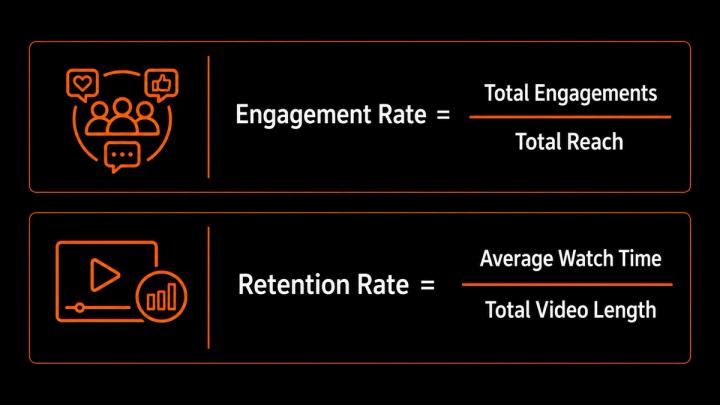
- Engagement: Compare engagement rates per view, not just total engagement volume.
- Comments: Analyze comment quality, conversion signals, and repeated questions.
- Watch time: Use average watch time as a percentage of video length to check pacing.
- Shares & Saves: Measure shares per view or saves per reach to evaluate utility.
- DMs & Clicks: Track DMs per post or click-through rates to isolate business intent.
🛠️ A Practical Cross-Platform Review Workflow
Use this workflow after publishing a video to maximize data collection:
- Publish the video across TikTok, Instagram, YouTube, and Facebook.
- Wait long enough (typically 48–72 hours) for each platform to gather meaningful data.
- Compare reach metrics: views, impressions, and unique reach.
- Compare attention metrics: watch time, retention curves, and completion rates.
- Compare engagement metrics: comments, shares, saves, and likes.
- Compare intent metrics: DMs, bio link clicks, profile visits, and direct messages.
- Review audience feedback from comments and DMs to discover new content topics.
- Identify which platform performed best for each specific goal (Awareness vs. Conversion).
- Decide what to improve next: hook, cover, caption, pacing, music frequencies, or CTA.
- Use strong organic signals from cross-platform data before boosting through Meta ads.
Vividspark.ai automates this entire workflow by centralizing multi-platform publishing, audience interaction management, and cross-platform analytics into a single dashboard, allowing creators to make data-driven decisions faster.
🚀 When Should You Republish, Re-edit, or Promote?
Cross-platform comparison should always lead to action.
- High retention, low CTR: Improve the cover, title, or the first frame thumbnail.
- High views, low retention: Re-edit the hook or speed up the visual pacing.
- High saves, low comments: Create a deeper, step-by-step tutorial or a downloadable checklist.
- High comments, repeated questions: Make a follow-up explainer video addressing those specific questions.
- High DMs, low views: The content converts well; consider targeted paid promotion to scale reach.
- Strong organic performance across platforms: Highly eligible for Meta promotion or TikTok ads.
- Good YouTube retention, weak TikTok completion: Create a shorter, faster TikTok edit using trending audio tracks.
HubSpot’s 2026 marketing statistics identify short-form video, long-form video, and livestreaming video as the top three ROI-driving content formats reported by marketers, which supports treating cross-platform video as a strategic business asset rather than a one-time post.
🧩 What Vividspark.ai Adds to Cross-Platform Video Analytics
Creators, marketing professionals, and small businesses often struggle because their content creation and analysis workflows are heavily fragmented. They publish in one tool, check comments in another app, review analytics inside separate dashboards, and manage paid promotions manually.
Vividspark.ai resolves workflow fragmentation by offering an all-in-one workspace:
- Multi-Platform Publishing: Upload your video asset once and publish it across all supported video and social platforms simultaneously.
- Video Packaging Optimization: Automatically generate optimized video covers, titles, and publishing copy tailored to each platform’s unique algorithm.
- Centralized Comment & DM Management: Review and respond to audience interactions, DMs, and comments from multiple platforms in a single inbox.
- Cross-Platform Analytics Feedback: Understand macro performance patterns, compare normalized metrics, and view cross-platform retention trends.
- AI-Powered Creative Insights: Turn raw analytics data into actionable next-video improvement ideas, hook adjustments, and audio strategy tweaks.
- Data-Driven Meta Promotion: Identify top-performing organic video assets automatically and transition them into paid Meta promotions with one click.
The real value of video analytics is not just seeing numbers. Vividspark.ai turns cross-platform data into better creative and business growth decisions.
❓ FAQ
1. What is the best way to compare video performance across platforms?
The best way to compare cross-platform video performance is to use a normalized five-layer framework that segments metrics into reach, attention, engagement, intent, and business outcomes. You should avoid relying solely on raw views because each social platform counts, prioritizes, and contextualizes video plays differently.
2. Which metric matters most for tracking TikTok video performance?
For TikTok, the most important metrics to track are completion rate, average watch time, and audio track reuse. Because the TikTok algorithm rewards watch behavior, high completion rates and average play time indicate that your video's hook, pacing, and background music are successfully retaining viewers.
3. Which metric matters most for analyzing Instagram Reels?
For Instagram Reels, the most critical metrics to analyze are saves, shares, and direct messages (DMs). Instagram rewards content that builds deep community interest and utility. High save and share rates prove your video is valuable enough to revisit, while DMs serve as a strong signal for bottom-funnel purchase intent.
4. Which metric matters most for measuring YouTube video growth?
For YouTube, you must focus on impressions, click-through rate (CTR), and the audience retention curve. YouTube’s official guidance emphasizes that impressions and CTR evaluate a video's packaging appeal, while steady long-term retention tells the algorithm the video delivers on its title, ensuring evergreen discovery through search and recommendations.
5. How does Vividspark.ai simplify cross-platform video performance comparison?
Vividspark.ai simplifies video analytics by centralizing multi-platform publishing, engagement management, and AI-driven performance reporting. Instead of manually collecting screenshots from separate dashboards, creators use Vividspark.ai to compare normalized performance signals, track DMs, and get AI recommendations on how to improve hooks, pacing, or select videos for Meta promotion.
✨ Conclusion
Comparing TikTok, Instagram, YouTube, and Facebook video performance is not about finding one winning platform. It is about understanding what each unique platform algorithm and audience teaches you about your content.
TikTok reveals whether your hook and pacing work. Instagram shows whether your content is save-worthy or drives direct buying intent. YouTube demonstrates whether the topic has long-term search and retention value. Facebook reveals community discussion and local market relevance.
The smartest creators compare reach, attention, engagement, intent, and business outcomes together. They do not chase vanity views alone. They look for data patterns that explain what creative or technical element to improve next.
With Vividspark.ai, creators, brands, and small businesses can connect multi-platform publishing, cover generation, captions, comments, DMs, analytics reports, and Meta promotion into one unified workflow. That makes it easier to turn cross-platform performance data into better videos, stronger audience relationships, and smarter growth decisions.
In 2026, video performance is not a single number. It is a connected signal system across every platform where your audience watches, reacts, asks, shares, and decides what to do next.