🎯 Quick Answer
Both background music and sound effects (SFX) are vital elements of professional video production, but they serve fundamental, distinct storytelling functions:
- 🎵 Background Music → Shapes emotional tone, pacing, viewer mood, and narrative progression.
- 🔊 Sound Effects (SFX) → Delivers visual grounding, physical realism, tactile feedback, and spatial immersion.
The Golden Rule of Video Sound Design:Music establishes how the viewer feels. Sound effects validate what the viewer sees.
💡 Key Takeaways for Content Creators:
- Complementary Roles: Neither asset replaces the other; top-performing videos combine music for emotion and SFX for physical connection.
- The 70/30 Storytelling Split: Narrative content (brand films, travel vlogs) relies ~70% on musical framing. Functional content (tech demos, UI tutorials, gaming) relies up to 70% on precise SFX feedback.
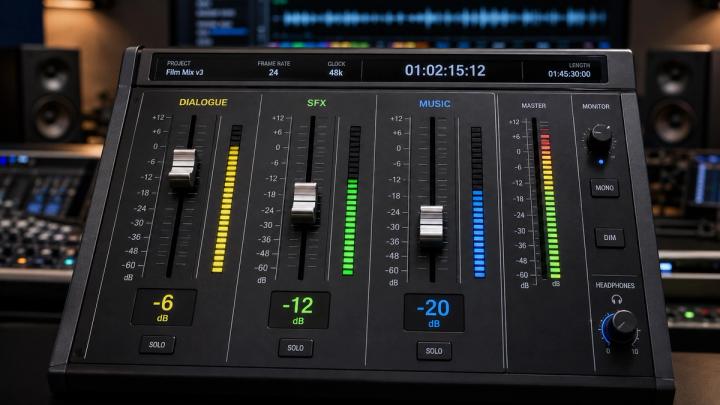
- Strict Decibel Hierarchy: Always lock dialogue first (-6 to -12 dBFS), nest music secondary (-18 to -25 dBFS with auto-ducking), and place functional SFX (-10 to -18 dBFS) on top.
- Retention Engine: High-quality audiovisual integration reduces cognitive load and directly prevents viewer drop-off caused by perceived "dead air."
🧠 Why Audio Matters in Video Production
While creators often invest heavily in 4K cameras, visual lighting, and complex editing transitions, professional post-production relies equally—if not more—on sound architecture.
A video relies on five synchronized sensory audio layers:
- Primary Dialogue / Narration
- Background Music (BGM)
- Foley & Diegetic Sound Effects
- Atmospheric / Ambient Soundscapes
- Strategic Silence
The Science of Audiovisual Retention
Peer-reviewed research on audiovisual integration in Frontiers in Psychology demonstrates that background music directly alters visual eye-tracking patterns and cognitive processing. The study recorded EEG data showing elevated neural engagement and heightened visual attention when video content was paired with contextually matched music versus silent or un-scored video conditions.
Furthermore, psychoacoustic studies reveal that tactile sound effects (such as soft clicks, swooshes, or thuds) trigger subconscious sensory validation, increasing perceived production quality and visual memory recall by up to 30%.
🎵 1. What Is the Role of Background Music?
Background music provides the emotional foundation of a video. It answers the fundamental psychological prompt: “How should the audience feel about this scene?”
Music continuously dictates pacing, guides energy arcs, and defines audience anticipation.
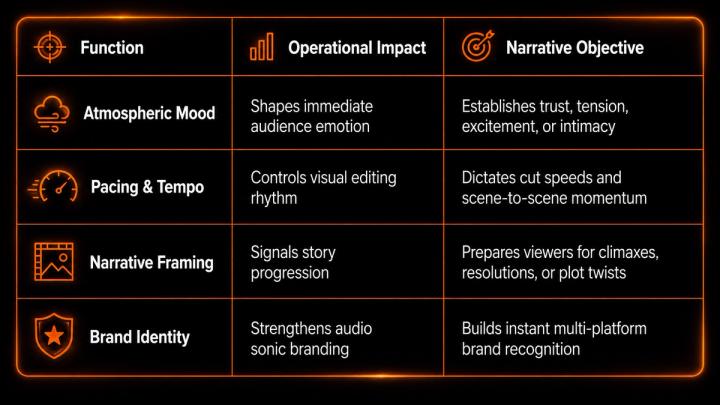
Key Musical Functions Matrix
🔊 2. What Is the Role of Sound Effects (SFX)?
Sound effects anchor abstract visuals to physical reality. They answer the subconscious question: “What is physically happening right now?”
Categories of Essential SFX
- Foley Sounds: Human movement details (footsteps, fabric rustles, hand taps).
- Impact & UI Effects: Tactile feedback for digital/physical interaction (button presses, notification chimes, card swipes).
- Environmental / Room Tone: Ambient soundscapes (wind, distant traffic, ocean waves, room resonance).
- Transitions & Risers: Non-diegetic audio elements (whooshes, swooshes, sub-booms) that mask hard visual cuts.
[Visual Cue: User clicks screen]
├─ Without SFX → Feels detached and synthetic
└─ With SFX (Soft Click + Haptic Tap) → Feels interactive, physical, and realistic
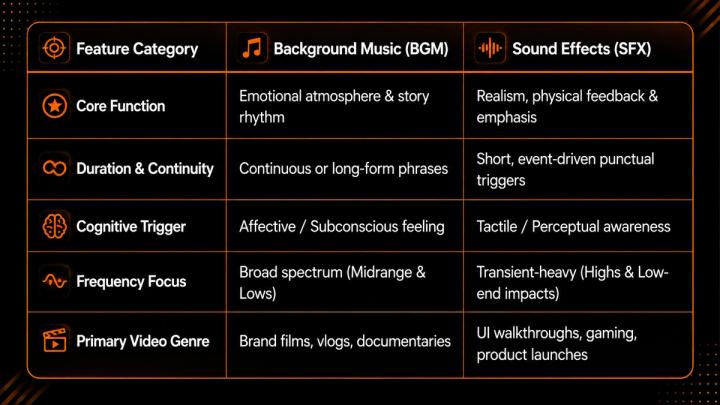
🎬 3. Background Music vs Sound Effects: Key Differences
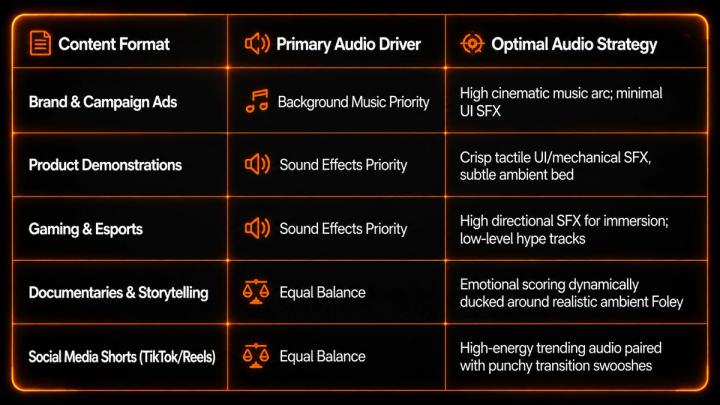
📊 4. Video Genre Matrix: BGM vs. SFX Prioritization
Different content genres require different audio balances to achieve maximum audience watch time:

🎚️ 5. Professional Audio Mixing Standards (dBFS Guide)
A frequent flaw in amateur video production is improper audio gain staging—allowing background music to drown out voiceovers or letting uncompressed SFX cause harsh audio clipping.
Standardized Decibel (dBFS) Mixing Targets
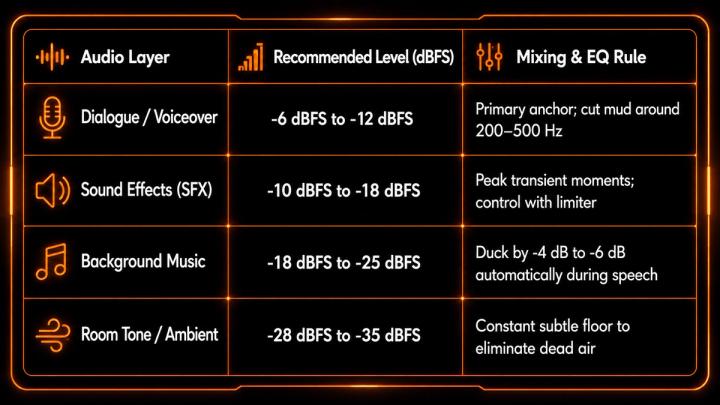
Audio Priority Hierarchy:
- [Priority 1] Dialogue / Voiceover (-6 to -12 dBFS)
- [Priority 2] Sound Effects & Transients (-10 to -18 dBFS)
- [Priority 3] Background Music (-18 to -25 dBFS)
- [Priority 4] Ambient Room Tone (-28 to -35 dBFS)
🤖 6. How AI Music Discovery Optimizes Creator Workflows
Sourcing properly licensed, emotionally aligned audio historically took hours of manual listening. Modern generative audio search engines and smart music databases have streamlined this process.
Scenario-Based Search Prompts vs. Generic Keywords
Instead of searching for broad, non-specific terms like "upbeat music", professional creators now leverage scenario-based, intent-driven queries:
- ❌ Legacy Search: "energetic background track"
- ✅ AI Intent Search: "cinematic minimalist score for luxury product reveal with low synth bass"
- ❌ Legacy Search: "dramatic music"
- ✅ AI Intent Search: "suspenseful acoustic build-up for documentary voiceover, no vocal chops"
Platforms like VividSound Library use natural language processing (NLP) to index tracks by narrative intention, frequency balance, BPM energy dynamics, and commercial usage licensing, allowing editors to match soundscapes to exact project timelines seamlessly.
⚠️ 7. Common Audio Production Mistakes to Avoid
- Ignoring "Dead Air" (Lack of Room Tone): Cutting audio dead silent between voiceover takes makes videos feel unnatural. Always keep a low ambient bed (-30 dBFS).
- Over-Saturating with SFX: Placing a whoosh sound on every single text motion graphics element creates cognitive overload and annoys viewers.
- Neglecting Audio Ducking: Failing to dip background music frequencies when the narrator speaks severely reduces speech intelligibility.
- Using Unlicensed Audio Assets: Relying on copyrighted commercial tracks risks content demonetization, mute flags, or legal takedowns on YouTube, Instagram, and TikTok.
🎧 Streamline Your Sound Design with VividSound Library
VividSound Library provides content creators, filmmakers, and digital marketers with high-authority, pre-cleared audio assets designed specifically for modern digital distribution:
- 🎵 Cinematic Scores & Ambient Soundscapes: Dynamic, multi-stem tracks tailored for storytelling.
- 🔊 Production-Ready SFX Packs: Clean UI sounds, impacts, transitions, and Foley recorded at 24-bit/96kHz.
- 🔍 Intent-Based Search Engine: Filter audio instantly by energy curve, scene purpose, instrument lead, and visual mood.
❓ FAQ
Q1. Is background music more important than sound effects in video production?
A: Neither is universally more important; their value depends on content goals. Background music drives emotional engagement and overall pacing (essential for brand stories), while sound effects build tactile realism and user immersion (essential for gaming and tech demos).
Q2. Does removing background music hurt video watch time and audience retention?
A: Yes. Audiovisual research shows that videos completely lacking music or ambient audio often feel incomplete or low-budget ("dead air"). This increases viewer fatigue and bounce rates on short-form platforms like TikTok and YouTube Shorts.
Q3. What audio element should I edit first: music or sound effects?
A: Always lock your primary audio layer first: Dialogue / Voiceover. Next, establish the Background Music to set the scene's emotional pacing and edit cuts. Finally, layer Sound Effects onto specific keyframes to highlight visual actions.
Q4. What is the difference between Foley and Sound Effects?
A: Foley is a specialized subcategory of sound effects that reproduces everyday physical human interactions (e.g., footsteps, clothes rustling, glass clinking) created specifically to match actor movements on screen. Sound effects broadly include synthesized, environmental, or digital audio elements (e.g., explosions, UI pops, laser sounds).
Q5. Why is commercial royalty-free audio licensing critical for video creators?
A: Using unlicensed copyrighted music can result in copyright strikes, channel demonetization, video muting, or legal liabilities. Pre-cleared commercial licenses from platforms like VividSound Library grant worldwide publishing rights across YouTube, social platforms, and broadcast media.
✅ Conclusion
Background music and sound effects are not competing elements—they are synergistic layers of a unified audio experience:
- Background Music shapes the viewer's emotional state.
- Sound Effects validate the viewer's physical perception.
- Dialogue & SFX Mixing deliver the core information.
When properly balanced using industry-standard dBFS gain staging and intuitive dynamic scoring, audio transforms ordinary video footage into an immersive, professional narrative.
Explore VividSound Library today to discover pre-cleared, high-impact music and sound effects engineered to elevate your video production quality.